Naseribafrouei Ali, Eliassen Bent Martin, Melhus Marita, Svartberg Johan, Broderstad Ann Ragnhild
Centre for Sami Health Research, Department of Community Medicine, Faculty of Health Sciences, UiT The Arctic University of Norway, Box 6050 Langnes, N-9037, Tromsø, Norway.
Faculty of Nursing and Health Sciences, Nord University, Bodø, Norway.
BMC Endocr Disord. 2019 Jun 24;19(1):66. doi: 10.1186/s12902-019-0399-7.
The aim of the study was to estimate and compare the 8-year cumulative incidence of diabetes mellitus (DM) among Sami and non-Sami inhabitants of rural districts in Northern Norway.
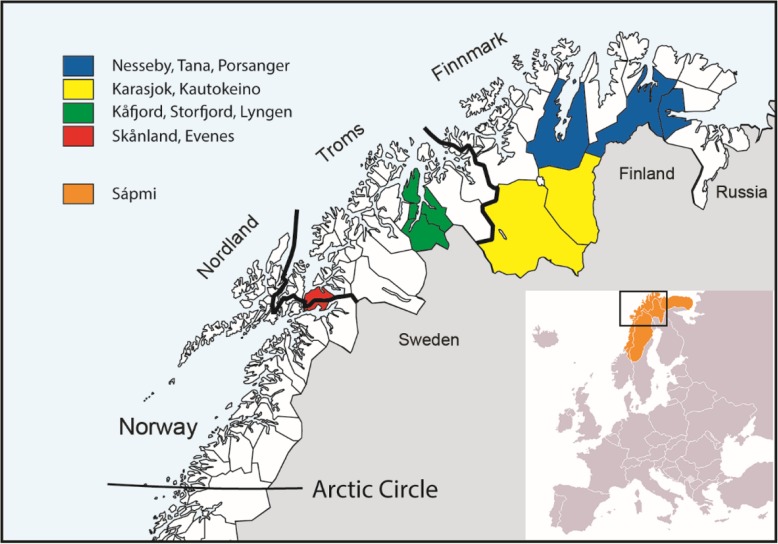
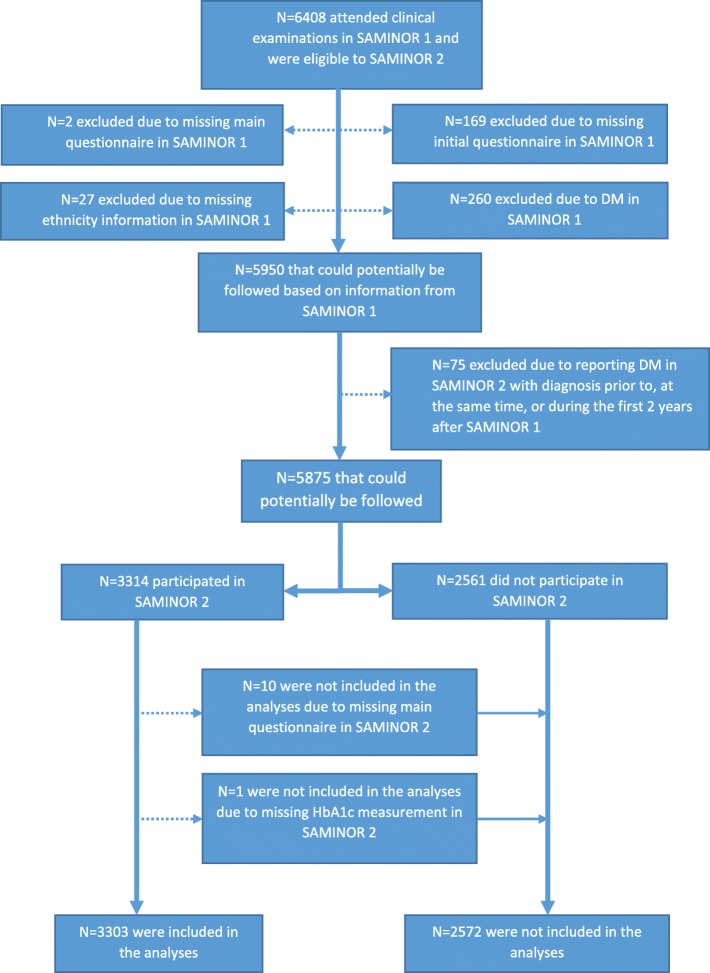
Longitudinal study based on linkage of two cross-sectional surveys, the SAMINOR 1 Survey (2003-2004) and the SAMINOR 2 Clinical Survey (2012-2014). Ten municipalities in rural Northern Norway were included in the study. DM-free participants aged 30 and 36-71 years in SAMINOR 1 were followed from 2 years after SAMINOR 1 to attendance in SAMINOR 2. The average follow-up time was 8.1 years. Of 5875 subjects who had participated in SAMINOR 1 and could potentially be followed to SAMINOR 2, 3303 were included in the final analysis. Self-reported DM and/or HbA1c ≥ 6.5% were used to identify incident cases of DM.
At baseline, body mass index (BMI) and waist-to-height ratio (WHtR) were higher among Sami than among their non-Sami counterparts. After 8 years of follow-up, 201 incident cases of DM were identified (6.1% both Sami and non-Sami subjects). No statistically significant difference was observed in the cumulative incidence of DM between the Sami and non-Sami.
No statistically significant difference in the 8-year cumulative incidence of DM among Sami and non-Sami was observed, although Sami men and women had higher baseline BMI and WHtR.
本研究旨在评估和比较挪威北部农村地区萨米族和非萨米族居民8年糖尿病(DM)累积发病率。
基于两项横断面调查(萨米族健康研究1调查(2003 - 2004年)和萨米族健康研究2临床调查(2012 - 2014年))的纵向研究。挪威北部农村的10个自治市纳入研究。萨米族健康研究1中年龄在30岁以及36 - 71岁且无糖尿病的参与者从萨米族健康研究1后2年开始随访至参与萨米族健康研究2。平均随访时间为8.1年。在参与萨米族健康研究1且有可能被随访至萨米族健康研究2的5875名受试者中,3303名被纳入最终分析。自我报告的糖尿病和/或糖化血红蛋白(HbA1c)≥6.5%用于确定糖尿病发病病例。
基线时,萨米族的体重指数(BMI)和腰高比(WHtR)高于非萨米族。随访8年后,确定了201例糖尿病发病病例(萨米族和非萨米族受试者均为6.1%)。萨米族和非萨米族之间糖尿病累积发病率未观察到统计学显著差异。
尽管萨米族男性和女性基线BMI和WHtR较高,但在萨米族和非萨米族之间未观察到8年糖尿病累积发病率的统计学显著差异。