Jack Rhona M, Scott C Ronald
Department of Laboratories Seattle Children's Hospital Seattle Washington.
Department of Laboratory Medicine University of Washington Seattle Washington.
JIMD Rep. 2019 Mar 14;46(1):75-78. doi: 10.1002/jmd2.12023. eCollection 2019 Mar.
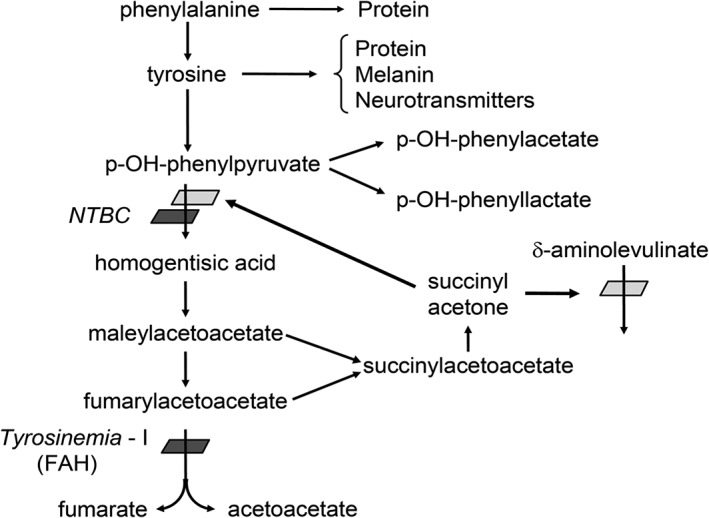
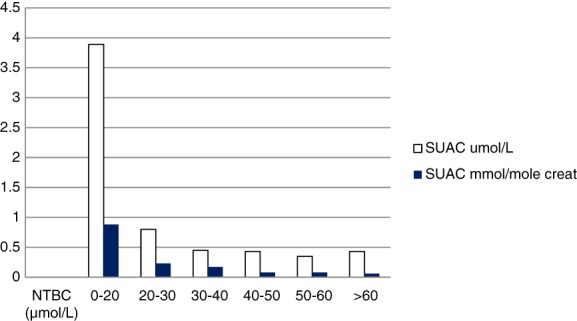
The drug nitisinone (NTBC; Orfadin, Vienna, Austria) has been used for the treatment of hereditary tyrosinemia type-1 since 1991. Nitisinone effectively blocks the metabolism of tyrosine to prevent the formation of the toxic compound succinylacetone (and precursor fumarylacetoacetate) in affected children. Monitoring of plasma drug levels and urine succinylacetone can be used to assess compliance and adequate dose of drug. We present retrospective data from patient monitoring for over 10 years that provide validation of a target therapeutic range for nitisinone of 40 to 60 μmol/L. The target nitisinone range is justified as valid based on reduction of succinylacetone excretion. There was no statistical significance in succinylacetone excretion in mmol/mol creatinine above a level of 40 μmol/L plasma NTBC ( > 0.05).
自1991年以来,药物尼替西农(NTBC;商品名Orfadin,奥地利维也纳)一直用于治疗1型遗传性酪氨酸血症。尼替西农可有效阻断酪氨酸代谢,以防止患病儿童体内形成有毒化合物琥珀酰丙酮(及其前体延胡索酰乙酰乙酸)。监测血浆药物水平和尿液中的琥珀酰丙酮可用于评估服药依从性和药物剂量是否合适。我们提供了超过10年的患者监测回顾性数据,这些数据验证了尼替西农的目标治疗范围为40至60μmol/L。基于琥珀酰丙酮排泄量的减少,尼替西农的目标范围被证明是有效的。当血浆NTBC水平高于40μmol/L时,每毫摩尔肌酐中琥珀酰丙酮的排泄量无统计学意义(P>0.05)。