Ministry of Health, Riyadh, Saudi Arabia.
School of Public Health, The University of Queensland, Australia.
J Epidemiol Glob Health. 2019 Jun;9(2):116-124. doi: 10.2991/jegh.k.190518.002.
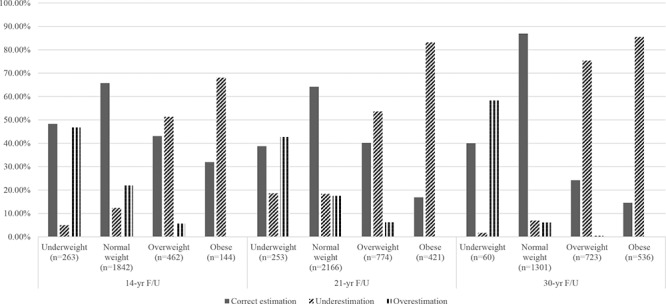
This study examined whether body weight misclassification continues from adolescence to adulthood and the associated predictors behind that misclassification. Data are from a sample of a longitudinal Australian birth-cohort study. Data analyses were restricted to 2938 participants whose measured and perceived body weights were recorded during their adolescence and adulthood follow-ups. To identify misclassification, we objectively compared their measured and perceived body weights at each follow-up. Potential predictors during early life or adolescence periods were included in data analyses. At each follow-up, underestimation was recorded more often among overweight and obese participants, whereas overestimation was mostly recorded among underweight ones. Over 40% males and females were able to correctly estimate their body weight at one follow-up, whereas almost 30% males and 40% females were able to do so in more than one follow-ups. One-third females and 45% males underestimated their body weight at one follow-up, whereas 13% females and a quarter of males were able to do so in more than one follow-ups. Being female, dieting, being overweight, having an overweight mother, and having poor mental health were the most significant predictors for more than one follow-up misclassifications. Further studies are needed to evaluate the impact of persistent misclassification on population health benefits.
本研究旨在探讨体重的错误分类是否会从青春期持续到成年期,以及导致这种错误分类的相关因素。数据来自澳大利亚一项纵向出生队列研究的样本。数据分析仅限于 2938 名参与者,他们在青春期和成年期随访期间记录了他们的实际体重和自我感知体重。为了确定错误分类,我们在每个随访中客观地比较了他们的实际体重和自我感知体重。将生命早期或青春期的潜在预测因素纳入数据分析。在每个随访中,超重和肥胖参与者中更多地记录到低估,而在体重不足的参与者中更多地记录到高估。超过 40%的男性和女性能够在一次随访中正确估计自己的体重,而近 30%的男性和 40%的女性能够在多次随访中正确估计自己的体重。三分之一的女性和 45%的男性在一次随访中低估了自己的体重,而 13%的女性和四分之一的男性能够在多次随访中正确估计自己的体重。女性、节食、超重、超重母亲和心理健康状况不佳是多次随访错误分类的最显著预测因素。需要进一步的研究来评估持续错误分类对人群健康益处的影响。