Department of Neural and Behavioral Sciences, Penn State College of Medicine, Hershey, Pennsylvania.
Oklahoma Center for Neuroscience, University of Oklahoma Health Science Center, Oklahoma City, Oklahoma.
Am J Physiol Gastrointest Liver Physiol. 2019 Aug 1;317(2):G203-G209. doi: 10.1152/ajpgi.00144.2019. Epub 2019 Jun 26.
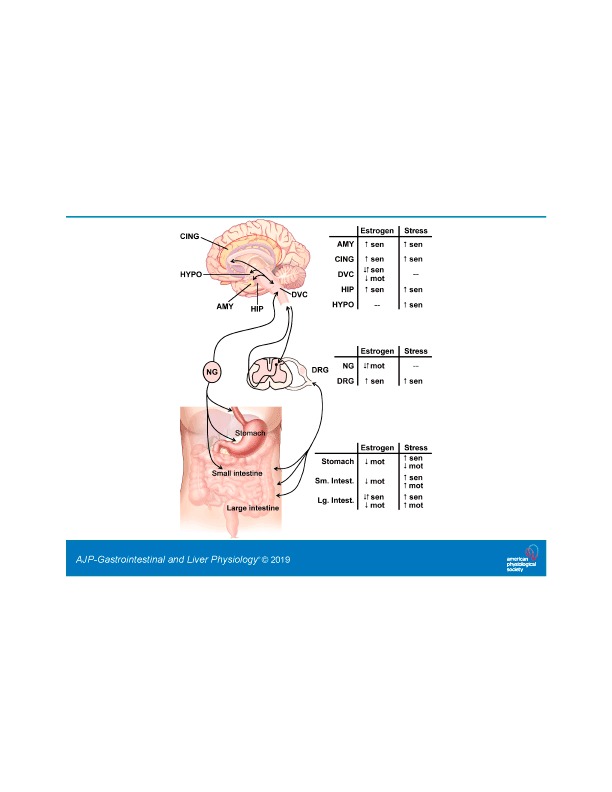
Symptoms of functional gastrointestinal disorders (FGIDs), including fullness, bloating, abdominal pain, and altered gastrointestinal (GI) motility, present a significant clinical problem, with a reported prevalence of 25%-40% within the general population. More than 60% of those affected seek and require healthcare, and affected individuals report a significantly decreased quality of life. FGIDs are highly correlated with episodes of acute and chronic stress and are increased in prevalence and reported severity in women compared with men. Although there is evidence that sex and stress interact to exacerbate FGID symptoms, the physiological mechanisms that mediate these sex-dependent disparities are incompletely understood, although hormonal-related differences in GI motility and visceral sensitivity have been purported to play a significant role in the etiology. In this mini review, we will discuss brain-gut axis control of GI motility and sensitivity, the influence of estrogen on GI motility and sensitivity, and stress modulation of the brain-gut axis.
功能性胃肠疾病(FGIDs)的症状,包括饱胀感、腹胀、腹痛和胃肠道(GI)运动改变,是一个重大的临床问题,据报道在普通人群中的患病率为 25%-40%。超过 60%受影响的人寻求并需要医疗保健,受影响的个体报告生活质量显著下降。FGIDs 与急性和慢性应激发作高度相关,并且在女性中比男性更普遍,且报告的严重程度更高。尽管有证据表明性别和压力相互作用会加重 FGID 症状,但介导这些性别差异的生理机制尚不完全清楚,尽管胃肠道运动和内脏敏感性的激素相关差异被认为在病因中起重要作用。在这篇迷你综述中,我们将讨论肠道轴对 GI 运动和敏感性的控制,雌激素对 GI 运动和敏感性的影响,以及应激对肠道轴的调节。