Group of Sensors and Actuators, Department of Electrical Engineering and Applied Physics, Westphalian University of Applied Sciences, 45877 Gelsenkirchen, Germany.
Sensors (Basel). 2019 Jun 25;19(12):2836. doi: 10.3390/s19122836.
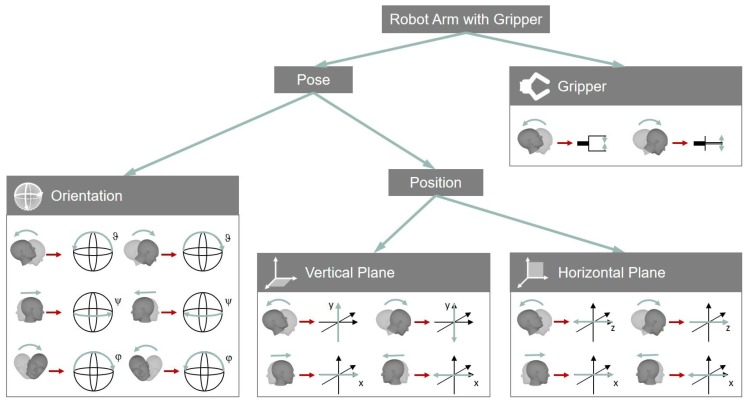
Within this work we present AMiCUS, a Human-Robot Interface that enables tetraplegics to control a multi-degree of freedom robot arm in real-time using solely head motion, empowering them to perform simple manipulation tasks independently. The article describes the hardware, software and signal processing of AMiCUS and presents the results of a volunteer study with 13 able-bodied subjects and 6 tetraplegics with severe head motion limitations. As part of the study, the subjects performed two different pick-and-place tasks. The usability was assessed with a questionnaire. The overall performance and the main control elements were evaluated with objective measures such as completion rate and interaction time. The results show that the mapping of head motion onto robot motion is intuitive and the given feedback is useful, enabling smooth, precise and efficient robot control and resulting in high user-acceptance. Furthermore, it could be demonstrated that the robot did not move unintendedly, giving a positive prognosis for safety requirements in the framework of a certification of a product prototype. On top of that, AMiCUS enabled every subject to control the robot arm, independent of prior experience and degree of head motion limitation, making the system available for a wide range of motion impaired users.
在这项工作中,我们展示了 AMiCUS,这是一种人机接口,使四肢瘫痪患者能够仅使用头部运动实时控制多自由度机器人手臂,使他们能够独立执行简单的操作任务。本文描述了 AMiCUS 的硬件、软件和信号处理,并介绍了一项针对 13 名健康志愿者和 6 名头部运动严重受限的四肢瘫痪患者的志愿者研究的结果。作为研究的一部分,参与者执行了两个不同的取放任务。使用问卷评估了可用性。使用客观措施,如完成率和交互时间,评估了整体性能和主要控制元素。结果表明,头部运动到机器人运动的映射是直观的,并且提供的反馈是有用的,从而实现了机器人的平滑、精确和高效控制,并获得了很高的用户接受度。此外,还可以证明机器人不会意外移动,这为产品原型认证框架中的安全要求提供了积极的预测。最重要的是,AMiCUS 使每个参与者都能够控制机器人手臂,无论其先前的经验和头部运动限制程度如何,使系统可供广泛的运动障碍用户使用。