Shenzhen Hospital of Southern Medical University, Xinhu Rd. 1333, Bao'an District, Shenzhen, 518110, Guangdong, China.
Futian District Center for Disease Control and Prevention, Hongli Xi lu 8043, Futian District, Shenzhen, 518040, Guangdong, China.
BMC Infect Dis. 2019 Jun 26;19(1):560. doi: 10.1186/s12879-019-4162-5.
Acute meningitis and encephalitis syndromes (AMES) is a severe neurological infection which causes high case fatality and severe sequelae in children. To determine the etiology of childhood AMES in Shenzhen, a hospital-based study was undertaken.
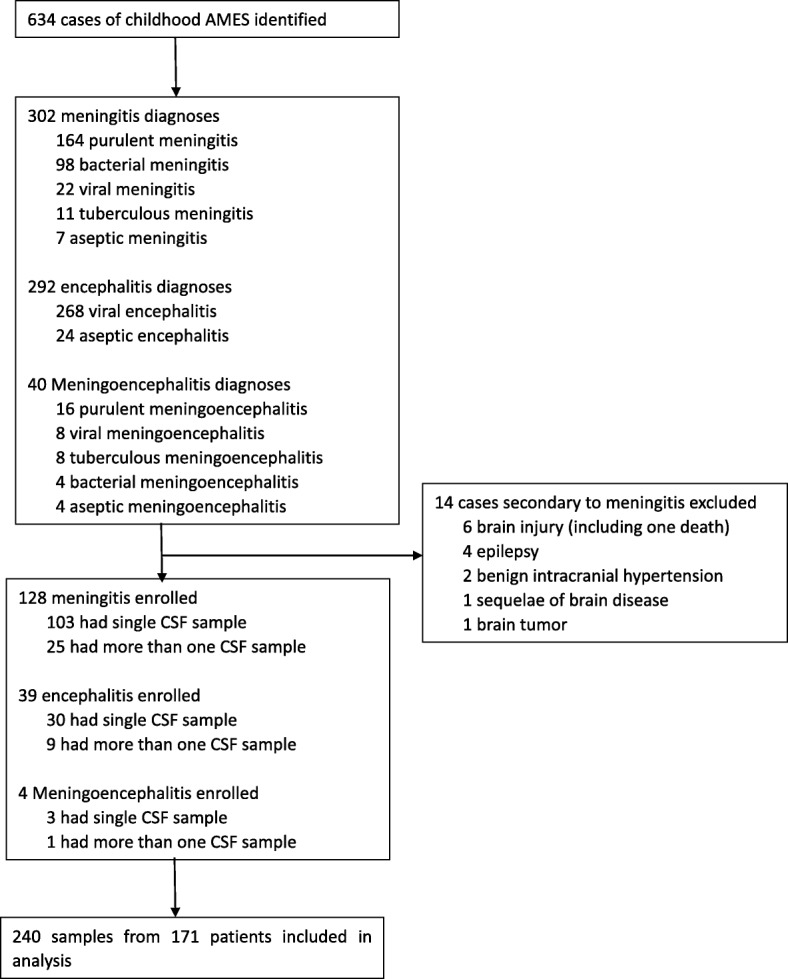
A total of 240 cerebrospinal fluid (CSF) samples from 171 children meeting the case definition were included and screened for 12 common causative organisms. The clinical data and conventional testing results were collected and analyzed. Whole genome sequencing was performed on a Neisseria meningitidis isolate.
A pathogen was found in 85 (49.7%) cases; Group B Streptococcus (GBS) was detected in 17 cases, Escherichia coli in 15, Streptococcus pneumoniae in 14, enterovirus (EV) in 13, herpes simplex virus (HSV) in 3, N. meningitidis in 1, Haemophilus influenzae in 1, and others in 23. Notably, HSV was found after 43 days of treatment. Twelve GBS and 6 E. coli meningitis were found in neonates aged less than 1 month; 13 pneumococcal meningitis in children aged > 3 months; and 12 EV infections in children aged > 1 year old. The multilocus sequence typing of serogroup B N. meningitidis isolate was ST-3200/CC4821. High resistance rate to tetracycline (75%), penicillin (75%), and trimethoprim/sulfamethoxazole (75%) was found in 4 of S. pneumoniae isolates; clindamycin (100%) and tetracycline (100%) in 9 of GBS; and ampicillin (75%) and trimethoprim/sulfamethoxazole (67%) in 12 of E. coli.
The prevalence of N. meningitidis and JEV was very low and the cases of childhood AMES were mainly caused by other pathogens. GBS and E. coli were the main causative organisms in neonates, while S. pneumoniae and EV were mainly found in older children. HSV could be persistently found in the CSF samples despite of the treatment. A better prevention strategy for GBS, the introduction of pneumococcal vaccine, and incorporation of PCR methods were recommended.
急性脑膜炎和脑炎综合征(AMES)是一种严重的神经系统感染,可导致儿童高病死率和严重后遗症。为了确定深圳市儿童 AMES 的病因,我们进行了一项基于医院的研究。
共纳入符合病例定义的 171 例儿童 240 例脑脊液(CSF)样本,对 12 种常见病原体进行筛查。收集并分析了临床资料和常规检测结果。对脑膜炎奈瑟菌分离株进行了全基因组测序。
85 例(49.7%)病例中发现了病原体;17 例检出 B 群链球菌(GBS),15 例检出大肠埃希菌,14 例检出肺炎链球菌,13 例检出肠道病毒(EV),3 例检出单纯疱疹病毒(HSV),1 例检出脑膜炎奈瑟菌,1 例检出流感嗜血杆菌,23 例检出其他病原体。值得注意的是,HSV 是在治疗后 43 天发现的。12 例 GBS 和 6 例大肠埃希菌脑膜炎发生在 1 个月龄以下的新生儿;13 例肺炎链球菌脑膜炎发生在 >3 个月龄的儿童;12 例 EV 感染发生在 >1 岁的儿童。B 群脑膜炎奈瑟菌分离株的多位点序列分型为 ST-3200/CC4821。4 株肺炎链球菌分离株对四环素(75%)、青霉素(75%)和复方磺胺甲噁唑(75%)的耐药率较高;9 株 GBS 对克林霉素(100%)和四环素(100%)耐药;12 株大肠埃希菌对氨苄西林(75%)和复方磺胺甲噁唑(67%)耐药。
脑膜炎奈瑟菌和日本脑炎病毒的流行率非常低,儿童 AMES 主要由其他病原体引起。GBS 和大肠埃希菌是新生儿的主要病原体,而肺炎链球菌和 EV 主要见于较大儿童。尽管进行了治疗,但 CSF 样本中仍可持续检出 HSV。建议采取更好的 GBS 预防策略、引入肺炎球菌疫苗以及纳入 PCR 方法。