Department of Molecular Medicine, The Scripps Research Institute, La Jolla, CA.
Division of Blood and Marrow Transplantation, Masonic Cancer Center and.
Blood. 2019 Aug 29;134(9):776-781. doi: 10.1182/blood.2019001259. Epub 2019 Jun 26.
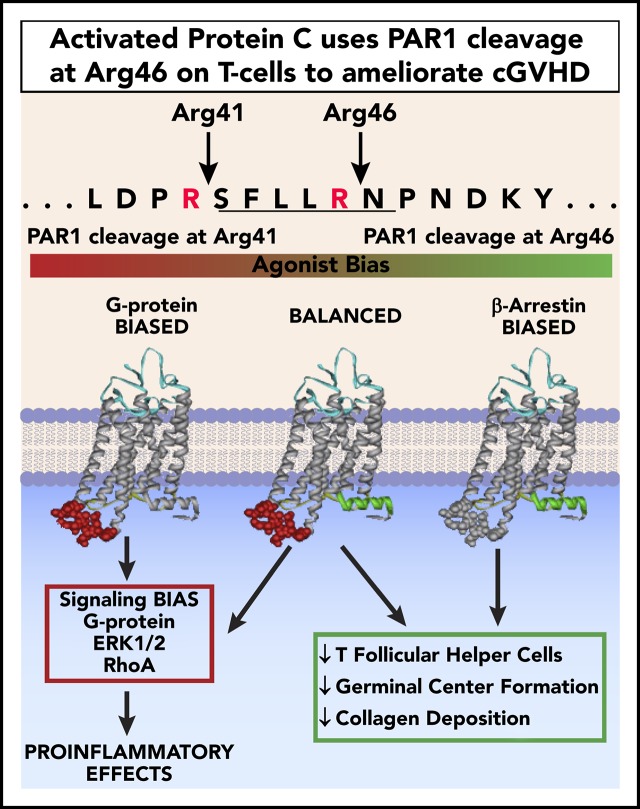
Soluble thrombomodulin plasma concentrations are elevated in steroid-resistant graft-versus-host disease (GVHD), implying endothelial hypofunctioning for thrombomodulin-dependent generation of activated protein C's (APC) anticoagulant, anti-inflammatory, and antiapoptotic functions. Recombinant thrombomodulin or APC administration decreases acute GVHD, manifested by intense inflammation and tissue destruction. Here, we administered recombinant murine wild-type (WT) APC to mice with established chronic GVHD (cGVHD), a less-inflammatory autoimmune-like disease. WT APC normalized bronchiolitis obliterans-induced pulmonary dysfunction. Signaling-selective APC variants (3A-APC [APC with lysine 191-193 replaced with 3 alanines] or 5A-APC [APC with lysine 191-193 replaced with 3 alanines and arginine 229/230 replaced with 2 alanines]) with normal cytoprotective properties, but greatly reduced anticoagulant activity, provided similar results. Mechanistically, WT APC and signaling-selective variants reduced T follicular helper cells, germinal center formation, immunoglobulin, and collagen deposition. WT APC can potentially cleave protease-activated receptor 1 (PAR1) at Arg41 or Arg46, the latter causing anti-inflammatory signaling. cGVHD was reduced in recipients of T cells from WT PAR1 or mutated Gln41-PAR1 donors but not from mutated Gln46-PAR1 donors. These data implicate donor T-cell APC-induced noncanonical cleavage at Arg46-PAR1, which is known to confer cytoprotective and anti-inflammatory activities. Together, these data indicate that APC anticoagulant activity is dispensable, whereas anti-inflammatory signaling and cytoprotective cell signaling by APC are essential. Because a phase 2 ischemic stroke clinical trial did not raise any safety issues for 3A-APC treatment, our studies provide a foundational platform for testing in clinical cGVHD therapy.
可溶性血栓调节蛋白血浆浓度在激素耐药性移植物抗宿主病(GVHD)中升高,这意味着血栓调节蛋白依赖性激活蛋白 C(APC)抗凝、抗炎和抗凋亡功能的内皮功能低下。重组血栓调节蛋白或 APC 给药可减少急性 GVHD 的发生,其表现为强烈的炎症和组织破坏。在这里,我们给已经患有慢性 GVHD(cGVHD)的小鼠(一种炎症较轻的自身免疫样疾病)施用重组鼠野生型(WT)APC。WT APC 可使闭塞性细支气管炎引起的肺功能障碍正常化。具有正常细胞保护特性但抗凝活性大大降低的信号选择性 APC 变体(3A-APC [APC 中赖氨酸 191-193 被 3 个丙氨酸取代]或 5A-APC [APC 中赖氨酸 191-193 被 3 个丙氨酸和精氨酸 229/230 取代为 2 个丙氨酸])提供了类似的结果。从机制上讲,WT APC 和信号选择性变体减少了 T 滤泡辅助细胞、生发中心形成、免疫球蛋白和胶原蛋白沉积。WT APC 可能会在 Arg41 或 Arg46 处切割蛋白酶激活受体 1(PAR1),后者引起抗炎信号。WT PAR1 或突变 Gln41-PAR1 供体的 T 细胞受体接受者的 cGVHD 减少,但突变 Gln46-PAR1 供体的 T 细胞受体接受者的 cGVHD 没有减少。这些数据表明,供体 T 细胞 APC 诱导的 Arg46-PAR1 非典型切割,已知其赋予细胞保护和抗炎活性。总的来说,这些数据表明 APC 的抗凝活性是可有可无的,而 APC 的抗炎信号和细胞保护信号是必不可少的。由于 3A-APC 治疗的二期缺血性脑卒中临床试验没有出现任何安全问题,因此我们的研究为临床 cGVHD 治疗的测试提供了一个基础平台。