Biozentrum, University of Basel, Basel, Switzerland.
Biozentrum, University of Basel, Basel, Switzerland
mSphere. 2019 Jun 26;4(3):e00380-19. doi: 10.1128/mSphere.00380-19.
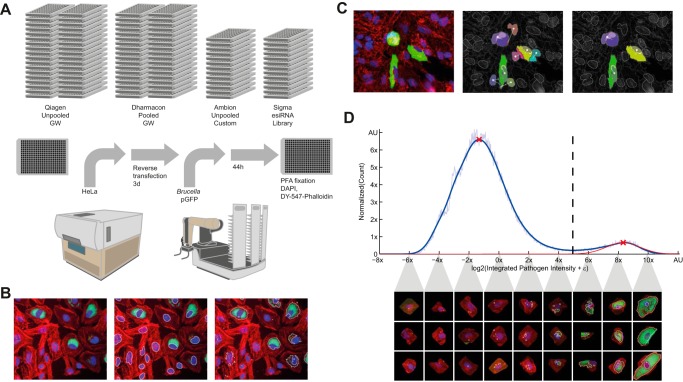
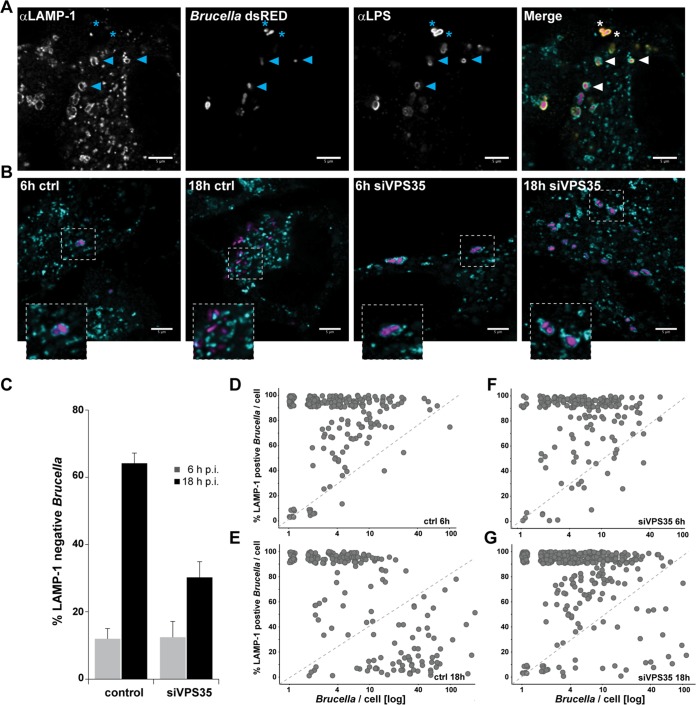
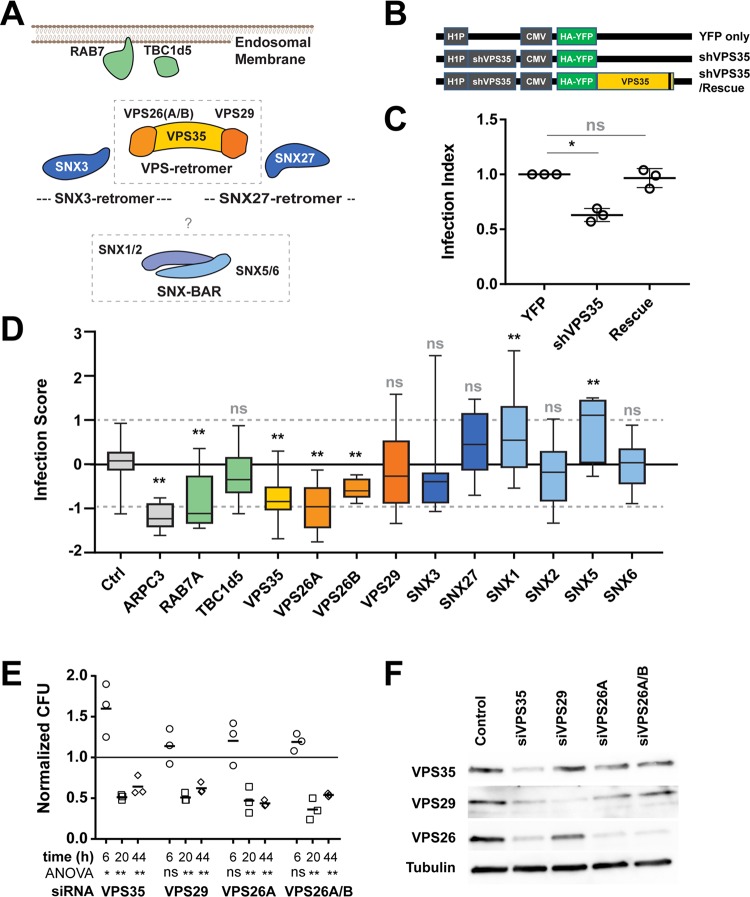
, the agent causing brucellosis, is a major zoonotic pathogen with worldwide distribution. resides and replicates inside infected host cells in membrane-bound compartments called containing vacuoles (BCVs). Following uptake, resides in endosomal BCVs (eBCVs) that gradually mature from early to late endosomal features. Through a poorly understood process that is key to the intracellular lifestyle of the eBCV escapes fusion with lysosomes by transitioning to the replicative BCV (rBCV), a replicative niche directly connected to the endoplasmic reticulum (ER). Despite the notion that this complex intracellular lifestyle must depend on a multitude of host factors, a holistic view on which of these components control cell entry, trafficking, and replication is still missing. Here we used a systematic cell-based small interfering RNA (siRNA) knockdown screen in HeLa cells infected with and identified 425 components of the human infectome for infection. These include multiple components of pathways involved in central processes such as the cell cycle, actin cytoskeleton dynamics, or vesicular trafficking. Using assays for pathogen entry, knockdown complementation, and colocalization at single-cell resolution, we identified the requirement of the VPS retromer for to escape the lysosomal degradative pathway and to establish its intracellular replicative niche. We thus validated the VPS retromer as a novel host factor critical for intracellular trafficking. Further, our genomewide data shed light on the interplay between central host processes and the biogenesis of the replicative niche. With >300,000 new cases of human brucellosis annually, is regarded as one of the most important zoonotic bacterial pathogens worldwide. The agent causing brucellosis resides inside host cells within vacuoles termed containing vacuoles (BCVs). Although a few host components required to escape the degradative lysosomal pathway and to establish the ER-derived replicative BCV (rBCV) have already been identified, the global understanding of this highly coordinated process is still partial, and many factors remain unknown. To gain deeper insight into these fundamental questions, we performed a genomewide RNA interference (RNAi) screen aiming at discovering novel host factors involved in the intracellular cycle. We identified 425 host proteins that contribute to cellular entry, intracellular trafficking, and replication. Together, this study sheds light on previously unknown host pathways required for the infection cycle and highlights the VPS retromer components as critical factors for the establishment of the intracellular replicative niche.
布鲁氏菌是一种主要的人畜共患病原体,分布广泛。这种病原体存在于感染宿主细胞内的膜结合小泡(BCVs)中进行复制。在被吞噬后,布鲁氏菌首先存在于早期内体特征的内体 BCVs(eBCVs)中,然后逐渐成熟为晚期内体特征。通过一个尚未被完全理解的过程,布鲁氏菌逃脱了与溶酶体的融合,从而进入了复制 BCV(rBCV),这是一个与内质网(ER)直接相连的复制龛位。尽管这种复杂的细胞内生活方式必须依赖于大量的宿主因子,但对于控制布鲁氏菌细胞进入、运输和复制的宿主因子的整体认识仍然缺失。在这里,我们在 HeLa 细胞中使用了一种系统的基于细胞的小干扰 RNA(siRNA)敲低筛选方法来感染布鲁氏菌,并鉴定出了 425 种人类感染组成分,这些成分包括参与细胞周期、肌动蛋白细胞骨架动力学或小泡运输等核心过程的多个成分。我们使用病原体进入测定、敲低互补和单细胞分辨率下的共定位等方法,鉴定出 VPS 逆行转运体对于布鲁氏菌逃脱溶酶体降解途径并建立其细胞内复制龛位的必要性。因此,我们验证了 VPS 逆行转运体作为一种新型的宿主因子对于布鲁氏菌细胞内运输至关重要。此外,我们的全基因组数据揭示了核心宿主过程与布鲁氏菌复制龛位生物发生之间的相互作用。每年有超过 30 万例人类布鲁氏菌病新病例,布鲁氏菌被认为是全球最重要的人畜共患病原体之一。这种病原体存在于宿主细胞内的小泡中,称为含菌小泡(BCVs)。尽管已经鉴定出了一些宿主成分,这些成分对于逃脱降解性溶酶体途径并建立 ER 衍生的复制 BCV(rBCV)是必需的,但对于这个高度协调的过程的全面理解仍然是不完整的,并且还有许多因素尚不清楚。为了更深入地了解这些基本问题,我们进行了全基因组 RNA 干扰(RNAi)筛选,旨在发现参与布鲁氏菌细胞内周期的新的宿主因子。我们鉴定出了 425 种宿主蛋白,这些蛋白参与了布鲁氏菌的细胞进入、细胞内运输和复制。总之,这项研究揭示了以前未知的宿主途径,这些途径对于布鲁氏菌感染周期是必需的,并强调了 VPS 逆行转运体作为建立布鲁氏菌细胞内复制龛位的关键因素。