Chen Chun-Wei, Cheng Jur-Shan, Chen Tai-Di, Le Puo-Hsien, Ku Hsin-Ping, Chang Ming-Ling
Department of Gastroenterology and Hepatology, Chang Gung Memorial Hospital, Taoyuan, Taiwan.
Clinical Informatics and Medical Statistics Research Center, Chang Gung University, Taoyuan, Taiwan.
Therap Adv Gastroenterol. 2019 Jun 17;12:1756284819855732. doi: 10.1177/1756284819855732. eCollection 2019.
Hepatitis C virus (HCV) infection causes many extrahepatic malignancies; whether it increases gastric cancer risk and the risk reverses after anti-HCV therapy remain elusive.
A nationwide population-based cohort study of Taiwan National Health Insurance Research Database (TNHIRD) was conducted. In parallel, the risk factors and HCV-core-protein expressions were surveyed in gastric cancer patients from a tertiary care center.
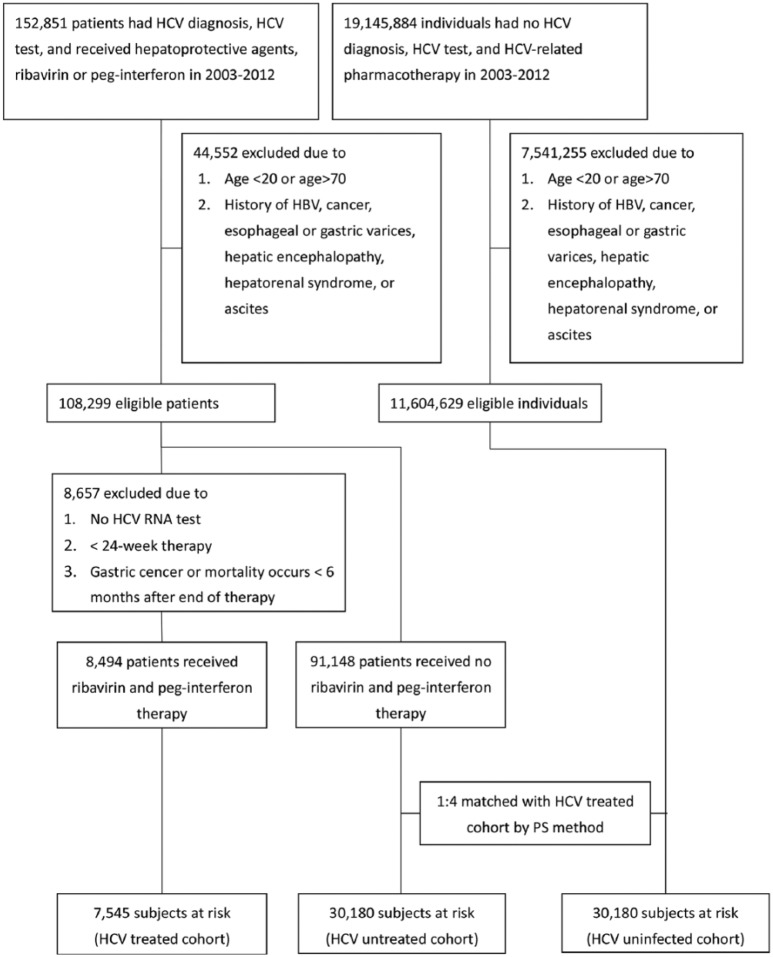
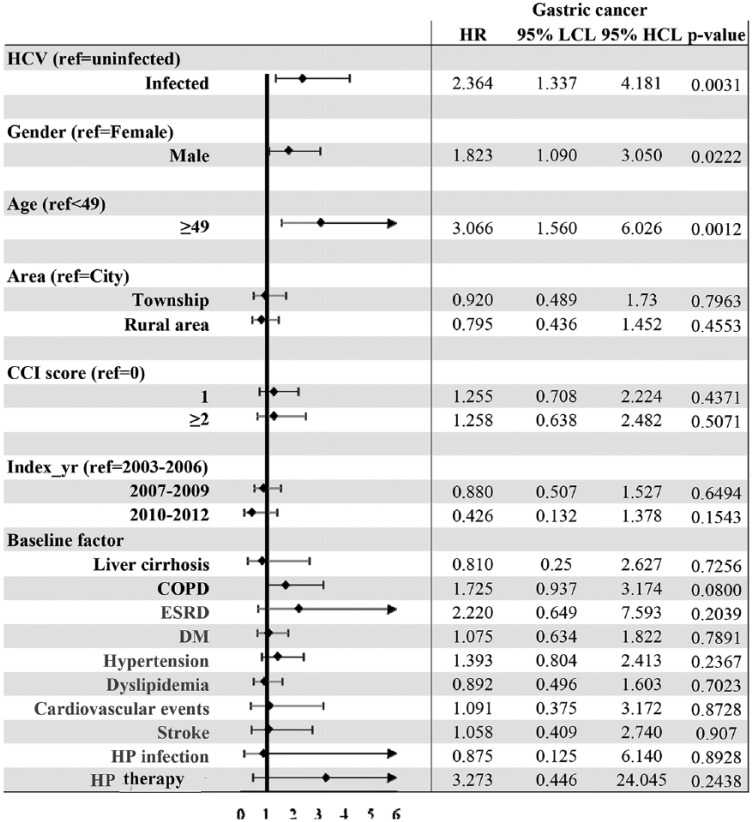
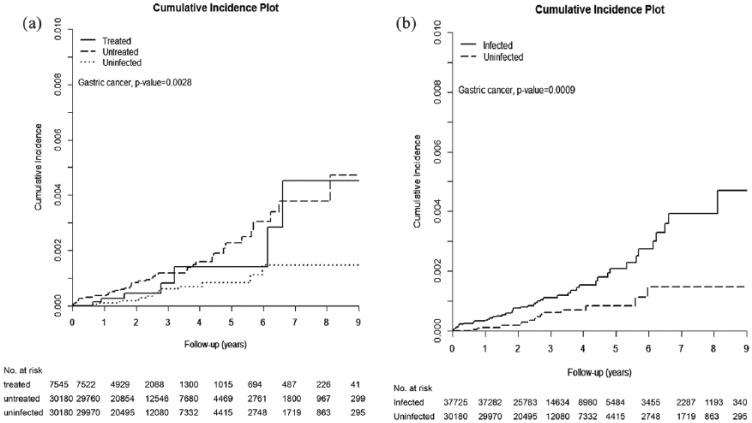
From 2003 to 2012, of 11,712,928 patients, three 1:4:4, propensity-score-matched TNHIRD cohorts including HCV-treated (7545 patients with interferon-based therapy ⩾ 6 months), HCV-untreated ( = 30,180), and HCV-uninfected cohorts ( = 30,180) were enrolled. The cumulative incidences of gastric cancer [HCV-treated: 0.452%; 95% confidence interval (CI): 0.149-1.136%; HCV-untreated: 0.472%; 95% CI: 0.274-0.776%; HCV-uninfected: 0.146%; 95% CI 0.071-0.280%] were lowest in HCV-uninfected cohort ( = 0.0028), but indifferent between treated and untreated cohorts. HCV infection [hazards ratio (HR): 2.364; 95% CI: 1.337-4.181], male sex (HR: 1.823; 95% CI: 1.09-3.05) and age ⩾ 49 years (HR: 3.066; 95% CI: 1.56-6.026) were associated with incident gastric cancers. Among 887 (males: 68.4%; mean age: 66.5 ± 12.9 years, 2008-2018) hospitalized gastric cancer patients, HCV Ab-positive rate was 7.8%. None of the investigated factors exhibited different rates between HCV Ab-positive and Ab-negative patients. No HCV-core-positive cells were demonstrated in gastric cancer tissues.
HCV infection, male sex and old age were risk factors for gastric cancer development. HCV-associated gastric cancer risk might be neither reversed by interferon-based therapy, nor associated with HCV-core-related carcinogenesis.
丙型肝炎病毒(HCV)感染会引发多种肝外恶性肿瘤;HCV感染是否会增加胃癌风险以及抗HCV治疗后该风险是否会逆转,目前仍不清楚。
基于台湾全民健康保险研究数据库(TNHIRD)进行了一项全国性的基于人群的队列研究。同时,对一家三级医疗中心的胃癌患者的危险因素和HCV核心蛋白表达情况进行了调查。
在2003年至2012年期间,从11712928名患者中,纳入了三个1:4:4倾向评分匹配的TNHIRD队列,包括接受HCV治疗的队列(7545例接受基于干扰素的治疗≥6个月的患者)、未接受HCV治疗的队列(30180例)和未感染HCV的队列(30180例)。胃癌的累积发病率[接受HCV治疗的队列:0.452%;95%置信区间(CI):0.149 - 1.136%;未接受HCV治疗的队列:0.472%;95% CI:0.274 - 0.776%;未感染HCV的队列:0.146%;95% CI 0.071 - 0.280%]在未感染HCV的队列中最低(P = 0.0028),但接受治疗和未接受治疗的队列之间无差异。HCV感染[风险比(HR):2.364;95% CI:1.337 - 4.181]、男性(HR:1.823;95% CI:1.09 - 3.05)和年龄≥49岁(HR:3.066;95% CI:1.56 - 6.026)与胃癌发病相关。在887例(男性:68.4%;平均年龄:66.5±12.9岁,2008 - 2018年)住院胃癌患者中,HCV抗体阳性率为7.8%。在调查的因素中,HCV抗体阳性和阴性患者之间未显示出不同的发生率。在胃癌组织中未发现HCV核心蛋白阳性细胞。
HCV感染、男性和老年是胃癌发生的危险因素。基于干扰素的治疗可能既不会逆转与HCV相关的胃癌风险,也与HCV核心蛋白相关的致癌作用无关。