Sheflin Amy M, Chiniquy Dawn, Yuan Chaohui, Goren Emily, Kumar Indrajit, Braud Max, Brutnell Thomas, Eveland Andrea L, Tringe Susannah, Liu Peng, Kresovich Stephen, Marsh Ellen L, Schachtman Daniel P, Prenni Jessica E
Department of Horticulture and Landscape Architecture Colorado State University Fort Collins Colorado.
Joint Genome Institute Department of Energy Walnut Creek California.
Plant Direct. 2019 Mar 14;3(3):e00122. doi: 10.1002/pld3.122. eCollection 2019 Mar.
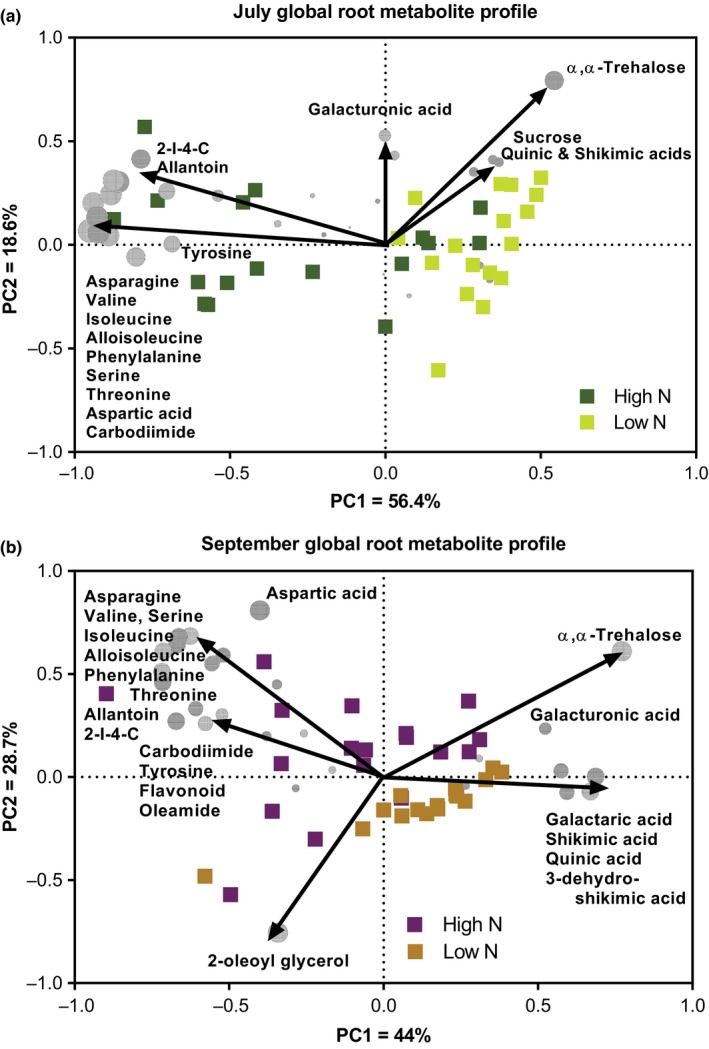
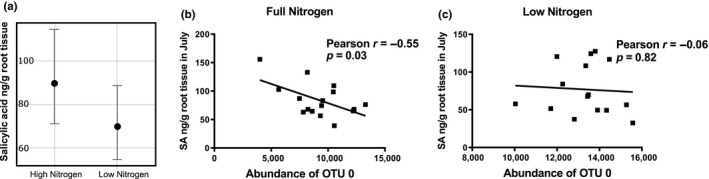
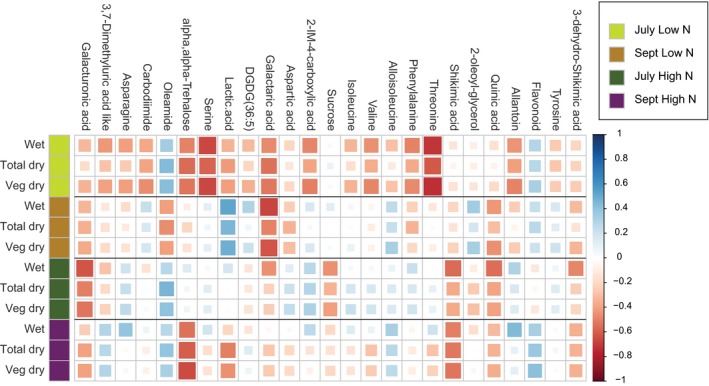
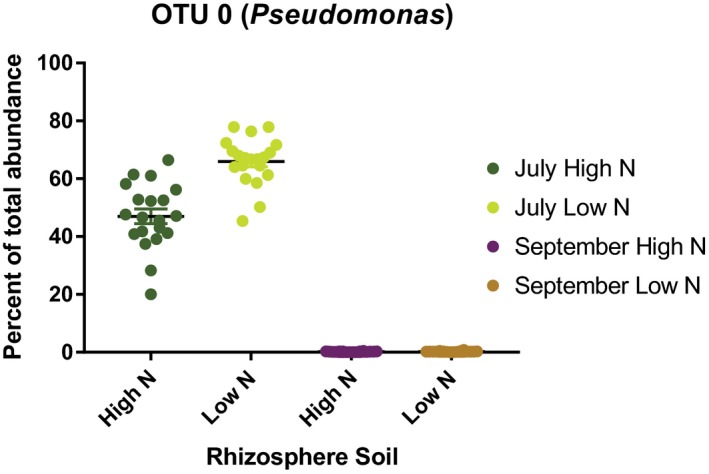
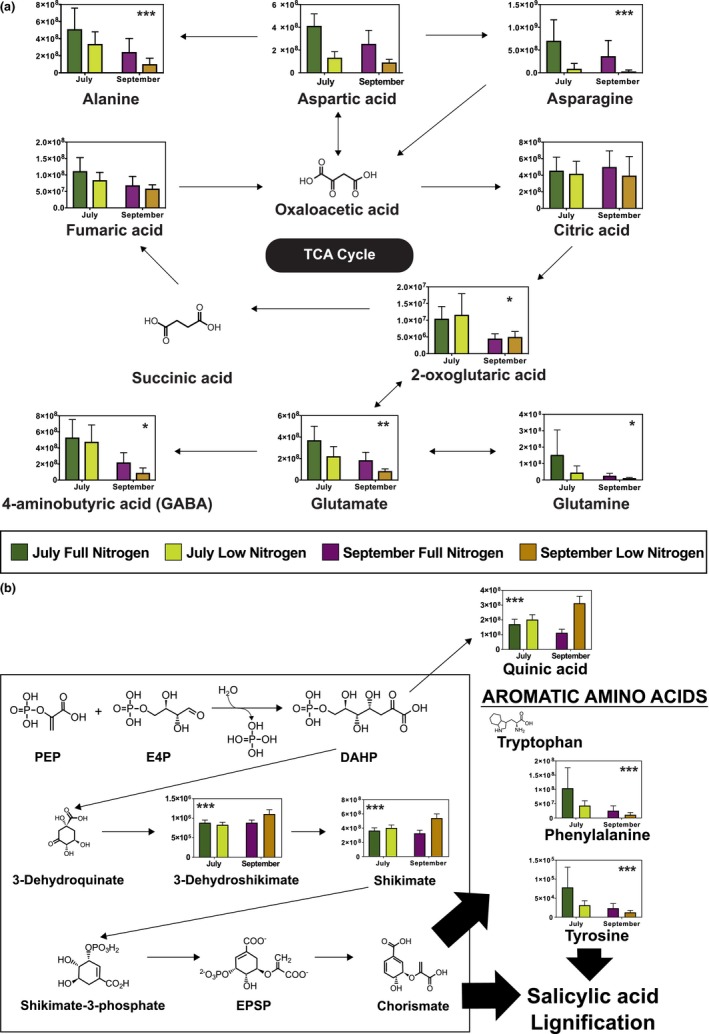
Sorghum ( [L.] Moench) is the fifth most productive cereal crop worldwide with some hybrids having high biomass yield traits making it promising for sustainable, economical biofuel production. To maximize biofuel feedstock yields, a more complete understanding of metabolic responses to low nitrogen (N) will be useful for incorporation in crop improvement efforts. In this study, 10 diverse sorghum entries (including inbreds and hybrids) were field-grown under low and full N conditions and roots were sampled at two time points for metabolomics and 16S amplicon sequencing. Roots of plants grown under low N showed altered metabolic profiles at both sampling dates including metabolites important in N storage and synthesis of aromatic amino acids. Complementary investigation of the rhizosphere microbiome revealed dominance by a single operational taxonomic unit (OTU) in an early sampling that was taxonomically assigned to the genus . Abundance of this OTU was significantly greater under low N in July and was decreased dramatically in September. Correlation of abundance with root metabolites revealed a strong negative association with the defense hormone salicylic acid (SA) under full N but not under low N, suggesting reduced defense response. Roots from plants with N stress also contained reduced phenylalanine, a precursor for SA, providing further evidence for compromised metabolic capacity for defense response under low N conditions. Our findings suggest that interactions between biotic and abiotic stresses may affect metabolic capacity for plant defense and need to be concurrently prioritized as breeding programs become established for biofuels production on marginal soils.
高粱([L.] Moench)是全球产量排名第五的谷类作物,一些杂交品种具有高生物量产量特性,使其有望用于可持续、经济的生物燃料生产。为了使生物燃料原料产量最大化,更全面地了解对低氮(N)的代谢反应将有助于纳入作物改良工作。在本研究中,10个不同的高粱品种(包括自交系和杂交种)在低氮和全氮条件下进行田间种植,并在两个时间点采集根系用于代谢组学和16S扩增子测序。在低氮条件下生长的植物根系在两个采样日期均显示出代谢谱的改变,包括在氮储存和芳香族氨基酸合成中重要的代谢物。对根际微生物群的补充调查显示,在早期采样中一个单一的操作分类单元(OTU)占主导地位,该分类单元在分类学上被归为 属。该OTU的丰度在7月低氮条件下显著更高,而在9月急剧下降。该OTU丰度与根系代谢物的相关性显示,在全氮条件下与防御激素水杨酸(SA)呈强负相关,而在低氮条件下则不然,表明防御反应降低。氮胁迫植物的根系中苯丙氨酸(SA的前体)含量也降低,这为低氮条件下防御反应的代谢能力受损提供了进一步证据。我们的研究结果表明,生物和非生物胁迫之间的相互作用可能会影响植物防御的代谢能力,并且随着在边际土壤上建立生物燃料生产的育种计划,需要同时将其作为优先事项。