
保卫细胞光合作用在脱落酸诱导的气孔关闭过程中至关重要。
Guard cell photosynthesis is crucial in abscisic acid-induced stomatal closure.
作者信息
Iwai Sumio, Ogata Sho, Yamada Naotaka, Onjo Michio, Sonoike Kintake, Shimazaki Ken-Ichiro
机构信息
Department of Horticultural Science Faculty of Agriculture Kagoshima University Kagoshima Japan.
Kagoshima University Experimental Farm Kagoshima Japan.
出版信息
Plant Direct. 2019 May 30;3(5):e00137. doi: 10.1002/pld3.137. eCollection 2019 May.
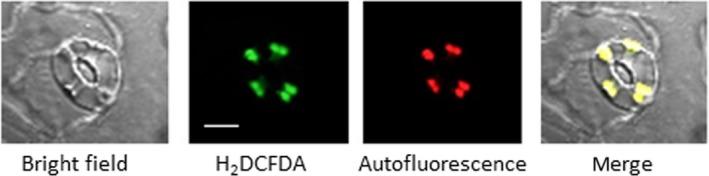
Reactive oxygen species (ROS) are ubiquitous signaling molecules involved in diverse physiological processes, including stomatal closure. Photosynthetic electron transport (PET) is the main source of ROS generation in plants, but whether it functions in guard cell signaling remains unclear. Here, we assessed whether PET functions in abscisic acid (ABA) signaling in guard cells. ABA-elicited ROS were localized to guard cell chloroplasts in , , and in the light and abolished by the PET inhibitors 3-(3, 4-dichlorophenyl)-1, 1-dimethylurea and 2, 5-dibromo-3-methyl-6-isopropyl--benzoquinone. These inhibitors reduced ABA-induced stomatal closure in all three species, as well as in the NADPH oxidase-lacking mutant . However, an NADPH oxidase inhibitor did not fully eliminate ABA-induced ROS in the chloroplasts, and ABA-induced ROS were still observed in the guard cell chloroplasts of . This study demonstrates that ROS generated through PET act as signaling molecules in ABA-induced stomatal closure and that this occurs in concert with ROS derived through NADPH oxidase.
活性氧(ROS)是参与多种生理过程(包括气孔关闭)的普遍存在的信号分子。光合电子传递(PET)是植物中ROS产生的主要来源,但它是否在保卫细胞信号传导中起作用仍不清楚。在这里,我们评估了PET是否在保卫细胞的脱落酸(ABA)信号传导中起作用。ABA诱导的ROS在光下定位到拟南芥、大豆和蚕豆保卫细胞的叶绿体中,并被PET抑制剂3-(3,4-二氯苯基)-1,1-二甲基脲和2,5-二溴-3-甲基-6-异丙基-对苯醌消除。这些抑制剂在所有三个物种以及缺乏NADPH氧化酶的突变体中均降低了ABA诱导的气孔关闭。然而,NADPH氧化酶抑制剂并未完全消除叶绿体中ABA诱导的ROS,并且在蚕豆保卫细胞叶绿体中仍观察到ABA诱导的ROS。这项研究表明,通过PET产生的ROS在ABA诱导的气孔关闭中作为信号分子起作用,并且这与通过NADPH氧化酶产生的ROS协同发生。



 Zotero 插件