Department of Life Technologies, Molecular Plant Biology Unit, University of Turku, FI-20014 Turku, Finland.
Plant Physiol. 2022 May 3;189(1):112-128. doi: 10.1093/plphys/kiac058.
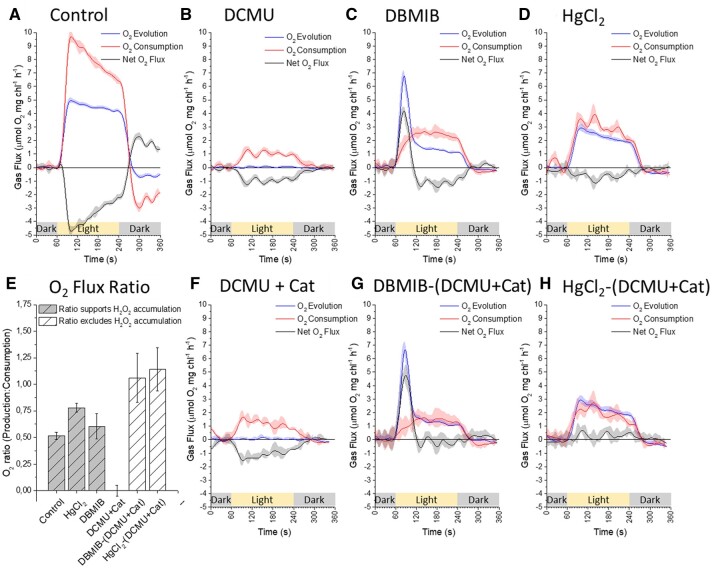
Reactive oxygen species (ROS) are generated in electron transport processes of living organisms in oxygenic environments. Chloroplasts are plant bioenergetics hubs where imbalances between photosynthetic inputs and outputs drive ROS generation upon changing environmental conditions. Plants have harnessed various site-specific thylakoid membrane ROS products into environmental sensory signals. Our current understanding of ROS production in thylakoids suggests that oxygen (O2) reduction takes place at numerous components of the photosynthetic electron transfer chain (PETC). To refine models of site-specific O2 reduction capacity of various PETC components in isolated thylakoids of Arabidopsis thaliana, we quantified the stoichiometry of oxygen production and consumption reactions associated with hydrogen peroxide (H2O2) accumulation using membrane inlet mass spectrometry and specific inhibitors. Combined with P700 spectroscopy and electron paramagnetic resonance spin trapping, we demonstrate that electron flow to photosystem I (PSI) is essential for H2O2 accumulation during the photosynthetic linear electron transport process. Further leaf disc measurements provided clues that H2O2 from PETC has a potential of increasing mitochondrial respiration and CO2 release. Based on gas exchange analyses in control, site-specific inhibitor-, methyl viologen-, and catalase-treated thylakoids, we provide compelling evidence of no contribution of plastoquinone pool or cytochrome b6f to chloroplastic H2O2 accumulation. The putative production of H2O2 in any PETC location other than PSI is rapidly quenched and therefore cannot function in H2O2 translocation to another cellular location or in signaling.
活性氧 (ROS) 在含氧环境中生物体的电子传递过程中产生。叶绿体是植物生物能的中心,在环境条件发生变化时,光合输入和输出之间的不平衡会导致 ROS 的产生。植物已经将各种特定于类囊体膜的 ROS 产物利用为环境感应信号。我们目前对类囊体中 ROS 产生的理解表明,氧气 (O2) 还原发生在光合作用电子传递链 (PETC) 的许多组件上。为了细化拟南芥孤立类囊体中各种 PETC 组件的特定于位点的 O2 还原能力模型,我们使用膜入口质谱和特定抑制剂定量了与过氧化氢 (H2O2) 积累相关的氧气产生和消耗反应的化学计量。结合 P700 光谱和电子顺磁共振自旋捕获,我们证明了电子流向光系统 I (PSI) 对于光合作用线性电子传递过程中 H2O2 积累是必不可少的。进一步的叶片圆盘测量提供了线索,表明来自 PETC 的 H2O2 有可能增加线粒体呼吸和 CO2 释放。基于对照、特定于位点抑制剂、甲紫精和过氧化氢酶处理的类囊体的气体交换分析,我们提供了令人信服的证据,证明质体醌池或细胞色素 b6f 对叶绿体 H2O2 积累没有贡献。PSI 以外的任何 PETC 位置产生的 H2O2 都会迅速猝灭,因此不能用于 H2O2 向另一个细胞位置的转运或信号转导。