Institute of Human Genetics, Julius Maximilians University, Würzburg, Germany.
Fertility Center; Wiesbaden, Germany.
PLoS One. 2019 Jun 27;14(6):e0218615. doi: 10.1371/journal.pone.0218615. eCollection 2019.
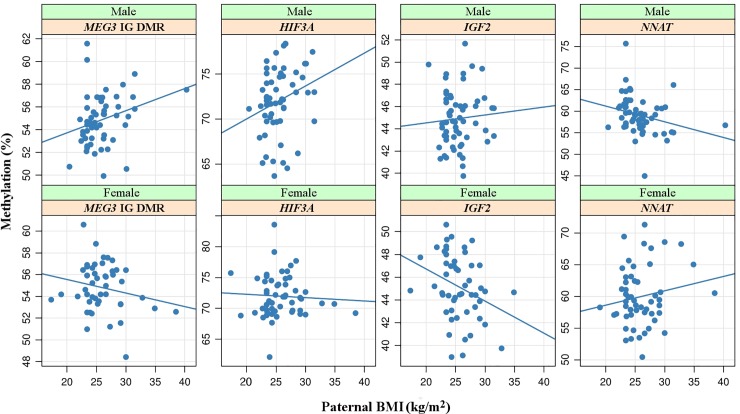
The prevalence of metabolic disorders, in particular obesity has dramatically increased worldwide. Genetic variants explain only a minor part of the obesity epidemic induced by physical inactivity and over-nutrition. Epidemiological studies in humans and animal models indicate that epigenetic changes associated with adverse parental and/or intrauterine factors may contribute to the missing heritability of metabolic disorders. Possible adverse paternal effects are likely transmitted by sperm to the next-generation. To investigate this hypothesis, we have systematically analyzed the effects of male body mass index (BMI) on sperm epigenome and its association with next-generation fetal cord blood (FCB) DNA methylation. Methylation levels of maternally imprinted (PEG1, PEG4, PEG5, and PEG10), paternally imprinted (H19-IG DMR, IGF2-DMR0, and MEG3-IG DMR) regions, and obesity-related non-imprinted HIF3A gene were quantified by bisulphite pyrosequencing in sperm samples of 294 human donors undergoing in vitro fertilization or intracytoplasmic sperm injection, and in 113 FCBs of the resulting offspring. Multivariable regression analyses revealed that MEG3 intergenic differentially methylated region (IG DMR) showed positive correlation between sperm methylation and donor's BMI. A gender-specific correlation between paternal BMI and FCB methylation was observed for MEG3-IG DMR, HIF3A, and IGF2-DMR0. The former two genes displayed same directional nominal association (as sperm) between paternal BMI and FCB methylation in male offspring. Hypomethylation of IGF2-DMR0 with increased paternal BMI was observed in FCBs from female offsprings. Our results suggest that male obesity is nominally associated with modification of sperm DNA methylome in humans, which may affect the epigenome of the next-generation. Nevertheless, it is important to note that none of the associated p-values survived multiple testing adjustments. Future work should test the effect of associated methylation aberrations in the offspring as DNA methylation was shown to control expression and/or imprint establishment across the studied genes.
代谢紊乱的流行率,尤其是肥胖症,在全球范围内急剧增加。遗传变异仅能解释一小部分由缺乏运动和营养过剩引起的肥胖症。人类和动物模型的流行病学研究表明,与不良的亲代和/或宫内因素相关的表观遗传变化可能导致代谢紊乱的遗传缺失。可能的不利父系效应可能通过精子传递给下一代。为了研究这一假设,我们系统地分析了男性体重指数(BMI)对精子表观基因组的影响及其与下一代胎儿脐血(FCB)DNA 甲基化的关联。通过对 294 名接受体外受精或胞浆内精子注射的人类供体的精子样本和 113 名由此产生的后代的 FCB 进行亚硫酸氢盐焦磷酸测序,定量了母源印迹(PEG1、PEG4、PEG5 和 PEG10)、父源印迹(H19-IG DMR、IGF2-DMR0 和 MEG3-IG DMR)区域和肥胖相关的非印迹 HIF3A 基因的甲基化水平。多变量回归分析显示,MEG3 基因间差异甲基化区(IG DMR)的精子甲基化与供体 BMI 呈正相关。观察到父系 BMI 与 FCB 甲基化之间存在性别特异性相关性,用于 MEG3-IG DMR、HIF3A 和 IGF2-DMR0。前两个基因在男性后代中,父系 BMI 与 FCB 甲基化之间存在相同方向的名义关联(与精子一样)。在女性后代的 FCB 中,IGF2-DMR0 的低甲基化与父系 BMI 的增加有关。我们的研究结果表明,男性肥胖与人类精子 DNA 甲基化组的修饰具有名义上的相关性,这可能影响下一代的表观基因组。然而,需要注意的是,没有一个相关的 p 值在多重测试调整后仍然存在。未来的工作应该测试相关甲基化异常在后代中的作用,因为 DNA 甲基化被证明可以控制所研究基因的表达和/或印迹建立。