Sharp Gemma C, Salas Lucas A, Monnereau Claire, Allard Catherine, Yousefi Paul, Everson Todd M, Bohlin Jon, Xu Zongli, Huang Rae-Chi, Reese Sarah E, Xu Cheng-Jian, Baïz Nour, Hoyo Cathrine, Agha Golareh, Roy Ritu, Holloway John W, Ghantous Akram, Merid Simon K, Bakulski Kelly M, Küpers Leanne K, Zhang Hongmei, Richmond Rebecca C, Page Christian M, Duijts Liesbeth, Lie Rolv T, Melton Phillip E, Vonk Judith M, Nohr Ellen A, Williams-DeVane ClarLynda, Huen Karen, Rifas-Shiman Sheryl L, Ruiz-Arenas Carlos, Gonseth Semira, Rezwan Faisal I, Herceg Zdenko, Ekström Sandra, Croen Lisa, Falahi Fahimeh, Perron Patrice, Karagas Margaret R, Quraishi Bilal M, Suderman Matthew, Magnus Maria C, Jaddoe Vincent W V, Taylor Jack A, Anderson Denise, Zhao Shanshan, Smit Henriette A, Josey Michele J, Bradman Asa, Baccarelli Andrea A, Bustamante Mariona, Håberg Siri E, Pershagen Göran, Hertz-Picciotto Irva, Newschaffer Craig, Corpeleijn Eva, Bouchard Luigi, Lawlor Debbie A, Maguire Rachel L, Barcellos Lisa F, Davey Smith George, Eskenazi Brenda, Karmaus Wilfried, Marsit Carmen J, Hivert Marie-France, Snieder Harold, Fallin M Daniele, Melén Erik, Munthe-Kaas Monica C, Arshad Hasan, Wiemels Joseph L, Annesi-Maesano Isabella, Vrijheid Martine, Oken Emily, Holland Nina, Murphy Susan K, Sørensen Thorkild I A, Koppelman Gerard H, Newnham John P, Wilcox Allen J, Nystad Wenche, London Stephanie J, Felix Janine F, Relton Caroline L
MRC Integrative Epidemiology Unit.
School of Social and Community Medicine.
Hum Mol Genet. 2017 Oct 15;26(20):4067-4085. doi: 10.1093/hmg/ddx290.
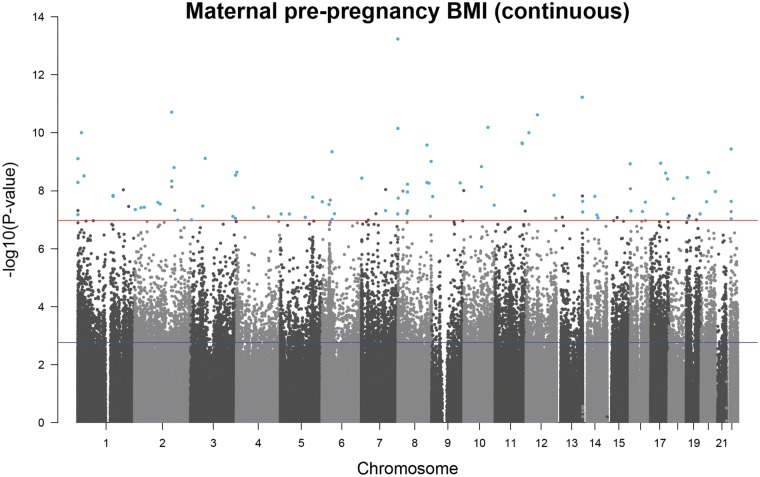
Pre-pregnancy maternal obesity is associated with adverse offspring outcomes at birth and later in life. Individual studies have shown that epigenetic modifications such as DNA methylation could contribute. Within the Pregnancy and Childhood Epigenetics (PACE) Consortium, we meta-analysed the association between pre-pregnancy maternal BMI and methylation at over 450,000 sites in newborn blood DNA, across 19 cohorts (9,340 mother-newborn pairs). We attempted to infer causality by comparing the effects of maternal versus paternal BMI and incorporating genetic variation. In four additional cohorts (1,817 mother-child pairs), we meta-analysed the association between maternal BMI at the start of pregnancy and blood methylation in adolescents. In newborns, maternal BMI was associated with small (<0.2% per BMI unit (1 kg/m2), P < 1.06 × 10⁻⁷) methylation variation at 9,044 sites throughout the genome. Adjustment for estimated cell proportions greatly attenuated the number of significant CpGs to 104, including 86 sites common to the unadjusted model. At 72/86 sites, the direction of the association was the same in newborns and adolescents, suggesting persistence of signals. However, we found evidence for acausal intrauterine effect of maternal BMI on newborn methylation at just 8/86 sites. In conclusion, this well-powered analysis identified robust associations between maternal adiposity and variations in newborn blood DNA methylation, but these small effects may be better explained by genetic or lifestyle factors than a causal intrauterine mechanism. This highlights the need for large-scale collaborative approaches and the application of causal inference techniques in epigenetic epidemiology.
孕前母亲肥胖与子代出生时及生命后期的不良结局相关。个别研究表明,DNA甲基化等表观遗传修饰可能起了作用。在妊娠与儿童表观遗传学(PACE)联盟中,我们对19个队列(9340对母婴)中孕前母亲BMI与新生儿血液DNA中超过45万个位点的甲基化之间的关联进行了荟萃分析。我们试图通过比较母亲与父亲BMI的影响并纳入基因变异来推断因果关系。在另外4个队列(1817对母婴)中,我们对妊娠开始时母亲BMI与青少年血液甲基化之间的关联进行了荟萃分析。在新生儿中,母亲BMI与全基因组9044个位点的微小(每BMI单位(1kg/m2)<0.2%,P<1.06×10-7)甲基化变异相关。对估计的细胞比例进行调整后,显著的CpG数量大幅减少至104个,其中包括未调整模型中的86个位点。在72/86个位点上,新生儿和青少年中关联的方向相同,表明信号具有持续性。然而,我们仅在8/86个位点上发现母亲BMI对新生儿甲基化存在非因果性宫内效应的证据。总之,这项有力的分析确定了母亲肥胖与新生儿血液DNA甲基化变异之间存在稳健的关联,但这些微小效应可能由遗传或生活方式因素而非因果性宫内机制更好地解释。这凸显了在表观遗传流行病学中采用大规模协作方法和应用因果推断技术的必要性。