Chee See Wee, Wong Zicong Marvin, Baraissov Zhaslan, Tan Shu Fen, Tan Teck Leong, Mirsaidov Utkur
Department of Physics, National University of Singapore, Singapore, 117551, Singapore.
Centre for BioImaging Sciences, Department of Biological Sciences, National University of Singapore, Singapore, 117557, Singapore.
Nat Commun. 2019 Jun 27;10(1):2831. doi: 10.1038/s41467-019-10623-0.
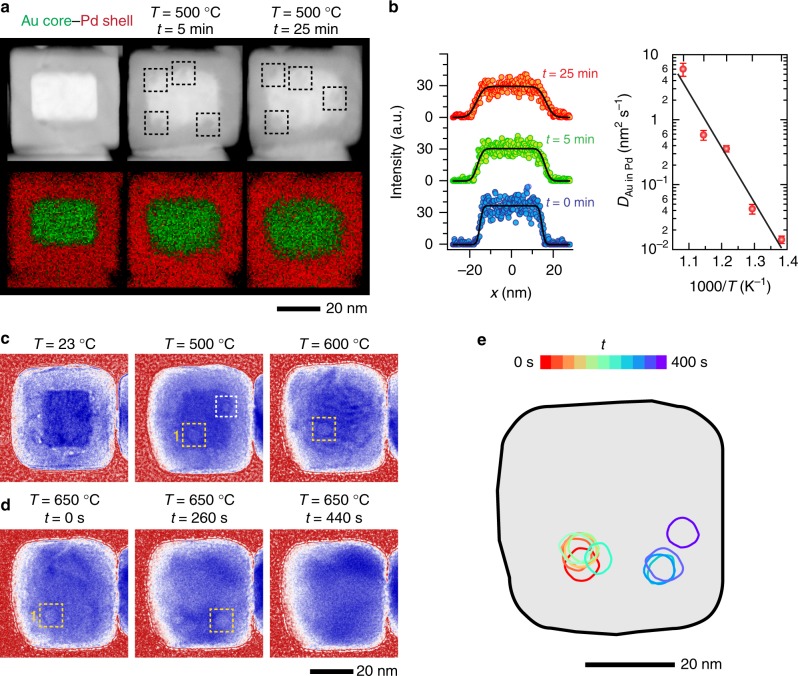
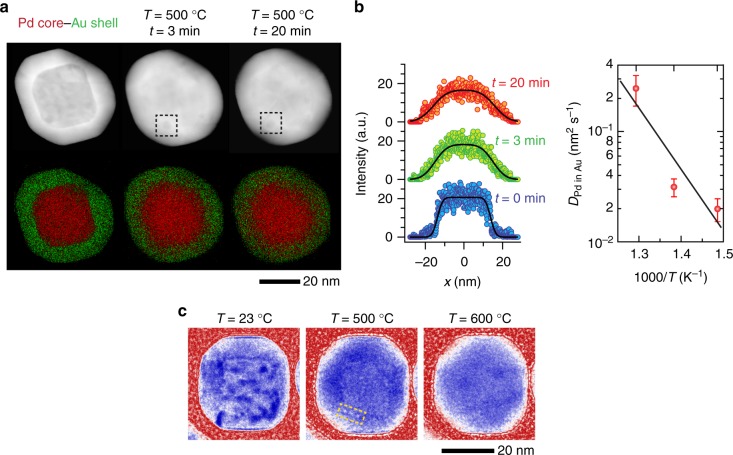
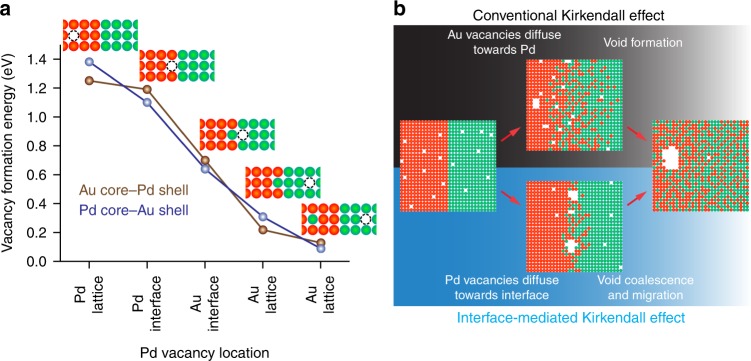
At elevated temperatures, bimetallic nanomaterials change their morphologies because of the interdiffusion of atomic species, which also alters their properties. The Kirkendall effect (KE) is a well-known phenomenon associated with such interdiffusion. Here, we show how KE can manifest in bimetallic nanoparticles (NPs) by following core-shell NPs of Au and Pd during heat treatment with in situ transmission electron microscopy. Unlike monometallic NPs, these core-shell NPs did not evolve into hollow core NPs. Instead, nanoscale voids formed at the bimetallic interface and then, migrated to the NP surface. Our results show that: (1) the direction of vacancy flow during interdiffusion reverses due to the higher vacancy formation energy of Pd compared to Au, and (2) nanoscale voids migrate during heating, contrary to conventional assumptions of immobile voids and void shrinkage through vacancy emission. Our results illustrate how void behavior in bimetallic NPs can differ from an idealized picture based on atomic fluxes and have important implications for the design of these materials for high-temperature applications.
在高温下,双金属纳米材料会因原子物种的相互扩散而改变其形态,这也会改变它们的性质。柯肯达尔效应(KE)是一种与此类相互扩散相关的著名现象。在此,我们通过在原位透射电子显微镜下对热处理过程中的金和钯核壳纳米颗粒(NPs)进行跟踪,展示了KE在双金属纳米颗粒(NPs)中是如何表现的。与单金属纳米颗粒不同,这些核壳纳米颗粒并没有演变成中空核纳米颗粒。相反,纳米级空隙在双金属界面处形成,然后迁移到纳米颗粒表面。我们的结果表明:(1)由于钯的空位形成能高于金,相互扩散过程中空位流动的方向发生了逆转;(2)与传统的固定空隙和通过空位发射使空隙收缩的假设相反,纳米级空隙在加热过程中会迁移。我们的结果说明了双金属纳米颗粒中的空隙行为如何不同于基于原子通量的理想化情况,并且对这些用于高温应用的材料的设计具有重要意义。