Vogl Lilian M, Schweizer Peter, Maeder Xavier, Utke Ivo, Minor Andrew M, Michler Johann
Swiss Federal Laboratories for Materials Science and Technology (Empa), 3603 Thun, Switzerland.
Department of Materials Science and Engineering, University of California, Berkeley, California 94720, United States.
ACS Nano. 2024 Oct 29;18(43):29658-29666. doi: 10.1021/acsnano.4c08502. Epub 2024 Oct 16.
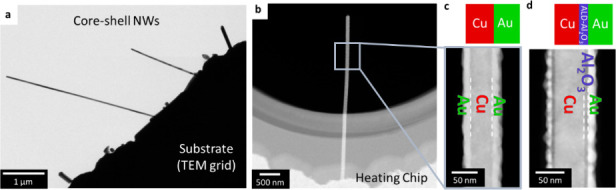
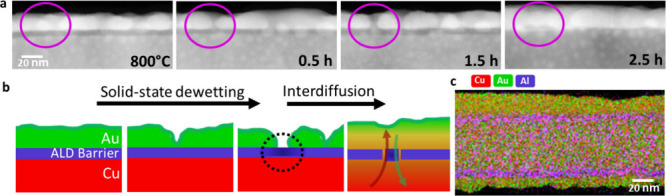
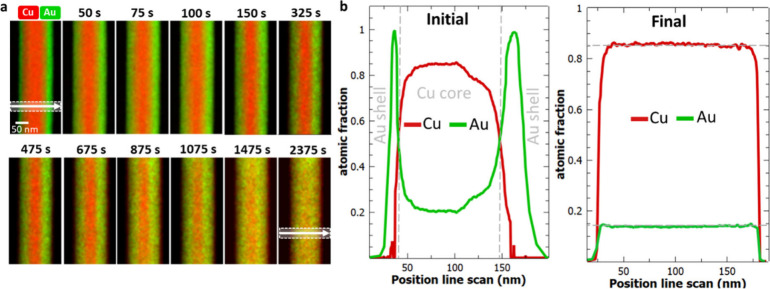
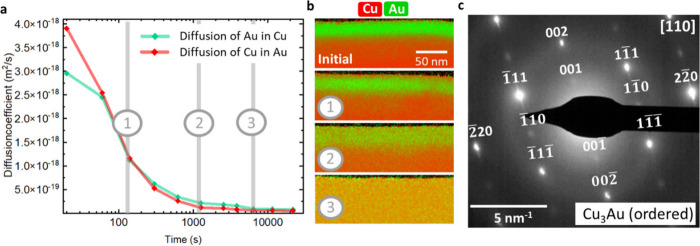
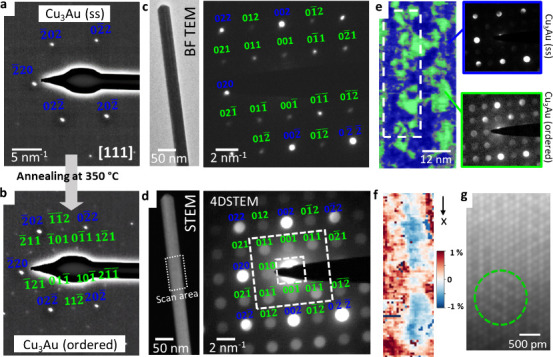
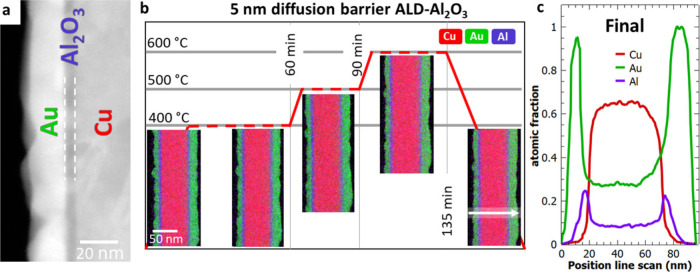
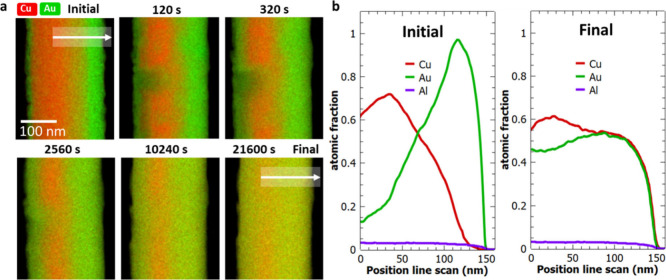
Diffusion is one of the most fundamental concepts in materials science, playing a pivotal role in materials synthesis, forming, and degradation. Of particular importance is solid state interdiffusion of metals which defines the usable parameter space for material combinations in the form of alloys. This parameter space can be explored on the macroscopic scale by using diffusion couples. However, this method reaches its limit when going to low temperatures, small scales, and when testing ultrathin diffusion barriers. Therefore, this work transfers the principle of the diffusion couples to small scales by using core-shell nanowires and heating. This allows us to delve into the interdiffusion dynamics of copper and gold, revealing the interplay between diffusion and the disorder-order phase transition. Our TEM experiments in combination with chemical mapping reveal the interdiffusion coefficients of Cu and Au at low temperatures and highlight the impact of ordering processes on the diffusion behavior. The formation of ordered domains within the solid-solution is examined using high-resolution imaging and nanodiffraction including strain mapping. In addition, we examine the effectiveness of ultrathin AlO barrier layers to control interdiffusion of the diffusion couple. Our findings indicate that a 5 nm thick layer serves as an efficient diffusion barrier. This research provides valuable insights into the interdiffusion behavior of Cu and Au on the nanoscale, offering potential applications in the development of miniaturized integrated circuits and nanodevices.
扩散是材料科学中最基本的概念之一,在材料合成、成型和降解过程中起着关键作用。金属的固态互扩散尤为重要,它以合金的形式定义了材料组合的可用参数空间。可以通过使用扩散偶在宏观尺度上探索这个参数空间。然而,当温度降低、尺度变小以及测试超薄扩散阻挡层时,这种方法就会达到其极限。因此,这项工作通过使用核壳纳米线和加热将扩散偶的原理应用于小尺度。这使我们能够深入研究铜和金的互扩散动力学,揭示扩散与无序-有序相变之间的相互作用。我们结合化学映射的透射电子显微镜实验揭示了低温下铜和金的互扩散系数,并突出了有序过程对扩散行为的影响。使用包括应变映射在内的高分辨率成像和纳米衍射研究了固溶体内有序畴的形成。此外,我们研究了超薄氧化铝阻挡层控制扩散偶互扩散的有效性。我们的研究结果表明,5纳米厚的层可作为有效的扩散阻挡层。这项研究为铜和金在纳米尺度上的互扩散行为提供了有价值的见解,为微型集成电路和纳米器件的开发提供了潜在应用。