Yang Chunyu, Zhou You, Cao Qilong, Xia Mengfan, An Jing
School of Economics and Management, Changzhou Institute of Technology, Changzhou, China.
School of Social and Behavioral Sciences, Nanjing University, Nanjing, China.
Front Psychiatry. 2019 Jun 12;10:388. doi: 10.3389/fpsyt.2019.00388. eCollection 2019.
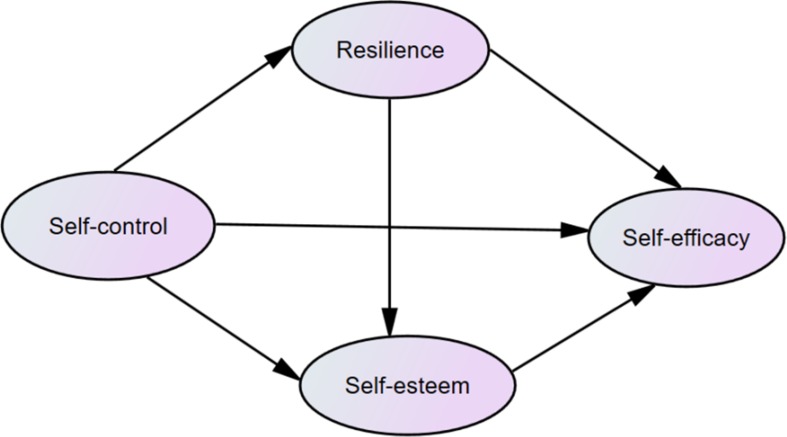
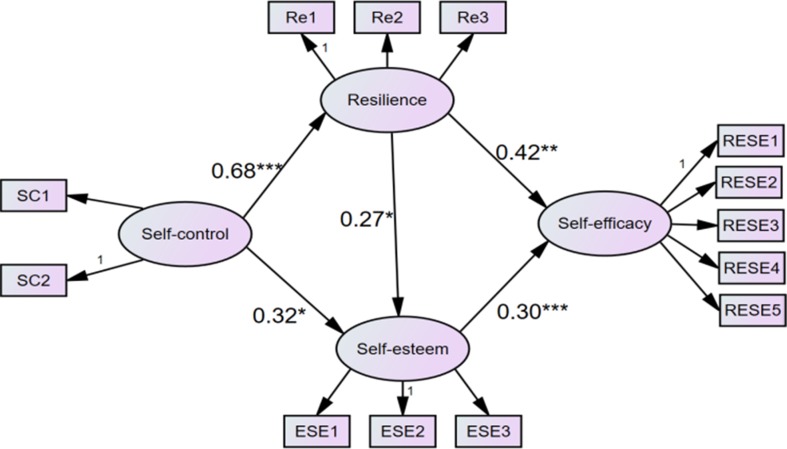
While substance use disorder is one of the overarching health and social issues that might seriously disrupt individuals' self-control and self-efficacy, most previous studies have been conducted among university students or other groups, and little is known about how the underlying mechanisms between self-control and self-efficacy might impact patients with substance use disorders. The purpose of this study is to investigate how resilience and self-esteem mediate the relationships between self-control and self-efficacy among patients with substance use disorders. We conducted a cross-sectional study of 298 patients with substance use disorder from Shifosi rehab in China. Diagnostic and Statistical Manual of Mental Disorders (5th Edition)-based diagnostic questionnaires were used to collect demographic information and assess addiction severity. The Dual-Modes of Self-Control Scale (DMSC-S) was implemented to measure self-control, while self-esteem was measured using the Self-esteem Scale (SES). The Connor-Davidson Resilience Scale (CD-RISC) was used to measure resilience, and self-efficacy was measured by the regulatory emotional self-efficacy scale (RESE). The correlations between all the dimensions and total scores on the self-control, resilience, self-esteem, and self-efficacy were significantly positive (p < 0.01), indicating that they could predict patients' self-efficacy. Bootstrap testing indicated that resilience and self-esteem fully mediated the relationship between self-control and self-efficacy, relationships between self-control and self-esteem were partially mediated by resilience, and resilience partially mediated the relationship between self-esteem and self-efficacy. Finally, the multiple-group analysis indicated that the relationships among self-control, resilience, self-esteem, and self-efficiency did not differ with respect to gender. The path from self-control through resilience and self-esteem and on to self-efficacy is significant among patients with substance use disorders, suggesting that increasing self-control, resilience, and self-esteem can improve self-efficacy among patients with substance use disorders.
虽然物质使用障碍是可能严重破坏个人自我控制和自我效能感的首要健康和社会问题之一,但以往大多数研究是在大学生或其他群体中进行的,对于自我控制和自我效能感之间的潜在机制如何影响物质使用障碍患者,我们知之甚少。本研究的目的是调查心理韧性和自尊如何在物质使用障碍患者的自我控制和自我效能感之间起中介作用。我们对来自中国石佛寺戒毒所的298名物质使用障碍患者进行了一项横断面研究。基于《精神疾病诊断与统计手册》(第5版)的诊断问卷用于收集人口统计学信息并评估成瘾严重程度。采用自我控制双模式量表(DMSC-S)测量自我控制,同时使用自尊量表(SES)测量自尊。采用康纳-戴维森心理韧性量表(CD-RISC)测量心理韧性,自我效能感由调节情绪自我效能量表(RESE)测量。自我控制、心理韧性、自尊和自我效能感各维度与总分之间的相关性均显著为正(p<0.01),表明它们可以预测患者的自我效能感。Bootstrap检验表明,心理韧性和自尊完全中介了自我控制与自我效能感之间的关系,自我控制与自尊之间的关系部分由心理韧性中介,心理韧性部分中介了自尊与自我效能感之间的关系。最后,多组分析表明,自我控制、心理韧性、自尊和自我效能感之间的关系在性别方面没有差异。在物质使用障碍患者中,从自我控制经心理韧性和自尊再到自我效能感的路径是显著的,这表明提高自我控制、心理韧性和自尊可以提高物质使用障碍患者的自我效能感。