Gibson C Michael, Spyropoulos Alex C, Cohen Alexander T, Hull Russell D, Goldhaber Samuel Z, Yusen Roger D, Hernandez Adrian F, Korjian Serge, Daaboul Yazan, Gold Alex, Harrington Robert A, Chi Gerald
Cardiovascular Division, Department of Medicine, Beth Israel Deaconess Medical Center, Harvard Medical School, Boston, Massachusetts, United States.
Department of Medicine, Anticoagulation and Clinical Thrombosis Services, Hofstra Northwell School of Medicine, Northwell Health System, Manhasset, New York, United States.
TH Open. 2017 Jun 28;1(1):e56-e65. doi: 10.1055/s-0037-1603929. eCollection 2017 Jun.
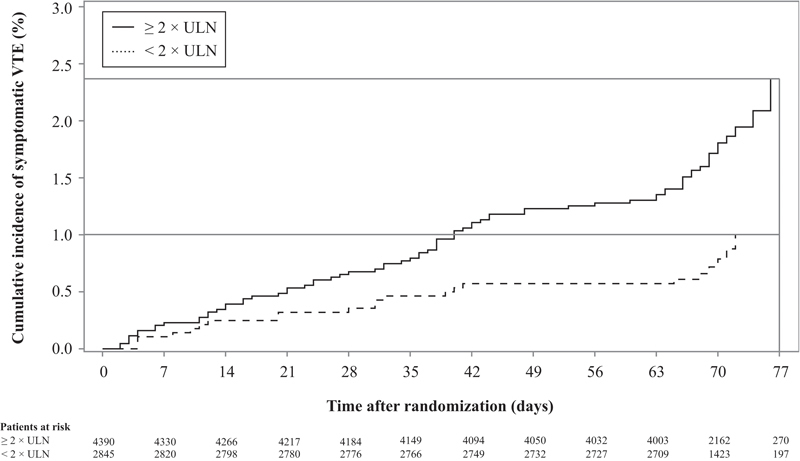
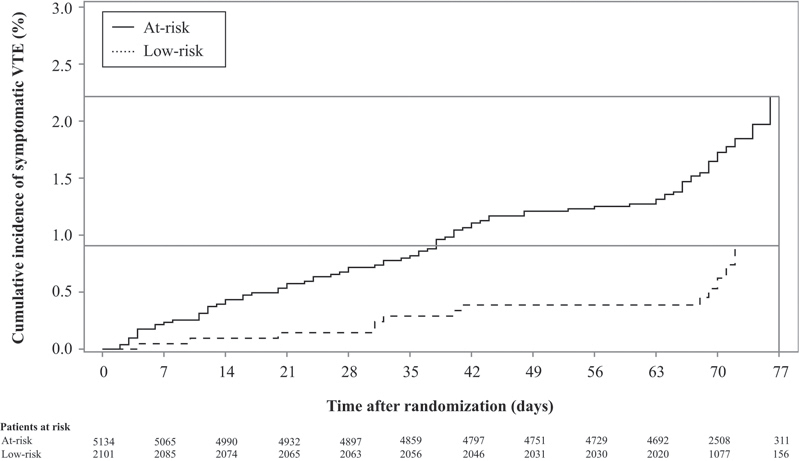
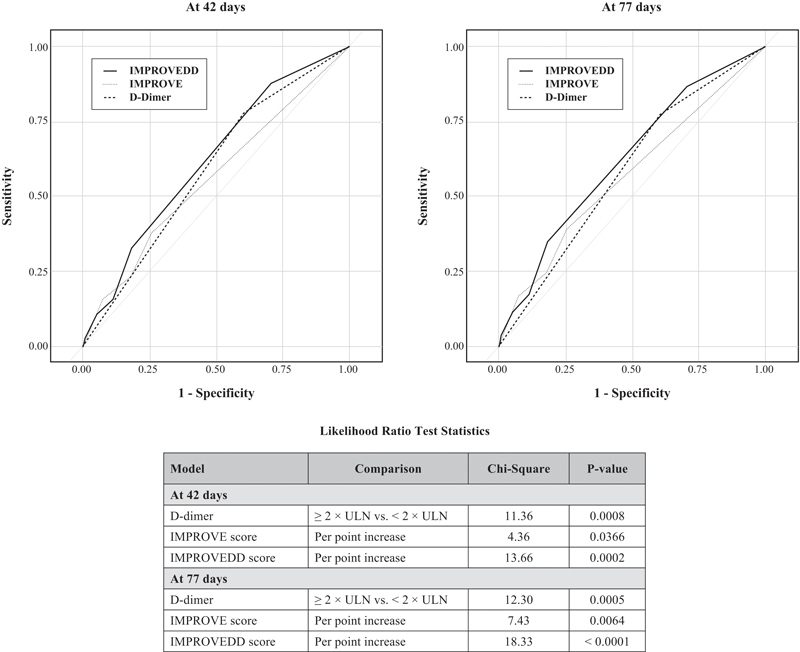
The IMPROVE score is a validated venous thromboembolism (VTE) assessment tool to risk stratify hospitalized, medically ill patients based on clinical variables. It was hypothesized that addition of D-dimer measurement to derive a new IMPROVEDD score would improve identification of at risk of VTE. The association of the IMPROVE score and D-dimer ≥ 2 × the upper limit of normal (ULN) with the risk of symptomatic deep vein thrombosis, nonfatal pulmonary embolism, or VTE-related death was evaluated in 7,441 hospitalized, medically ill patients randomized in the APEX trial. Based on the Cox regression analysis, the IMPROVEDD score was derived by adding two points to the IMPROVE score if the D-dimer was ≥ 2 × ULN. Baseline D-dimer was independently associated with symptomatic VTE through 77 days (adjusted HR: 2.22 [95% CI: 1.38-1.58], = 0.001). Incorporation of D-dimer into the IMPROVE score improved VTE risk discrimination (ΔAUC: 0.06 [95% CI: 0.02-0.09], = 0.0006) and reclassification (continuous NRI: 0.34 [95% CI: 0.17-0.51], = 0.001; categorical NRI: 0.13 [95% CI: 0.03-0.23], = 0.0159). Patients with an IMPROVEDD score of ≥2 had a greater VTE risk compared with those with an IMPROVEDD score of 0 to 1 (HR: 2.73 [95% CI: 1.52-4.90], = 0.0007). Incorporation of D-dimer into the IMPROVE VTE risk assessment model further improves risk stratification in hospitalized, medically ill patients who received thromboprophylaxis. An IMPROVEDD score of ≥2 identifies hospitalized, medically ill patients with a heightened risk for VTE through 77 days.
IMPROVE评分是一种经过验证的静脉血栓栓塞(VTE)评估工具,用于根据临床变量对住院的内科疾病患者进行风险分层。研究假设,增加D - 二聚体检测以得出新的IMPROVEDD评分将改善对VTE风险的识别。在APEX试验中随机分组的7441例住院内科疾病患者中,评估了IMPROVE评分和D - 二聚体≥2×正常上限(ULN)与有症状的深静脉血栓形成、非致命性肺栓塞或VTE相关死亡风险的关联。基于Cox回归分析,如果D - 二聚体≥2×ULN,则在IMPROVE评分上加2分得出IMPROVEDD评分。基线D - 二聚体与77天内有症状的VTE独立相关(校正风险比:2.22 [95%置信区间:1.38 - 1.58],P = 0.001)。将D - 二聚体纳入IMPROVE评分可改善VTE风险判别(ΔAUC:0.06 [95%置信区间:0.02 - 0.09],P = 0.0006)和重新分类(连续净重新分类指数:0.34 [95%置信区间:0.17 - 0.51],P = 0.001;分类净重新分类指数:0.13 [95%置信区间:0.03 - 0.23],P = 0.0159)。IMPROVEDD评分≥2的患者与IMPROVEDD评分为0至1的患者相比,VTE风险更高(风险比:2.73 [95%置信区间:1.52 - 4.90],P = 0.0007)。将D - 二聚体纳入IMPROVE VTE风险评估模型可进一步改善接受血栓预防的住院内科疾病患者的风险分层。IMPROVEDD评分≥2可识别出77天内VTE风险增加的住院内科疾病患者。