Peeters Frederique E C M, Dudink Elton A M P, Kimenai Dorien M, Weijs Bob, Altintas Sibel, Heckman Luuk I B, Mihl Casper, Schurgers Leon J, Wildberger Joachim E, Meex Steven J R, Kietselaer Bas L J H, Crijns Harry J G M
Department of Cardiology, Maastricht University Medical Center+ and CARIM, Maastricht, The Netherlands.
Department of Clinical Chemistry, Maastricht University Medical Center+, Maastricht, The Netherlands.
TH Open. 2018 Nov 10;2(4):e391-e398. doi: 10.1055/s-0038-1675578. eCollection 2018 Oct.
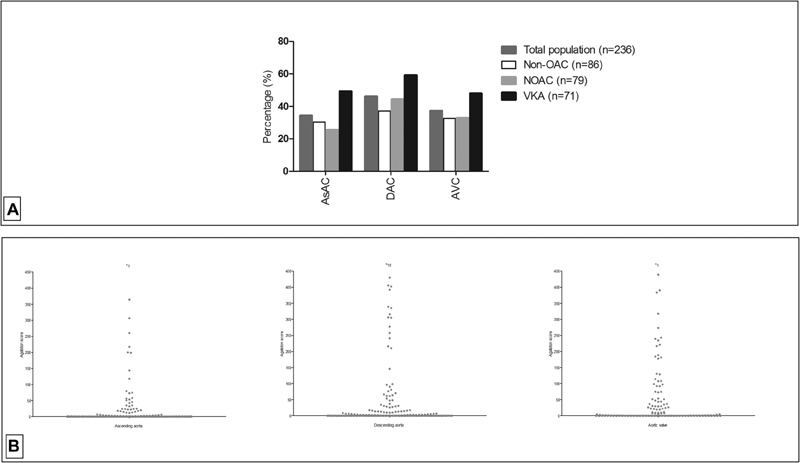
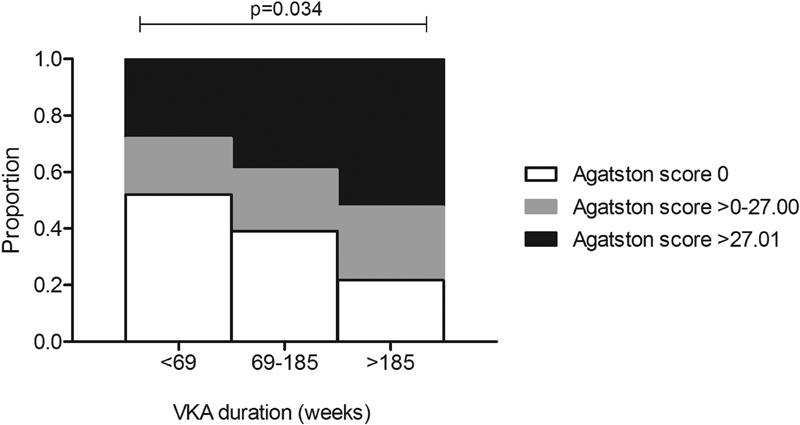
Vitamin K antagonists (VKAs) are associated with coronary artery calcification in low-risk populations, but their effect on calcification of large arteries remains uncertain. The effect of non-vitamin K antagonist oral anticoagulants (NOACs) on vascular calcification is unknown. We investigated the influence of use of VKA and NOAC on calcification of the aorta and aortic valve. In patients with atrial fibrillation without a history of major adverse cardiac or cerebrovascular events who underwent computed tomographic angiography, the presence of ascending aorta calcification (AsAC), descending aorta calcification (DAC), and aortic valve calcification (AVC) was determined. Confounders for VKA/NOAC treatment were identified and propensity score adjusted logistic regression explored the association between treatment and calcification (Agatston score > 0). AsAC, DAC, and AVC differences were assessed in propensity score-matched groups. Of 236 patients (33% female, age: 58 ± 9 years), 71 (30%) used VKA (median duration: 122 weeks) and 79 (34%) used NOAC (median duration: 16 weeks). Propensity score-adjusted logistic regression revealed that use of VKA was significantly associated with AsAC (odds ratio [OR]: 2.31; 95% confidence interval [CI]: 1.16-4.59; = 0.017) and DAC (OR: 2.38; 95% CI: 1.22-4.67; = 0.012) and a trend in AVC (OR: 1.92; 95% CI: 0.98-3.80; = 0.059) compared with non-anticoagulation. This association was absent in NOAC versus non-anticoagulant (AsAC OR: 0.51; 95% CI: 0.21-1.21; = 0.127; DAC OR: 0.80; 95% CI: 0.36-1.76; = 0.577; AVC OR: 0.62; 95% CI: 0.27-1.40; = 0.248). A total of 178 patients were propensity score matched in three pairwise comparisons. Again, use of VKA was associated with DAC ( = 0.043) and a trend toward more AsAC ( = 0.059), while use of NOAC was not (AsAC = 0.264; DAC = 0.154; AVC = 0.280). This cross-sectional study shows that use of VKA seems to contribute to vascular calcification. The calcification effect was not observed in NOAC users.
维生素K拮抗剂(VKAs)与低风险人群的冠状动脉钙化有关,但其对大动脉钙化的影响仍不确定。非维生素K拮抗剂口服抗凝药(NOACs)对血管钙化的影响尚不清楚。我们研究了使用VKA和NOAC对主动脉和主动脉瓣钙化的影响。
在接受计算机断层血管造影的无重大不良心脏或脑血管事件病史的房颤患者中,确定升主动脉钙化(AsAC)、降主动脉钙化(DAC)和主动脉瓣钙化(AVC)的存在。确定VKA/NOAC治疗的混杂因素,并采用倾向评分调整的逻辑回归分析治疗与钙化(阿加斯顿评分>0)之间的关联。在倾向评分匹配组中评估AsAC、DAC和AVC的差异。
在236例患者(33%为女性,年龄:58±9岁)中,71例(30%)使用VKA(中位持续时间:122周),79例(34%)使用NOAC(中位持续时间:16周)。倾向评分调整的逻辑回归显示,与未抗凝相比,使用VKA与AsAC(优势比[OR]:2.31;95%置信区间[CI]:1.16 - 4.59;P = 0.017)和DAC(OR:2.38;95%CI:1.22 - 4.67;P = 0.012)显著相关,AVC有相关趋势(OR:1.92;95%CI:0.98 - 3.80;P = 0.059)。在NOAC与未抗凝组之间未发现这种关联(AsAC OR:0.51;95%CI:0.21 - 1.21;P = 0.127;DAC OR:0.80;95%CI:0.36 - 1.76;P = 0.577;AVC OR:0.62;95%CI:0.27 - 1.40;P = 0.248)。总共178例患者在三次两两比较中进行了倾向评分匹配。同样,使用VKA与DAC相关(P = 0.043),AsAC有增加趋势(P = 0.059),而使用NOAC则无此情况(AsAC P = 0.264;DAC P = 0.154;AVC P = 0.280)。
这项横断面研究表明,使用VKA似乎会导致血管钙化。在使用NOAC的患者中未观察到钙化效应。