Larson Timothy P, Schou Jesper
1Stanford University, Stanford, CA USA.
2Max-Planck-Institut für Sonnensystemforschung, Göttingen, Germany.
Sol Phys. 2018;293(2):29. doi: 10.1007/s11207-017-1201-5. Epub 2018 Jan 31.
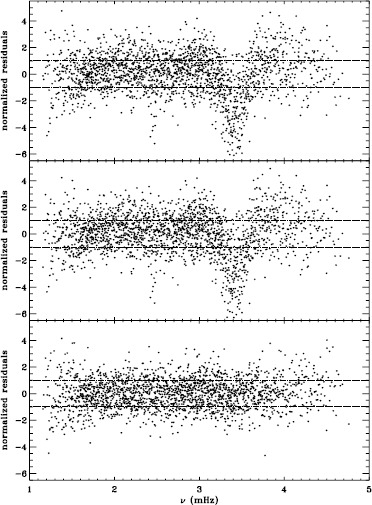
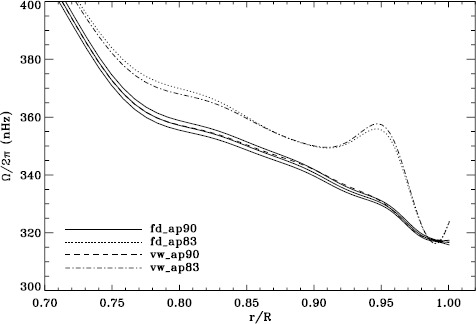
Building upon our previous work, in which we analyzed smoothed and subsampled velocity data from the (MDI), we extend our analysis to unsmoothed, full-resolution MDI data. We also present results from the (HMI), in both full resolution and processed to be a proxy for the low-resolution MDI data. We find that the systematic errors that we saw previously, namely peaks in both the high-latitude rotation rate and the normalized residuals of odd -coefficients, are almost entirely absent in the two full-resolution analyses. Furthermore, we find that both systematic errors seem to depend almost entirely on how the input images are apodized, rather than on resolution or smoothing. Using the full-resolution HMI data, we confirm our previous findings regarding the effect of using asymmetric profiles on mode parameters, and also find that they occasionally result in more stable fits. We also confirm our previous findings regarding discrepancies between 360-day and 72-day analyses. We further investigate a six-month period previously seen in -mode frequency shifts using the low-resolution datasets, this time accounting for solar-cycle dependence using magnetic-field data. Both HMI and MDI saw prominent six-month signals in the frequency shifts, but we were surprised to discover that the strongest signal at that frequency occurred in the mode coverage for the low-resolution proxy. Finally, a comparison of mode parameters from HMI and MDI shows that the frequencies and -coefficients agree closely, encouraging the concatenation of the two datasets.
The online version of this article (10.1007/s11207-017-1201-5) contains supplementary material, which is available to authorized users.
基于我们之前的工作(在该工作中我们分析了来自[具体名称未给出](MDI)的平滑和下采样速度数据),我们将分析扩展到未平滑的全分辨率MDI数据。我们还展示了[具体名称未给出](HMI)的结果,包括全分辨率数据以及处理后作为低分辨率MDI数据代理的数据。我们发现,我们之前看到的系统误差,即在高纬度旋转率和奇数[系数未明确给出]系数的归一化残差中出现的峰值,在这两个全分辨率分析中几乎完全不存在。此外,我们发现这两个系统误差似乎几乎完全取决于输入图像的切趾方式,而不是分辨率或平滑处理。使用全分辨率HMI数据,我们证实了之前关于使用不对称轮廓对模式参数影响的发现,并且还发现它们偶尔会导致更稳定的拟合。我们还证实了之前关于360天和72天分析之间差异的发现。我们使用低分辨率数据集进一步研究了之前在[模式未明确给出]模式频率偏移中看到的一个六个月周期,这次使用磁场数据考虑了太阳周期依赖性。HMI和MDI在频率偏移中都看到了显著的六个月信号,但我们惊讶地发现,在该频率下最强的信号出现在低分辨率代理的模式覆盖范围内。最后,对HMI和MDI模式参数的比较表明,频率和[系数未明确给出]系数非常一致,这鼓励了将这两个数据集合并。
本文的在线版本(10.1007/s11207-017-1201-5)包含补充材料,可供授权用户使用。