Centre for Primary Care and Public Health, Queen Mary University of London, 58 Turner Street, E1 2AB London, England.
Health Workforce Department, World Health Organization, Geneva, Switzerland.
Bull World Health Organ. 2019 Jul 1;97(7):460-467H. doi: 10.2471/BLT.18.225755. Epub 2019 May 14.
To analyse the characteristics, frequency, drivers, outcomes and stakeholders of health workers' strikes in low-income countries.
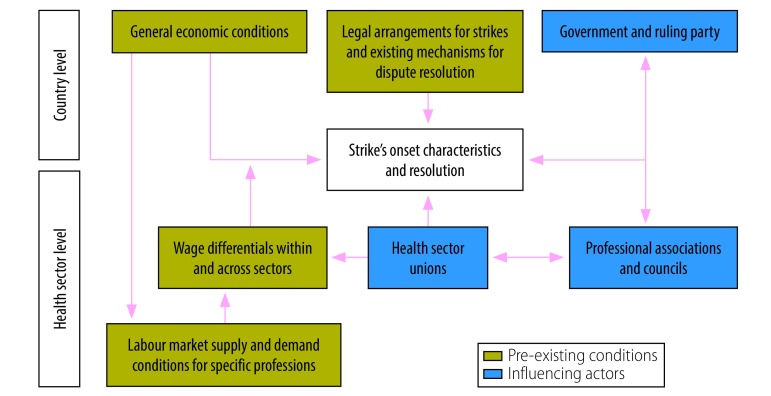
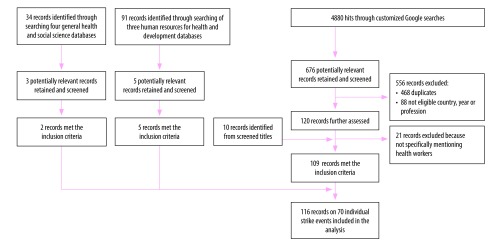
We reviewed the published and grey literature from online sources for the years 2009 to 2018. We used four search strategies: (i) exploration of main health and social sciences databases; (ii) use of specialized websites on human resources for health and development; (iii) customized Google search; and (iv) consultation with experts to validate findings. To analyse individual strike episodes, pre-existing conditions and influencing actors, we developed a conceptual framework from the literature.
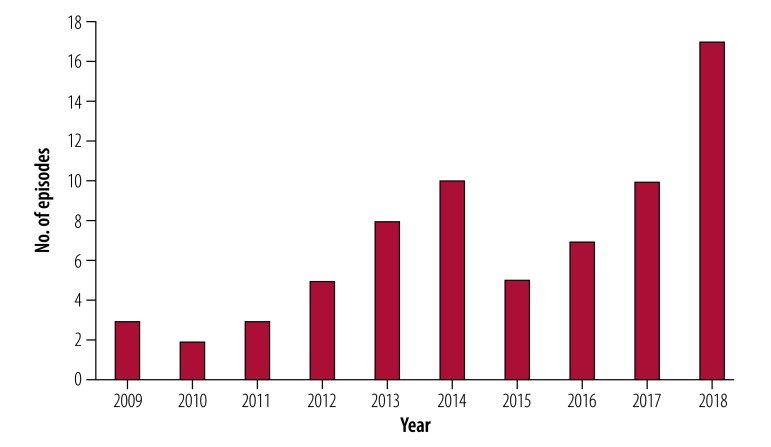
We identified 116 records reporting on 70 unique health workers' strikes in 23 low-income countries during the period, accounting for 875 days of strike. Year 2018 had the highest number of events (17), corresponding to 170 work days lost. Strikes involving more than one professional category was the frequent strike modality (32 events), followed by strikes by physicians only (22 events). The most commonly reported cause was complaints about remuneration (63 events), followed by protest against the sector's governance or policies (25 events) and safety of working conditions (10 events). Positive resolution was achieved more often when collective bargaining institutions and higher levels of government were involved in the negotiations.
In low-income countries, some common features appear to exist in health sector strikes' occurrence and actors involved in such events. Future research should focus on both individual events and regional patterns, to form an evidence base for mechanisms to prevent and resolve strikes.
分析低收入国家卫生工作者罢工的特点、频率、驱动因素、结果和利益相关者。
我们检索了 2009 年至 2018 年出版和灰色文献,使用了四种搜索策略:(i)探索主要的卫生和社会科学数据库;(ii)使用人力资源开发方面的专门网站;(iii)定制谷歌搜索;(iv)咨询专家以验证研究结果。为了分析单个罢工事件、预先存在的条件和影响因素,我们从文献中提出了一个概念框架。
我们确定了 116 份记录,报告了 23 个低收入国家在这一时期发生的 70 起独特的卫生工作者罢工事件,共涉及 875 天的罢工。2018 年发生的事件最多(17 起),对应的罢工天数为 170 天。涉及多个专业类别的罢工是常见的罢工模式(32 起),其次是只有医生参与的罢工(22 起)。最常报告的原因是对薪酬的投诉(63 起),其次是抗议部门治理或政策(25 起)和工作条件安全(10 起)。当涉及集体谈判机构和更高层次的政府参与谈判时,更有可能达成积极的解决方案。
在低收入国家,卫生部门罢工的发生和参与此类事件的利益相关者似乎存在一些共同特征。未来的研究应同时关注个别事件和区域模式,为预防和解决罢工的机制提供证据基础。