Gansterer Margaretha, Hartl Richard F
Department for Business Administration, University of Vienna, Oskar-Morgenstern-Platz 1, 1090 Vienna, Austria.
OR Spectr. 2018;40(3):613-635. doi: 10.1007/s00291-018-0516-4. Epub 2018 Mar 29.
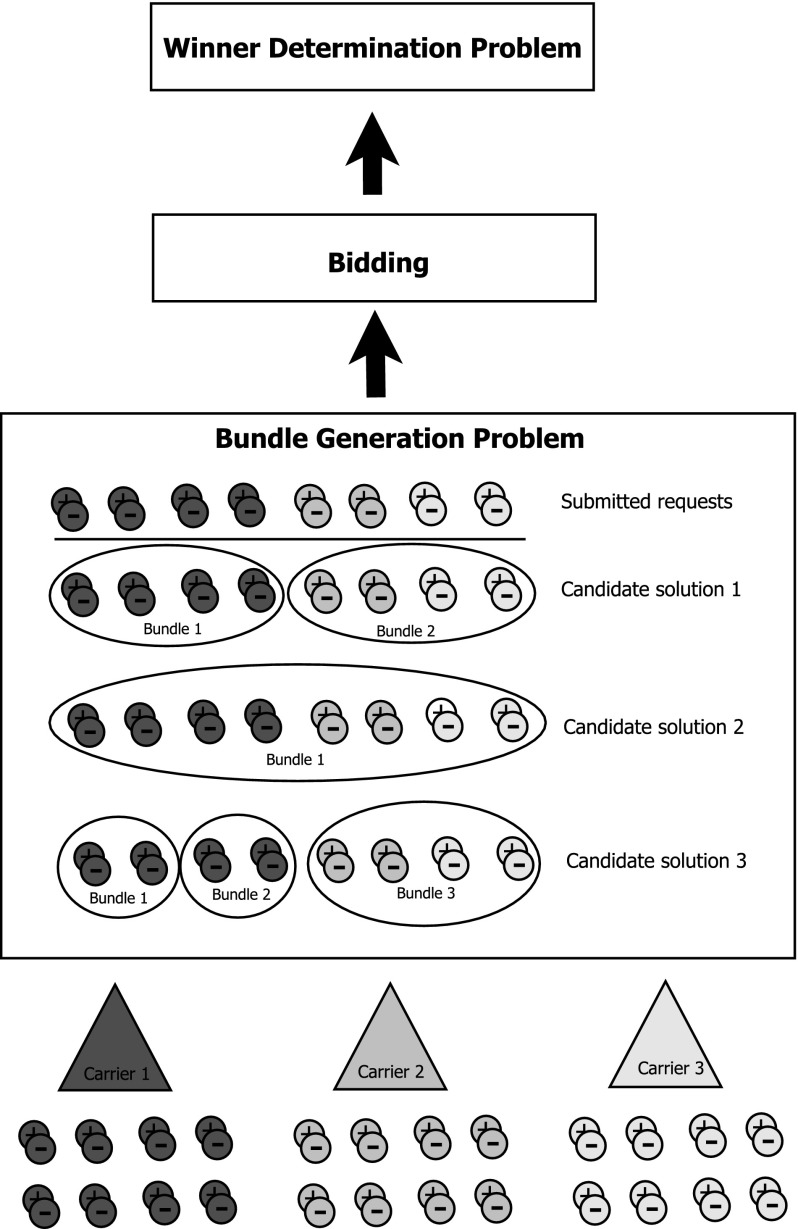
In horizontal collaborations, carriers form coalitions in order to perform parts of their logistics operations jointly. By exchanging transportation requests among each other, they can operate more efficiently and in a more sustainable way. This exchange of requests can be organized through combinatorial auctions, where collaborators submit requests for exchange to a common pool. The requests in the pool are grouped into bundles, and these are offered to participating carriers. From a practical point of view, offering all possible bundles is not manageable, since the number of bundles grows exponentially with the number of traded requests. We show how the complete set of bundles can be efficiently reduced to a subset of attractive ones. For this we define the Bundle Generation Problem (BuGP). The aim is to provide a reduced set of offered bundles that maximizes the total coalition profit, while a feasible assignment of bundles to carriers is guaranteed. The objective function, however, could only be evaluated whether carriers reveal sensitive information, which would be unrealistic. Thus, we develop a proxy for the objective function for assessing the attractiveness of bundles under incomplete information. This is used in a genetic algorithms-based framework that aims at producing attractive and feasible bundles, such that all requirements of the BuGP are met. We achieve very good solution quality, while reducing the computational time for the auction procedure significantly. This is an important step towards running combinatorial auctions of real-world size, which were previously intractable due to their computational complexity. The strengths but also the limitations of the proposed approach are discussed.
在横向合作中,运输公司结成联盟以便共同开展部分物流业务。通过相互交换运输请求,它们能够更高效且更可持续地运营。这种请求交换可以通过组合拍卖来组织,即合作伙伴将交换请求提交到一个公共池中。池中的请求被组合成捆绑包,然后提供给参与的运输公司。从实际角度来看,提供所有可能的捆绑包是不可行的,因为捆绑包的数量会随着交易请求的数量呈指数增长。我们展示了如何将完整的捆绑包集有效地缩减为一组有吸引力的子集。为此,我们定义了捆绑包生成问题(BuGP)。其目的是提供一组精简的捆绑包,在确保为运输公司分配可行捆绑包的同时,使联盟总利润最大化。然而,只有在运输公司披露敏感信息的情况下才能评估目标函数,而这是不现实的。因此,我们开发了一个目标函数的代理,用于在信息不完整的情况下评估捆绑包的吸引力。这被用于一个基于遗传算法的框架中,该框架旨在生成有吸引力且可行的捆绑包,从而满足BuGP的所有要求。我们在显著减少拍卖程序计算时间的同时,实现了非常好的求解质量。这是朝着运行实际规模的组合拍卖迈出的重要一步,这类拍卖由于计算复杂性,以前是难以处理的。本文还讨论了所提方法的优点和局限性。