Aoyama Toru, Yoshikawa Takaki, Maezawa Yukio, Kano Kazuki, Numata Masakatsu, Hara Kentaro, Komori Keisuke, Yamada Takanobu, Hayashi Tsutomu, Sato Tsutomu, Tamagawa Hiroshi, Yukawa Norio, Rino Yasushi, Masuda Munetaka, Ogata Takashi, Cho Haruhiko, Oshima Takashi
Department of Gastrointestinal Surgery, Kanagawa Cancer Center, Yokohama, Japan.
Department of Surgery, Yokohama City University, Yokohama, Japan.
J Cancer. 2019 May 28;10(11):2450-2456. doi: 10.7150/jca.30697. eCollection 2019.
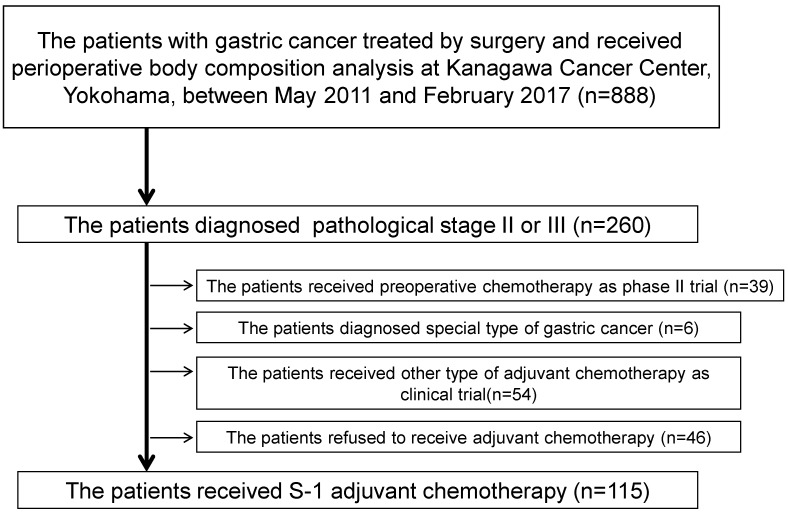
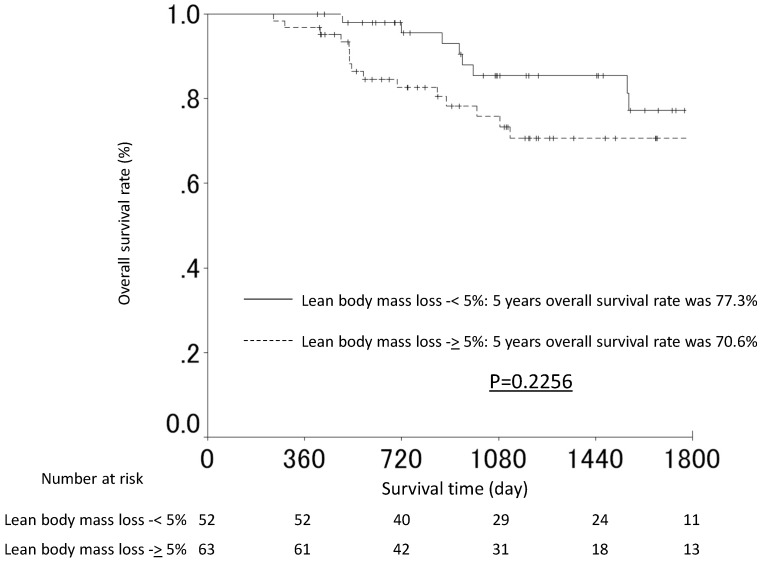
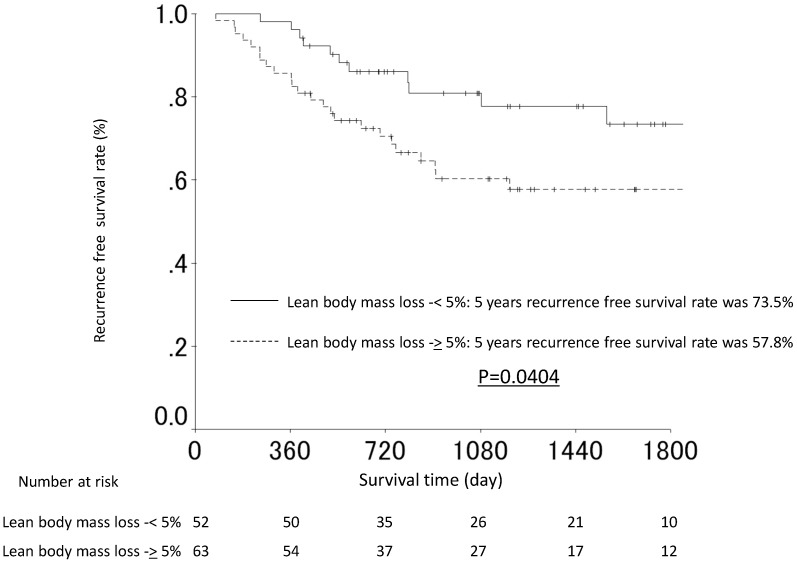
: We previously demonstrated that a loss of lean body mass loss at one month after gastrectomy was an independent risk factor for the continuation of adjuvant chemotherapy with S-1. However, it is unclear whether or not lean body mass loss after gastrectomy leads to a poor survival through poor compliance to adjuvant chemotherapy with S-1. : The recurrence free survival (RFS) overall survival (OS) and were examined in 115 patients who underwent curative gastrectomy and were pathologically diagnosed with stage II or III gastric cancer and who received postoperative adjuvant chemotherapy with S-1 between May 2011 and September 2016. : The median follow-up period was 40.6 months. The RFS rates at 5 years after surgery were 57.8% in the lean body mass loss ≥5% group and 73.5% in the lean body mass loss <5% group. The univariate and multivariate analyses for the disease free survival (RFS) demonstrated that a lean body mass loss >5% was a significant risk factor. The OS rates at 5 years after surgery were 72.0% in the lean body mass loss ≥5% group and 77.3% in the lean body mass loss <5% group. The OS was slightly worse in the lean body mass loss ≥5% group than in the lean body mass loss <5% group (p=0.2062). : The lean body mass loss at one month, which is closely associated with poor S-1 compliance, was an important risk factor for the RFS. A prospective cohort study is necessary to confirm whether or not the lean body mass loss affects the gastric cancer survival.
我们之前证明,胃切除术后1个月瘦体重的减少是继续使用S-1进行辅助化疗的独立危险因素。然而,胃切除术后瘦体重的减少是否会因对S-1辅助化疗的依从性差而导致生存率降低尚不清楚。
对2011年5月至2016年9月期间接受根治性胃切除术、病理诊断为II期或III期胃癌并接受S-1术后辅助化疗的115例患者进行了无复发生存期(RFS)和总生存期(OS)的研究。
中位随访期为40.6个月。术后5年,瘦体重减少≥5%组的RFS率为57.8%,瘦体重减少<5%组的RFS率为73.5%。无病生存期(RFS)的单因素和多因素分析表明,瘦体重减少>5%是一个显著的危险因素。术后5年,瘦体重减少≥5%组的OS率为72.0%,瘦体重减少<5%组的OS率为77.3%。瘦体重减少≥5%组的OS略低于瘦体重减少<5%组(p=0.2062)。
与S-1依从性差密切相关的术后1个月瘦体重减少是RFS的一个重要危险因素。有必要进行一项前瞻性队列研究,以确认瘦体重减少是否会影响胃癌的生存率。