Department of Electrical Engineering, Stanford University, 350 Serra Mall, Stanford, CA 94305, USA.
Sci Adv. 2019 Jun 28;5(6):eaav6187. doi: 10.1126/sciadv.aav6187. eCollection 2019 Jun.
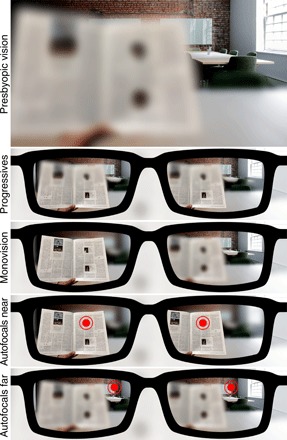
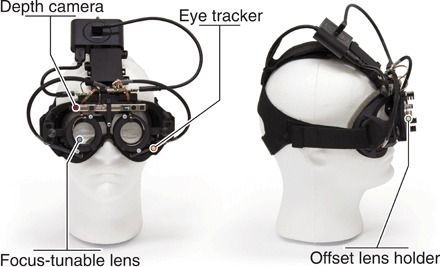
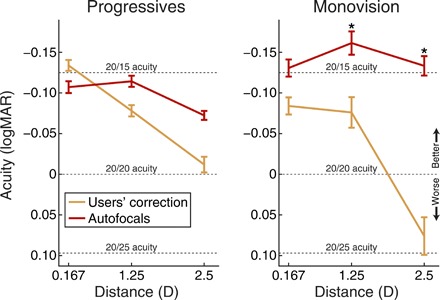
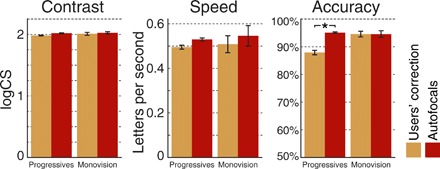
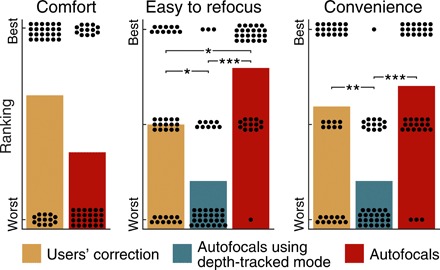
As humans age, they gradually lose the ability to accommodate, or refocus, to near distances because of the stiffening of the crystalline lens. This condition, known as presbyopia, affects nearly 20% of people worldwide. We design and build a new presbyopia correction, autofocals, to externally mimic the natural accommodation response, combining eye tracker and depth sensor data to automatically drive focus-tunable lenses. We evaluated 19 users on visual acuity, contrast sensitivity, and a refocusing task. Autofocals exhibit better visual acuity when compared to monovision and progressive lenses while maintaining similar contrast sensitivity. On the refocusing task, autofocals are faster and, compared to progressives, also significantly more accurate. In a separate study, a majority of 23 of 37 users ranked autofocals as the best correction in terms of ease of refocusing. Our work demonstrates the superiority of autofocals over current forms of presbyopia correction and could affect the lives of millions.
随着年龄的增长,人类逐渐失去调节(accommodate)或重新聚焦(refocus)到近距离的能力,这是由于晶状体变硬所致。这种情况被称为老花眼(presbyopia),影响着全球近 20%的人。我们设计并制造了一种新的老花眼矫正(presbyopia correction)设备,自动调焦(autofocals),以外部模拟(mimic)自然调节反应,结合眼动追踪(eye tracker)和深度传感器(depth sensor)数据,自动驱动(drive)可调节焦点的镜片。我们评估了 19 名用户的视力(visual acuity)、对比敏感度(contrast sensitivity)和重新聚焦任务(refocusing task)。与单视(monovision)和渐进镜片(progressive lenses)相比,自动调焦设备的视力更好,同时保持相似的对比敏感度。在重新聚焦任务中,自动调焦设备更快,并且与渐进镜片相比,也更准确。在另一项研究中,37 名用户中有 23 名大多数人认为自动调焦设备在重新聚焦方面是最好的矫正方式。我们的工作表明自动调焦设备优于现有的老花眼矫正方式,可能会影响数百万人的生活。