Revon-Rivière Gabriel, Banavali Shripad, Heississen Laila, Gomez Garcia Wendy, Abdolkarimi Babak, Vaithilingum Manickavallie, Li Chi-Kong, Leung Ping Chung, Malik Prabhat, Pasquier Eddy, Epelman Sidnei, Chantada Guillermo, André Nicolas
Assistance Publique-Hôpitaux de Marseille, La Timone Hospital, Marseille, France.
Metronomics Global Health Initiative, Marseille, France.
J Glob Oncol. 2019 Jul;5:1-8. doi: 10.1200/JGO.18.00244.
Low- and middle-income countries (LMICs) experience the burden of 80% of new childhood cancer cases worldwide, with cure rates as low as 10% in some countries. Metronomics combines frequent administrations of low-dose chemotherapy with drug repurposing, which consists of using already-approved drugs for new medical applications. With wide availability, limited costs, and little infrastructure needs, metronomics can be part of constraint-adapted regimens in these resource-limited settings-with the understanding that metronomics shall not be a substitute for standard treatments when available and doable. Our study aims to describe the experience, practices, opinions, and needs in metronomics of physicians working in LMICs.
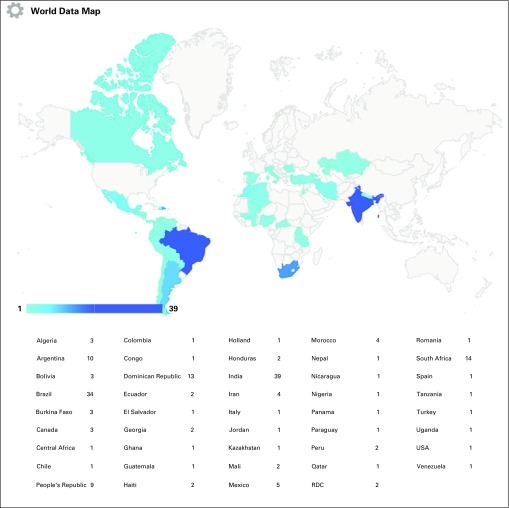
An online questionnaire was sent to more than 1,200 physicians in pediatric oncology networks in LMICs. Items included the type of center, physician's demographics, experience in pediatric oncology, and experience with current knowledge of metronomics. Opinions and perspectives were explored using multiple-answer and open questions.
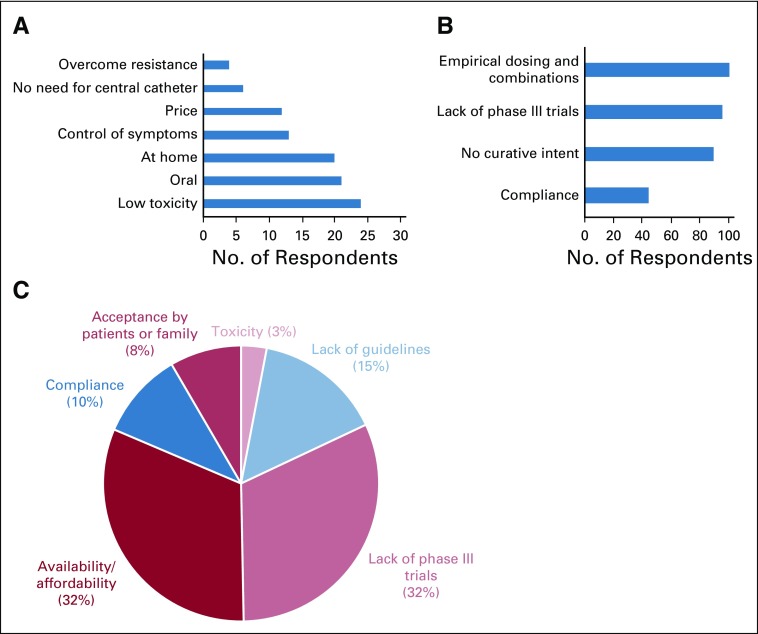
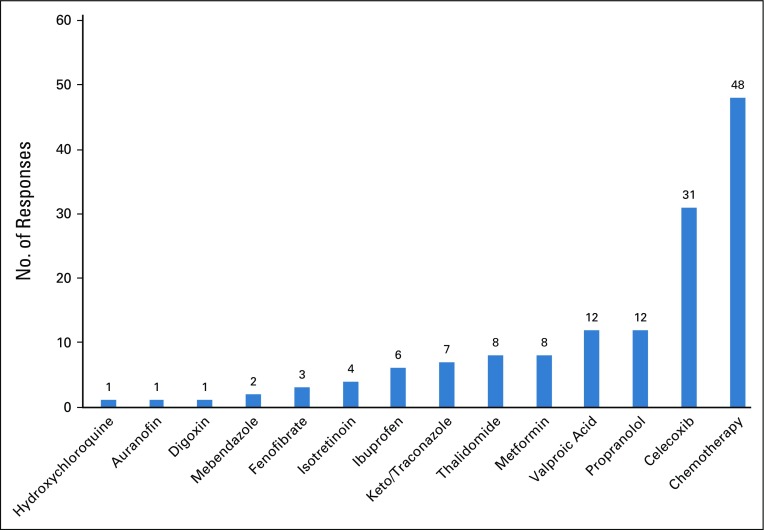
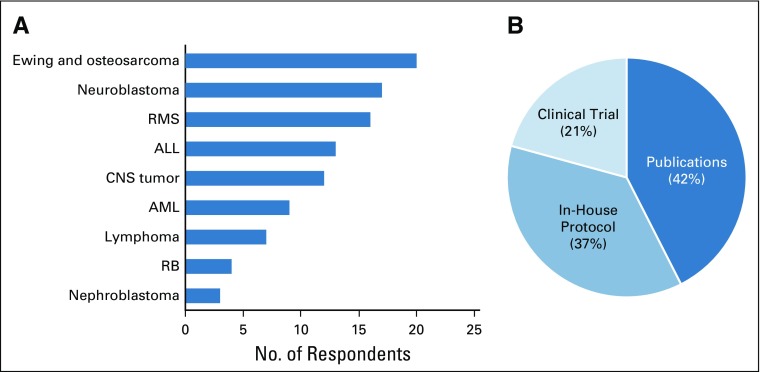
Of physicians, 17% responded. Of respondents, 54.9% declared that they had already used a metronomic regimen. The most frequently cited repositioned drugs were celecoxib (44%) followed by propranolol and valproic acid (17%). Respondents highlighted the advantages of outpatient use (20%) and expected low toxicity (24%). In considering the drawbacks of metronomics, 47% of responses highlighted the lack of scientific evidence or guidelines, 33% the availability or affordability of drugs, and 18% the problem of acceptance or compliance. Of physicians, 79% believed that use of metronomics will spread in LMICs in the near future and 98% of them were willing to participate in international metronomic protocols or registries.
Metronomics is already used in LMICs and is a potential answer to unmet needs in pediatric oncology. There is room for improvement in the availability of drugs and a necessity to develop collaborative protocols and research to generate level A evidence.
中低收入国家(LMICs)承担着全球80%的儿童新发癌症病例的负担,在一些国家,治愈率低至10%。节拍化疗将低剂量化疗的频繁给药与药物重新利用相结合,即使用已获批准的药物用于新的医学用途。由于其广泛可得、成本有限且对基础设施需求少,节拍化疗可以成为这些资源有限环境中适应限制条件的治疗方案的一部分——但要明白,在有标准治疗且可行时,节拍化疗不应替代标准治疗。我们的研究旨在描述中低收入国家从事儿科肿瘤工作的医生在节拍化疗方面的经验、做法、意见和需求。
向中低收入国家儿科肿瘤网络中的1200多名医生发送了一份在线问卷。问题包括中心类型、医生的人口统计学信息、儿科肿瘤学经验以及当前节拍化疗知识的经验。通过多项选择题和开放式问题探索意见和观点。
17%的医生回复。在回复者中,54.9%宣称他们已经使用过节拍化疗方案。最常被提及的重新利用的药物是塞来昔布(44%),其次是普萘洛尔和丙戊酸(17%)。回复者强调了门诊使用的优点(20%)和预期的低毒性(24%)。在考虑节拍化疗的缺点时,47%的回复强调缺乏科学证据或指南,33%强调药物的可得性或可负担性,18%强调接受度或依从性问题。79%的医生认为节拍化疗在不久的将来会在中低收入国家得到推广,其中98%愿意参与国际节拍化疗方案或登记。
节拍化疗已在中低收入国家使用,是满足儿科肿瘤未满足需求的一个潜在答案。药物的可得性仍有改进空间,有必要制定协作方案和开展研究以产生A级证据。