Department of Internal Medicine, National Taiwan University Hospital, Hsin-Chu Branch, Hsin-Chu, Taiwan.
Department of Internal Medicine, National Taiwan University Hospital, Taipei, Taiwan.
Sci Rep. 2019 Jul 1;9(1):9478. doi: 10.1038/s41598-019-45977-4.
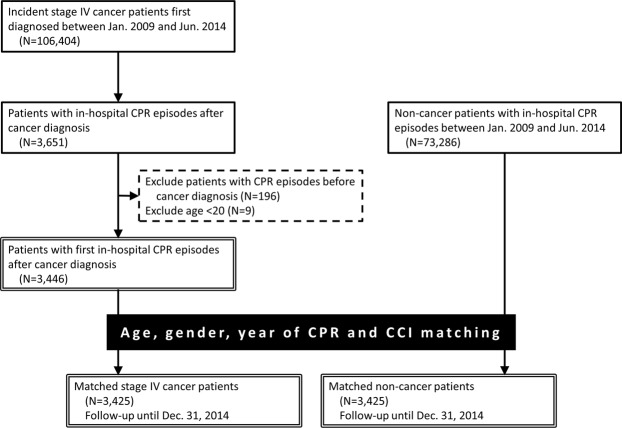
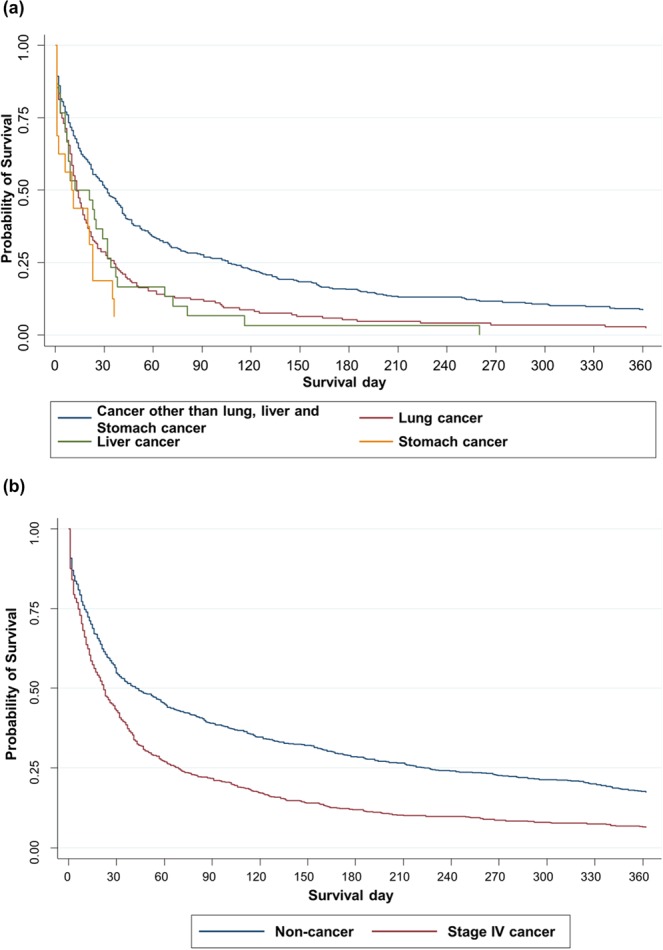
The effects of cardiopulmonary resuscitation (CPR) on patients with advanced cancer remain to be elucidated. We identified a cohort of patients with stage-IV cancer who received in-hospital CPR from the Taiwan Cancer Registry and National Health Insurance claims database, along with a matched cohort without cancer who also received in-hospital CPR. The main outcomes were post-discharge survival and in-hospital mortality. In total, 3,446 stage-IV cancer patients who underwent in-hospital CPR after cancer diagnosis were identified during January 2009-June 2014. A vast majority of the patients did not survive to discharge (n = 2,854, 82.8%). The median post-discharge survival was 22 days; 10.1% (n = 60; 1.7% of all patients) of the hospital survivors received anticancer therapy after discharge. We created 1:1 age-, sex-, Charlson comorbidity index (CCI)-, and year of CPR-matched noncancer and stage-IV cancer cohorts (n = 3,425 in both; in-hospital mortality rate = 82.1% and 82.8%, respectively). Regression analysis showed that the stage-IV cancer cohort had shorter post-discharge survival than did the noncancer cohort. The outcome of patients with advanced cancer was poor. Even among the survivors, post-discharge survival was short, with only few patients receiving further anticancer therapy.
心肺复苏术(CPR)对晚期癌症患者的影响仍有待阐明。我们从台湾癌症登记处和全民健康保险理赔数据库中确定了一组在医院接受 CPR 的 IV 期癌症患者,以及一组没有癌症但也在医院接受 CPR 的匹配队列。主要结果是出院后生存和院内死亡率。总共确定了 3446 名在癌症诊断后接受院内 CPR 的 IV 期癌症患者,这些患者在 2009 年 1 月至 2014 年 6 月期间接受了治疗。绝大多数患者未存活至出院(n=2854,82.8%)。出院后的中位生存时间为 22 天;出院后有 10.1%(n=60;占所有患者的 1.7%)的医院幸存者接受了抗癌治疗。我们创建了 1:1 的年龄、性别、Charlson 合并症指数(CCI)和 CPR 匹配的非癌症和 IV 期癌症队列(每组 n=3425;院内死亡率分别为 82.1%和 82.8%)。回归分析表明,IV 期癌症队列的出院后生存时间短于非癌症队列。晚期癌症患者的预后较差。即使在幸存者中,出院后的生存时间也很短,只有少数患者接受了进一步的抗癌治疗。