Ausma Ties, De Kok Luit J
Laboratory of Plant Physiology, Groningen Institute for Evolutionary Life Sciences, University of Groningen, Groningen, Netherlands.
Front Plant Sci. 2019 Jun 11;10:743. doi: 10.3389/fpls.2019.00743. eCollection 2019.
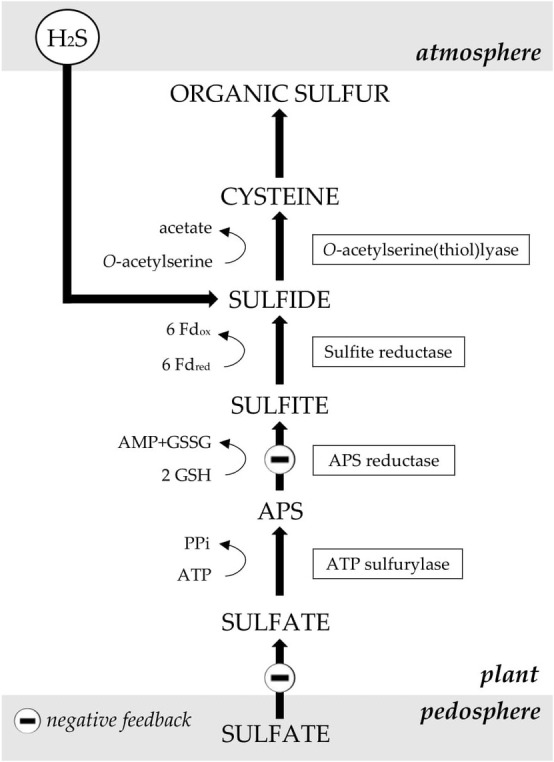
Hydrogen sulfide (HS) is an air pollutant present at high levels in various regions. Plants actively take up HS via the foliage, though the impact of the gas on the physiological functioning of plants is paradoxical. Whereas elevated HS levels may be phytotoxic, HS levels realistic for polluted areas can also significantly contribute to the sulfur requirement of the vegetation. Plants can even grow with HS as sole sulfur source. There is no relation between the rate of HS metabolism and the HS susceptibility of a plant, which suggests that the metabolism of HS does not contribute to the detoxification of absorbed sulfide. By contrast, there may be a strong relation between the rate of HS metabolism and the rate of sulfate metabolism: foliar HS absorbance may downregulate the metabolism of sulfate, taken up by the root. Studies with plants from the genus clarified the background of this downregulation. Simultaneously, these studies illustrated that HS fumigation may be a useful tool for obtaining insight in the regulation of sulfur homeostasis and the (signal) functions of sulfur-containing compounds in plants.
硫化氢(HS)是一种在各个地区都大量存在的空气污染物。植物通过叶片积极吸收HS,尽管这种气体对植物生理功能的影响是矛盾的。虽然较高的HS水平可能具有植物毒性,但污染地区实际存在的HS水平也能显著满足植被对硫的需求。植物甚至可以以HS作为唯一的硫源生长。植物HS代谢速率与对HS的敏感性之间没有关联,这表明HS的代谢对吸收的硫化物解毒没有作用。相比之下,HS代谢速率与硫酸盐代谢速率之间可能存在密切关系:叶片对HS的吸收可能会下调根系吸收的硫酸盐的代谢。对该属植物的研究阐明了这种下调的背景。同时,这些研究表明,HS熏蒸可能是深入了解植物硫稳态调节以及含硫化合物(信号)功能的有用工具。