Department of Biological Sciences, Fort Hays State University, Hays, KS, 67601-4099, USA.
Department of Biological Sciences, Fort Hays State University, Hays, KS, 67601-4099, USA.
Plant Physiol Biochem. 2015 Mar;88:36-41. doi: 10.1016/j.plaphy.2015.01.007. Epub 2015 Jan 23.
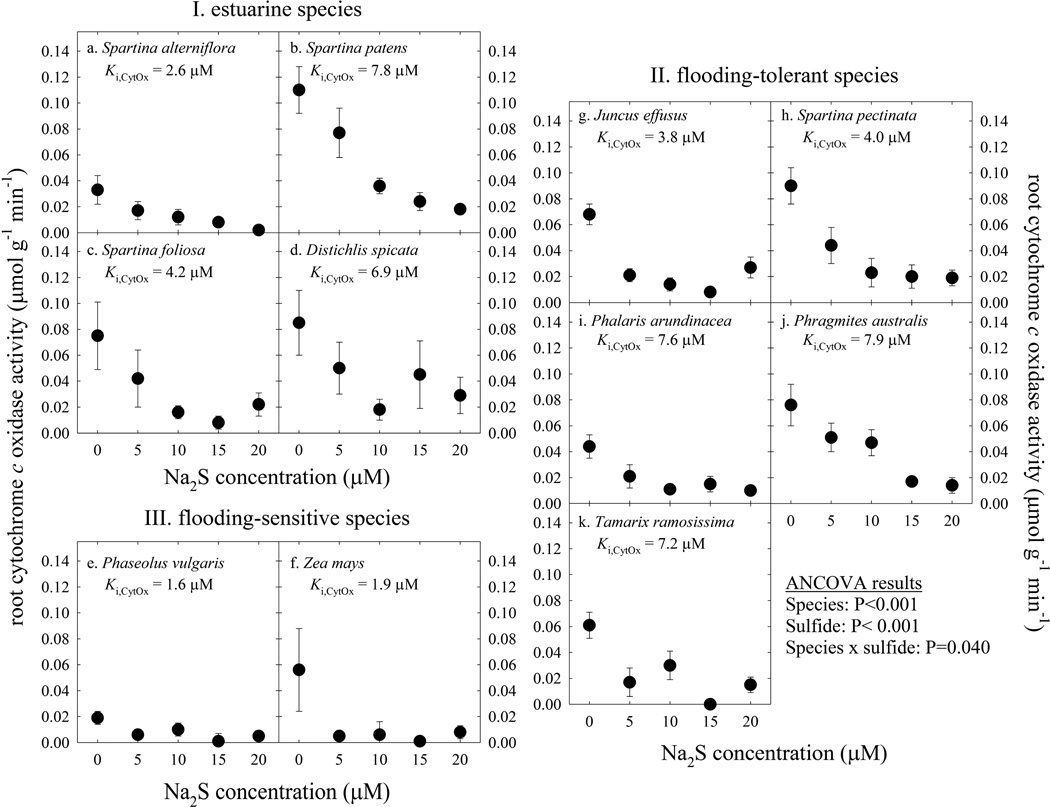
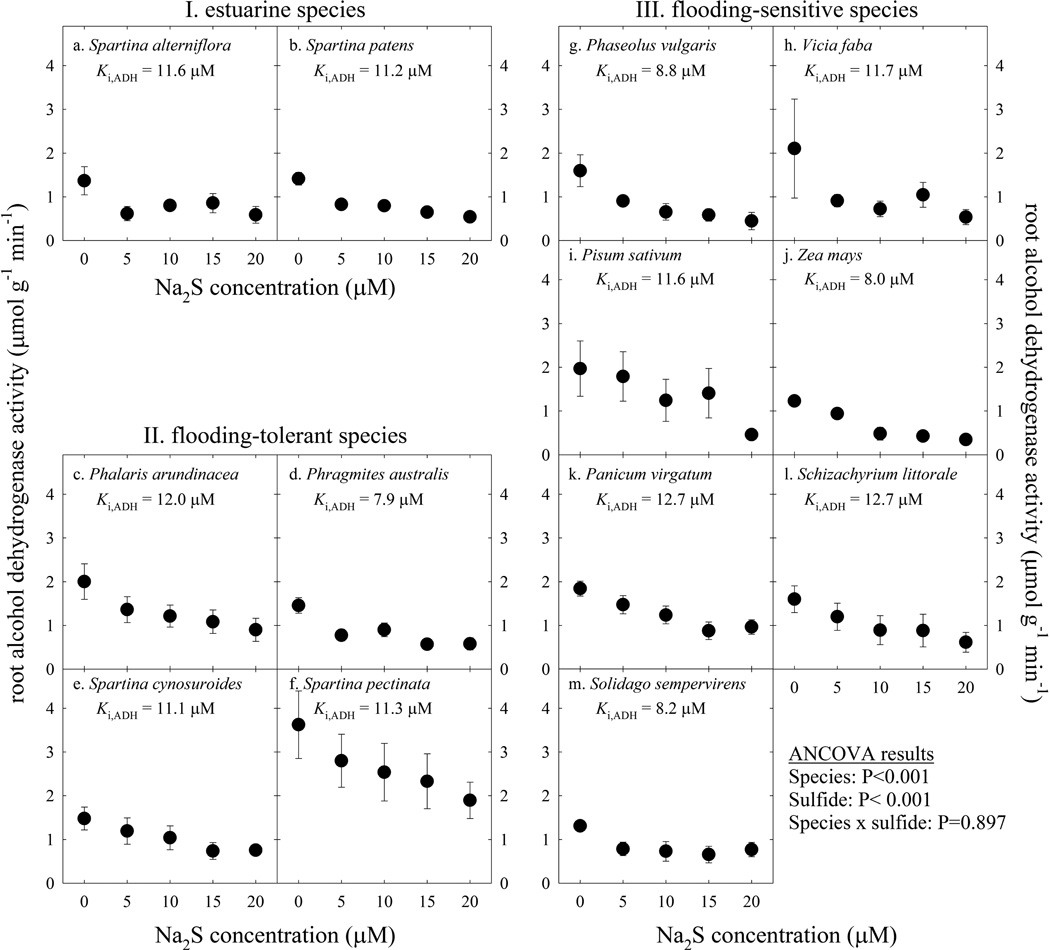
Toxic effects of sulfide come from a poisoning of a number of enzymes, especially cytochrome c oxidase, which catalyzes the terminal step in mitochondrial aerobic respiration. Despite this, some estuarine plants live in sulfide-rich sediments. We hypothesized estuarine and flooding-tolerant species might be more tolerant of sulfide compared to upland species, and this was tested by measures of root cytochrome c oxidase and alcohol dehydrogenase activities in extracts exposed to sulfide. Enzyme activities were measured in 0, 5, 10, 15, and 20 μM sodium sulfide, and compared among 17 species of plants. Activities of alcohol dehydrogenase and cytochrome c oxidase were both reduced by increasing sulfide concentration, but cytochrome c oxidase was more sensitive to sulfide compared to alcohol dehydrogenase. Activities of cytochrome c oxidase were reduced to near zero at 5-10 μM sulfide whereas alcohol dehydrogenase activities were only reduced by about 50% at 10 μM sulfide. All species were sensitive to increasing sulfide, but to different degrees. Cytochrome c oxidase in flooding-sensitive species was decreased to near zero activity at 5 μM sulfide, whereas activities in some flooding-tolerant species were still detectable until 15 μM sulfide. Cytochrome c oxidase activities in some estuarine species were low even in the absence of sulfide, perhaps an adaptation to avoid sulfide vulnerability in their native, sulfide-rich habitat. This illustrates the potent metabolic effects of sulfide, and this is the first demonstration of varying sensitivities of cytochrome c oxidase to sulfide across organisms, making these data of novel importance.
硫化物的毒性作用来自于对许多酶的毒害,尤其是细胞色素 c 氧化酶,它催化线粒体需氧呼吸的最后一步。尽管如此,一些河口植物仍生活在富含硫化物的沉积物中。我们假设与旱地物种相比,河口和耐淹物种可能对硫化物更具耐受性,这通过暴露于硫化物的提取物中根细胞色素 c 氧化酶和醇脱氢酶活性的测量来检验。在 0、5、10、15 和 20 μM 硫化钠中测量了酶活性,并在 17 种植物中进行了比较。醇脱氢酶和细胞色素 c 氧化酶的活性都随着硫化物浓度的增加而降低,但与醇脱氢酶相比,细胞色素 c 氧化酶对硫化物更敏感。细胞色素 c 氧化酶的活性在 5-10 μM 硫化物时降至接近零,而醇脱氢酶的活性在 10 μM 硫化物时仅降低约 50%。所有物种对硫化物的增加都很敏感,但敏感程度不同。在 5 μM 硫化物时,耐淹物种的细胞色素 c 氧化酶活性降至接近零,而一些耐淹物种的活性在 15 μM 硫化物时仍可检测到。一些河口物种的细胞色素 c 氧化酶活性即使在没有硫化物的情况下也很低,这也许是它们在原生的富含硫化物的栖息地中避免硫化物脆弱性的一种适应。这说明了硫化物的强大代谢作用,并且首次证明了细胞色素 c 氧化酶对硫化物的敏感性在不同生物体之间存在差异,这些数据具有新颖的重要性。