
大肠杆菌丝氨酸化学感受器在不同信号状态下的构象变化。
Conformational Changes of the Escherichia coli Serine Chemoreceptor in Different Signaling States.
机构信息
Institute of Biology, Leiden University, Leiden, The Netherlands.
Department of Biochemistry, University of Oxford, Oxford, United Kingdom.
出版信息
mBio. 2019 Jul 2;10(4):e00973-19. doi: 10.1128/mBio.00973-19.
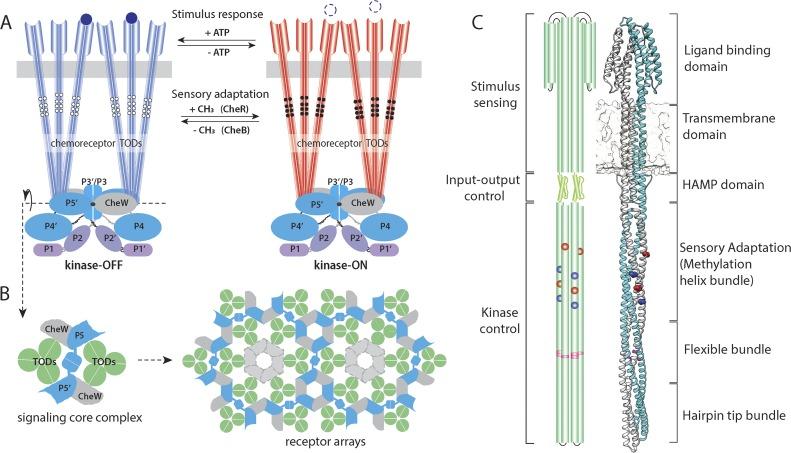
Tsr, the serine chemoreceptor in , transduces signals from a periplasmic ligand-binding site to its cytoplasmic tip, where it controls the activity of the CheA kinase. To function, Tsr forms trimers of homodimers (TODs), which associate with the CheA kinase and CheW coupling protein. Together, these proteins assemble into extended hexagonal arrays. Here, we use cryo-electron tomography and molecular dynamics simulation to study Tsr in the context of a near-native array, characterizing its signaling-related conformational changes at both the individual dimer and the trimer level. In particular, we show that individual Tsr dimers within a trimer exhibit asymmetric flexibilities that are a function of the signaling state, highlighting the effect of their different protein interactions at the receptor tips. We further reveal that the dimer compactness of the Tsr trimer changes between signaling states, transitioning at the glycine hinge from a compact conformation in the kinase-OFF state to an expanded conformation in the kinase-ON state. Hence, our results support a crucial role for the glycine hinge: to allow the receptor flexibility necessary to achieve different signaling states while also maintaining structural constraints imposed by the membrane and extended array architecture. In , membrane-bound chemoreceptors, the histidine kinase CheA, and coupling protein CheW form highly ordered chemosensory arrays. In core signaling complexes, chemoreceptor trimers of dimers undergo conformational changes, induced by ligand binding and sensory adaptation, which regulate kinase activation. Here, we characterize by cryo-electron tomography the kinase-ON and kinase-OFF conformations of the serine receptor in its native array context. We found distinctive structural differences between the members of a receptor trimer, which contact different partners in the signaling unit, and structural differences between the ON and OFF signaling complexes. Our results provide new insights into the signaling mechanism of chemoreceptor arrays and suggest an important functional role for a previously postulated flexible region and glycine hinge in the receptor molecule.
Tsr 是 中的丝氨酸化学感受器,它将信号从周质配体结合位点传递到其细胞质顶端,在那里它控制 CheA 激酶的活性。为了发挥作用,Tsr 形成同源二聚体的三聚体(TODs),与 CheA 激酶和 CheW 偶联蛋白结合。这些蛋白质一起组装成扩展的六边形阵列。在这里,我们使用低温电子断层扫描和分子动力学模拟研究 Tsr 在近天然阵列中的情况,在单体二聚体和三聚体水平上表征其与信号相关的构象变化。特别是,我们表明三聚体中二聚体的不对称柔韧性是信号状态的函数,突出了它们在受体尖端的不同蛋白质相互作用的影响。我们进一步表明,Tsr 三聚体的二聚体紧凑性在信号状态之间发生变化,在甘氨酸铰链处从激酶关闭状态的紧凑构象转变为激酶打开状态的扩展构象。因此,我们的结果支持甘氨酸铰链的关键作用:允许受体在实现不同信号状态时具有必要的柔韧性,同时保持由膜和扩展阵列结构施加的结构约束。在 中,组氨酸激酶 CheA 和偶联蛋白 CheW 形成高度有序的化学感受器阵列。在核心信号复合物中,配体结合和感官适应诱导的化学感受器三聚体的二聚体构象发生变化,从而调节激酶的激活。在这里,我们通过低温电子断层扫描对其天然阵列环境中的 丝氨酸受体的激酶打开和激酶关闭构象进行了表征。我们发现三聚体中二聚体成员之间存在独特的结构差异,这些成员与信号单元中的不同伙伴接触,并且在 ON 和 OFF 信号复合物之间存在结构差异。我们的结果为化学感受器阵列的信号机制提供了新的见解,并表明受体分子中先前假定的柔性区域和甘氨酸铰链具有重要的功能作用。



 Zotero 插件