Department of Kinesiology, Recreation, and Sport Studies, The University of Tennessee, Knoxville, TN 37996, USA.
Department of Kinesiology, University of Wisconsin-Milwaukee, Milwaukee, WI 53211, USA.
Appl Physiol Nutr Metab. 2020 Feb;45(2):161-168. doi: 10.1139/apnm-2019-0129. Epub 2019 Jul 3.
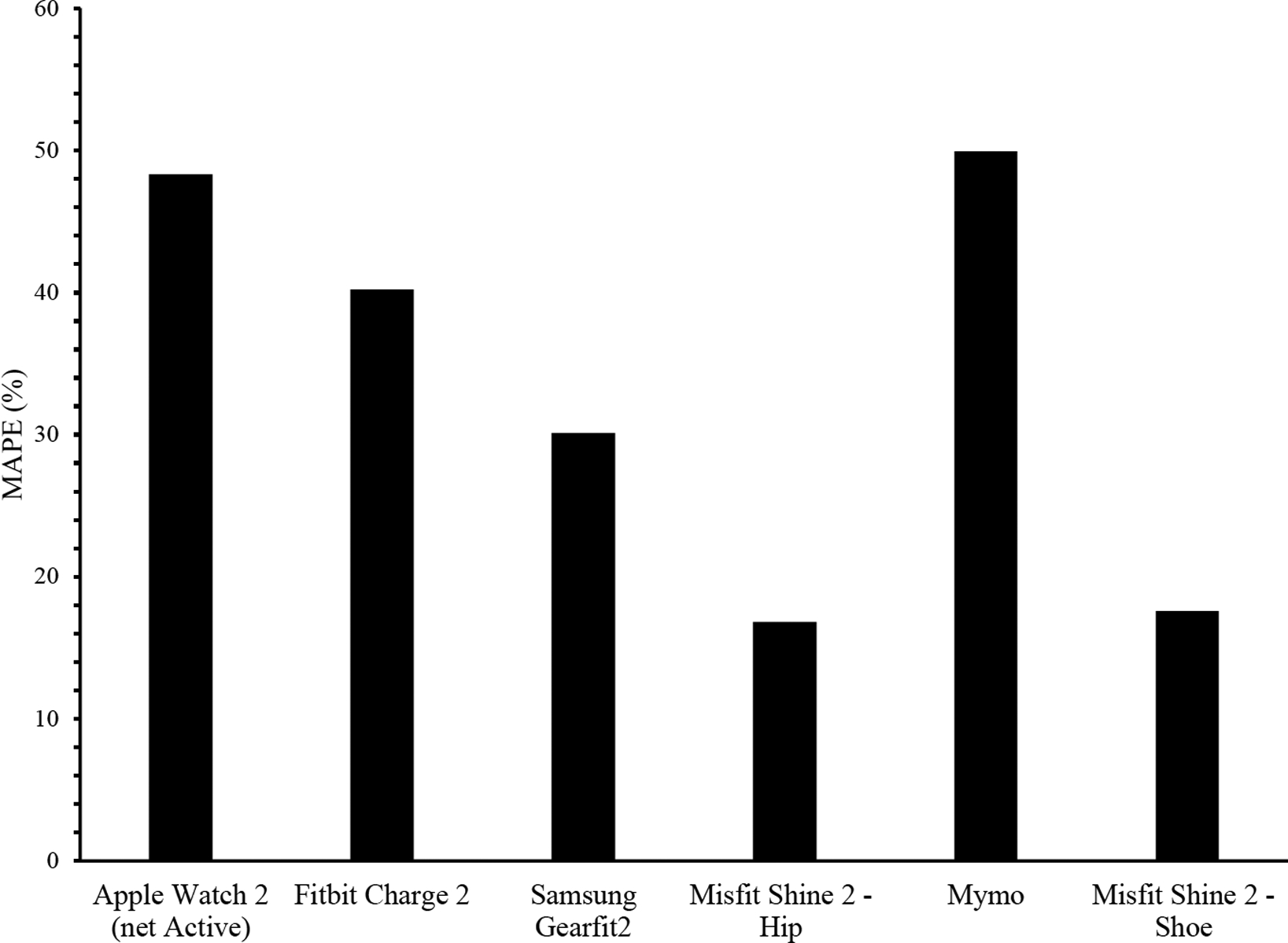
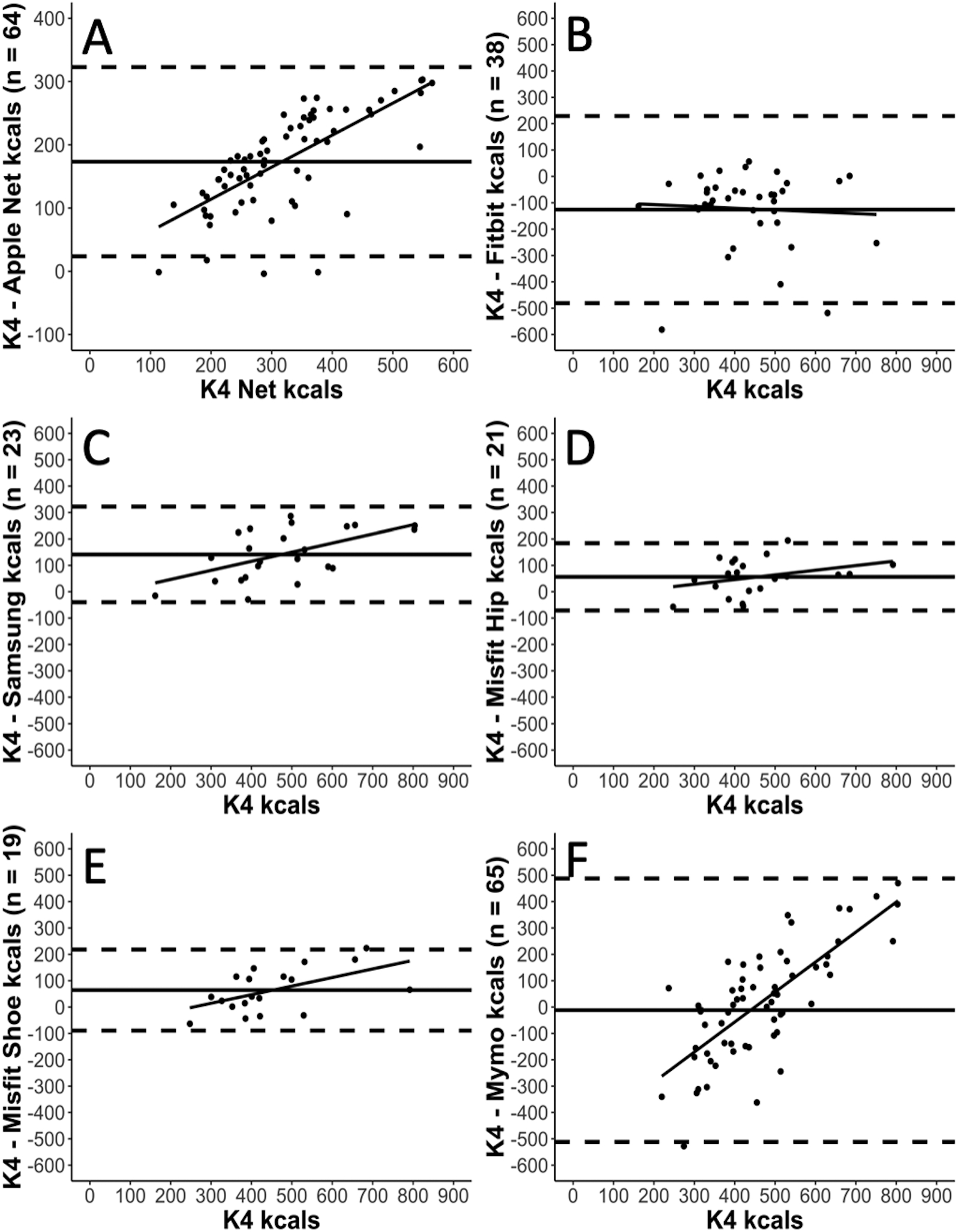
The purpose of this study was to compare energy expenditure (EE) estimates from 5 consumer physical activity monitors (PAMs) to indirect calorimetry in a sample of youth. Eighty-nine youth (mean (SD); age, 12.3 (3.4) years; 50% female) performed 16 semi-structured activities. Activities were performed in duplicate across 2 visits. Participants wore a Cosmed K4b (criterion for EE), an Apple Watch 2 (left wrist), Mymo Tracker (right hip), and Misfit Shine 2 devices (right hip; right shoe). Participants were randomized to wear a Samsung Gear Fit 2 or a Fitbit Charge 2 on the right wrist. Oxygen consumption was converted to EE by subtracting estimated basal EE (Schofield's equation) from the measured gross EE. EE from each visit was summed across the 2 visit days for comparison with the total EE recorded from the PAMs. All consumer PAMs estimated gross EE, except for the Apple Watch 2 (net Active EE). Paired tests were used to assess differences between estimated (PAM) and measured (K4b) EE. Mean absolute percent error (MAPE) was used to assess individual-level error. The Mymo Tracker was not significantly different from measured EE and was within 15.9 kcal of measured kilocalories ( = 0.764). Mean percent errors ranged from 3.5% (Mymo Tracker) to 48.2% (Apple Watch 2). MAPE ranged from 16.8% (Misfit Shine 2 - right hip) to 49.9% (Mymo Tracker). Only the Mymo Tracker was not significantly different from measured EE but had the greatest individual error. The Misfit Shine 2 - right hip had the lowest individual error. Caution is warranted when using consumer PAMs in youth for tracking EE.
本研究旨在比较 5 种消费者体能活动监测器(PAMs)与间接测热法在青少年群体中的能量消耗(EE)估计值。89 名青少年(平均(标准差);年龄,12.3(3.4)岁;50%为女性)进行了 16 项半结构化活动。两次就诊时重复进行活动。参与者佩戴 Cosmed K4b(EE 测定的标准)、Apple Watch 2(左手腕)、Mymo Tracker(右髋部)和 Misfit Shine 2 设备(右髋部;右鞋)。参与者随机佩戴三星 Gear Fit 2 或 Fitbit Charge 2 在右手腕上。通过从测量的总 EE 中减去估计的基础 EE(Schofield 方程)来将耗氧量转换为 EE。将两次就诊日的 EE 相加,与从 PAMs 记录的总 EE 进行比较。除了 Apple Watch 2(净主动 EE)之外,所有消费者 PAMs 均估计了总 EE。使用配对 t 检验评估估计值(PAM)和测量值(K4b)之间的差异。平均绝对百分比误差(MAPE)用于评估个体水平的误差。Mymo Tracker 与测量 EE 无显著差异,与测量千卡相差 15.9 kcal(=0.764)。平均百分比误差范围为 3.5%(Mymo Tracker)至 48.2%(Apple Watch 2)。MAPE 范围为 16.8%(Misfit Shine 2-右髋部)至 49.9%(Mymo Tracker)。仅 Mymo Tracker 与测量 EE 无显著差异,但个体误差最大。Misfit Shine 2-右髋部的个体误差最小。在青少年中使用消费者 PAMs 追踪 EE 时需要谨慎。