Zsikó Stella, Cutcher Kendra, Kovács Anita, Budai-Szűcs Mária, Gácsi Attila, Baki Gabriella, Csányi Erzsébet, Berkó Szilvia
Institute of Pharmaceutical Technology and Regulatory Affairs, Faculty of Pharmacy, University of Szeged, 6720 Szeged, Hungary.
Frederic and Mary Wolfe Center, College of Pharmacy and Pharmaceutical Sciences, University of Toledo, Toledo, OH 43614, USA.
Pharmaceutics. 2019 Jul 2;11(7):310. doi: 10.3390/pharmaceutics11070310.
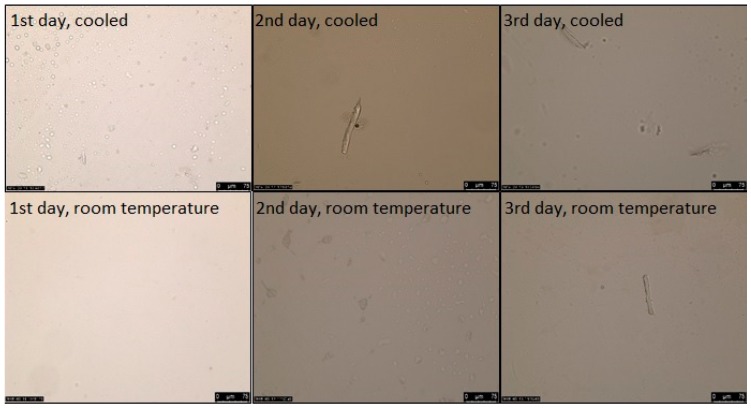
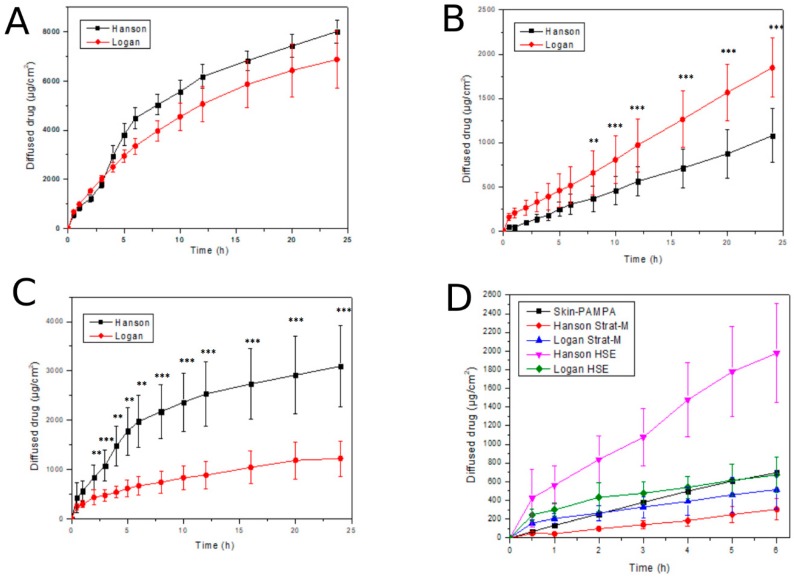
The aim of this research was to investigate the stability of a lidocaine-loaded nanostructured lipid carrier dispersion at different temperatures, formulate a nanostructured lipid carrier gel, and test the penetration profile of lidocaine from the nanostructured lipid carrier gel using different skin penetration modeling methods. The formulations were characterized by laser diffraction, rheological measurements and microscopic examinations. Various in vitro methods were used to study drug release, diffusion and penetration. Two types of vertical Franz diffusion cells with three different membranes, including cellulose, Strat-M, and heat separated human epidermis were used and compared to the Skin-parallel artificial membrane permeability assay (PAMPA) method. Results indicated that the nanostructured lipid carrier dispersion had to be gelified as soon as possible for proper stability. Both the Skin-PAMPA model and Strat-M membranes correlated favorably with heat separated human epidermis in this research, with the Strat-M membranes sharing the most similar drug permeability profile to an ex vivo human skin model. Our experimental findings suggest that even when the best available in vitro experiment is selected for modeling human skin penetration to study nanostructured lipid carrier gel systems, relevant in vitro/in vivo correlation should be made to calculate the drug release/permeation in vivo. Future investigations in this field are still needed to demonstrate the influence of membranes and equipment from other classes on other drug candidates.
本研究的目的是研究载利多卡因纳米结构脂质载体分散体在不同温度下的稳定性,制备纳米结构脂质载体凝胶,并使用不同的皮肤渗透建模方法测试利多卡因从纳米结构脂质载体凝胶中的渗透情况。通过激光衍射、流变学测量和显微镜检查对制剂进行表征。采用多种体外方法研究药物释放、扩散和渗透。使用了两种类型的垂直弗兰兹扩散池,带有三种不同的膜,包括纤维素膜、Strat-M膜和热分离的人表皮,并与皮肤平行人工膜通透性测定(PAMPA)方法进行比较。结果表明,纳米结构脂质载体分散体必须尽快凝胶化以确保适当的稳定性。在本研究中,皮肤-PAMPA模型和Strat-M膜与热分离的人表皮具有良好的相关性,其中Strat-M膜与离体人皮肤模型的药物通透性曲线最为相似。我们的实验结果表明,即使选择最佳的体外实验来模拟人体皮肤渗透以研究纳米结构脂质载体凝胶系统,也应建立相关的体外/体内相关性以计算体内药物释放/渗透情况。该领域未来仍需开展研究,以证明其他类型的膜和设备对其他候选药物的影响。