
帕博利珠单抗治疗经过大量治疗的转移性去势抵抗性前列腺癌男性患者。
Pembrolizumab in men with heavily treated metastatic castrate-resistant prostate cancer.
机构信息
Department of Medicine, School of Medicine, Duke University, Durham, North Carolina.
Department of Radiology, Duke University, Durham, North Carolina.
出版信息
Cancer Med. 2019 Aug;8(10):4644-4655. doi: 10.1002/cam4.2375. Epub 2019 Jul 3.
BACKGROUND
Pembrolizumab is approved for patients with metastatic, microsatellite instability (MSI)-high or mismatch repair-deficient (dMMR) solid tumors. However, very few men with prostate cancer were included in these initial studies.
METHODS
We performed a single institution retrospective review of men with metastatic castrate-resistant prostate cancer (mCRPC) who were treated with pembrolizumab. The primary objective was to describe the clinical efficacy of pembrolizumab associated with patient and genomic characteristics.
RESULTS
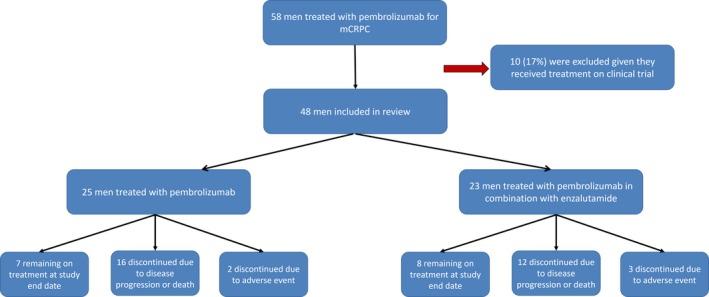
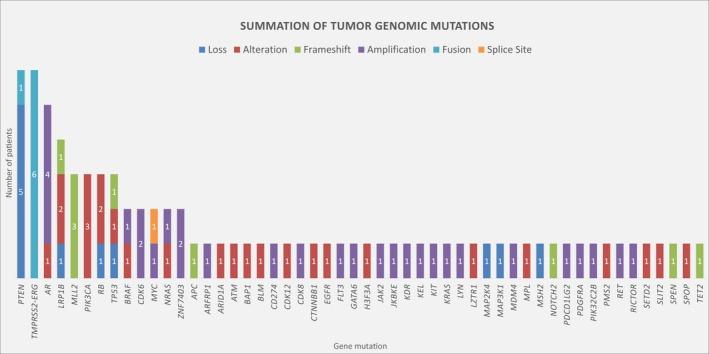
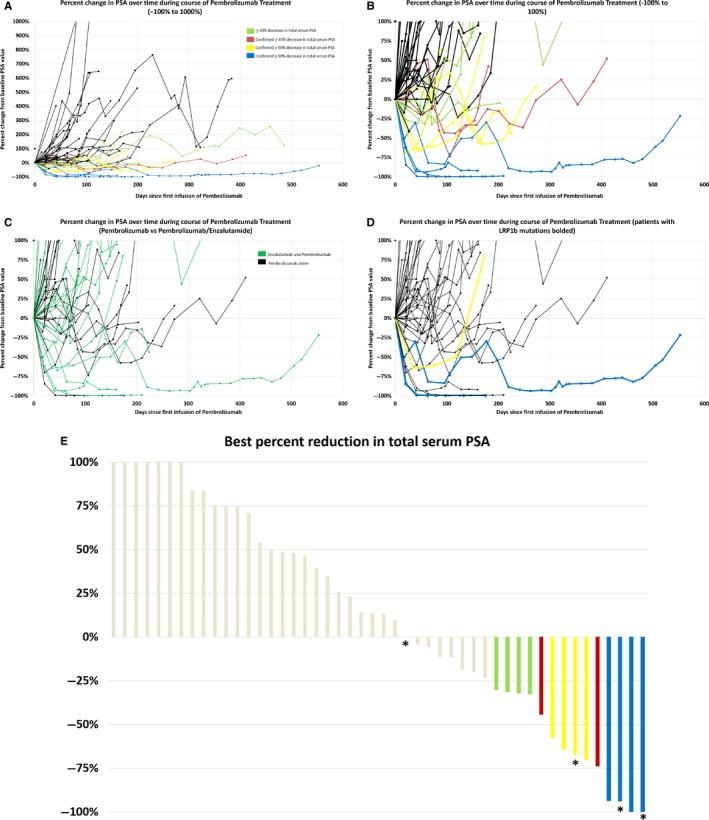
We identified 48 men who received ≥1 cycle of pembrolizumab for mCRPC. Of these, 94% (45/48) had ≥3 prior lines of therapy for mCRPC. Somatic tumor sequencing was available in 18/48 men (38%). We found that 17% (8/48) had a ≥50% confirmed PSA decline with pembrolizumab, and 8% (4/48) had a ≥90% PSA decline with durations of response ranging from 3.1 to 16.3 months. Two of these four men had mutations in LRP1b, one of whom also had MSH2 loss and was MSI-H and TMB-high. Despite prior progression on enzalutamide, 48% (23/48) of men were treated with concurrent enzalutamide. The median PSA progression-free-survival was 1.8 months (range 0.4-13.7 months), with 31% of patients remaining on pembrolizumab therapy and 54% of men remain alive with a median follow-up of 7.1 months.
CONCLUSIONS
In a heavily pretreated population of men with mCRPC, pembrolizumab was associated with a ≥50% PSA decline in 17% (8/48) of men, including a dramatic ≥90% PSA response in 8% (4/48), two of whom harbored pathogenic LRP1b mutations suggesting that LRP1b mutations may enrich for PD-1 inhibitor responsiveness in prostate cancer.
背景
派姆单抗获批用于治疗转移性、微卫星不稳定(MSI-H)或错配修复缺陷(dMMR)的实体瘤患者。然而,最初的这些研究中纳入的前列腺癌男性患者非常少。
方法
我们对接受派姆单抗治疗的转移性去势抵抗性前列腺癌(mCRPC)男性患者进行了单机构回顾性研究。主要目的是描述派姆单抗与患者和基因组特征相关的临床疗效。
结果
我们确定了 48 名接受至少 1 个周期派姆单抗治疗 mCRPC 的男性患者。其中,94%(45/48)的患者在 mCRPC 中接受了≥3 线治疗。18/48 名男性(38%)有可用的体细胞肿瘤测序结果。我们发现,17%(8/48)的患者在接受派姆单抗治疗后 PSA 有≥50%的确认下降,8%(4/48)的患者 PSA 有≥90%的下降,缓解持续时间为 3.1-16.3 个月。这 4 名患者中的 2 名有 LRP1b 突变,其中 1 名还存在 MSH2 缺失,为 MSI-H 和 TMB 高。尽管在接受恩扎鲁胺治疗后病情进展,仍有 48%(23/48)的患者同时接受恩扎鲁胺治疗。中位 PSA 无进展生存期为 1.8 个月(范围 0.4-13.7 个月),31%的患者仍在接受派姆单抗治疗,54%的患者仍存活,中位随访时间为 7.1 个月。
结论
在 mCRPC 男性的大量预处理人群中,派姆单抗与 17%(8/48)的男性 PSA 有≥50%的下降相关,其中 8%(4/48)的男性 PSA 有戏剧性的≥90%的下降,其中 2 名患者存在致病性 LRP1b 突变,这表明 LRP1b 突变可能使前列腺癌对 PD-1 抑制剂更敏感。


 Zotero 插件