Department of Urology, The Affiliated Hospital of Southwest Medical University, Luzhou, Sichuan 646000, P.R. China.
Department of Endocrinology, The Affiliated Hospital of Southwest Medical University, Luzhou, Sichuan 646000, P.R. China.
Mol Med Rep. 2019 Apr;19(4):2707-2715. doi: 10.3892/mmr.2019.9902. Epub 2019 Jan 28.
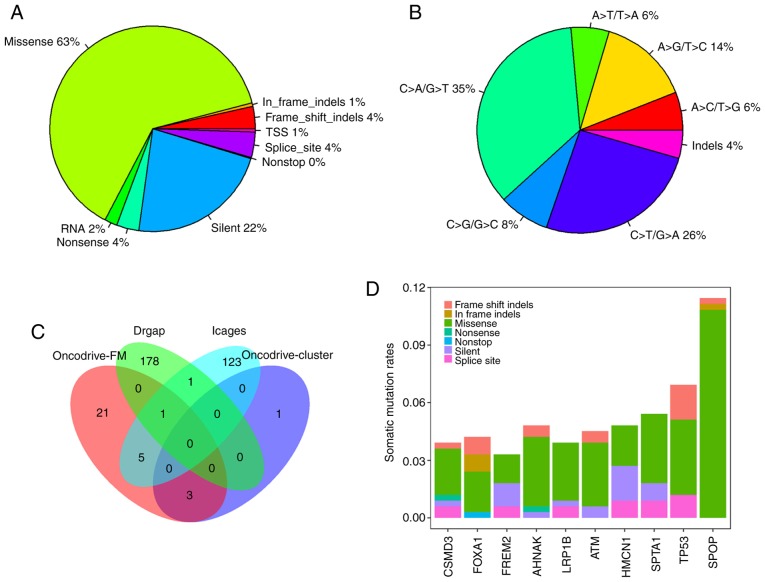
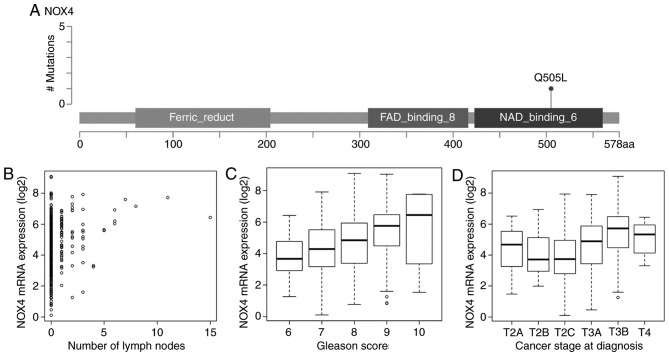
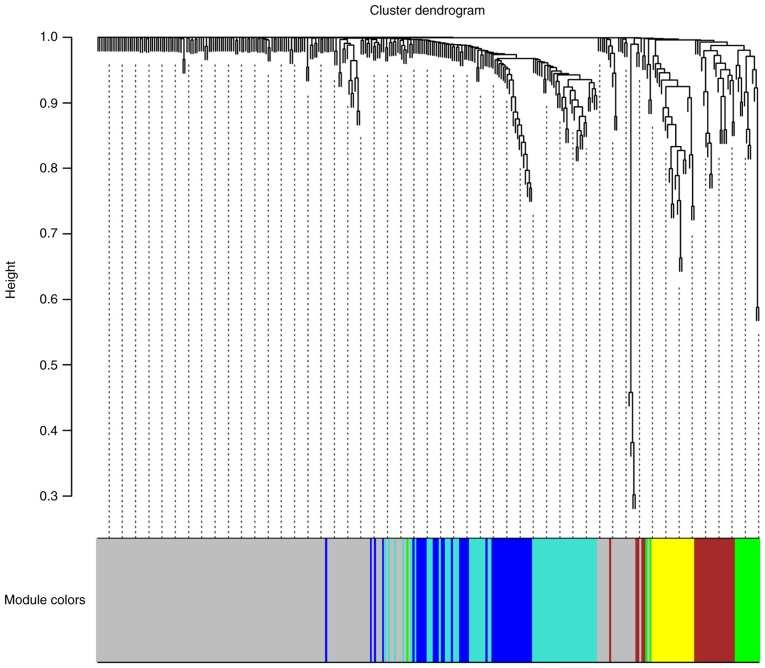
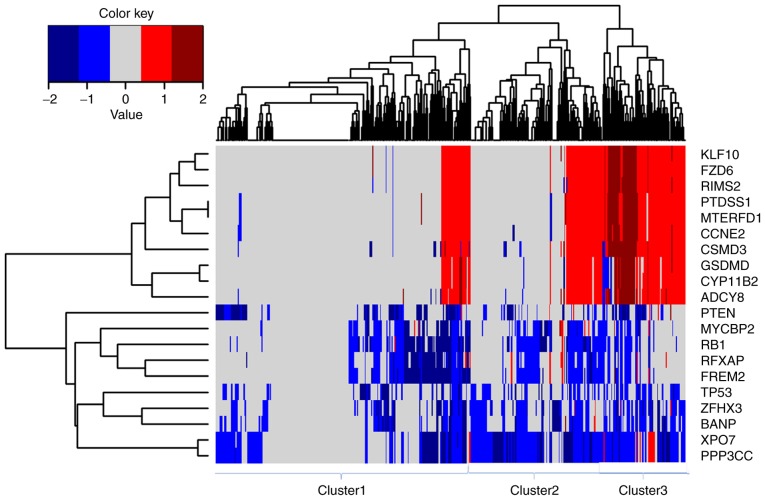
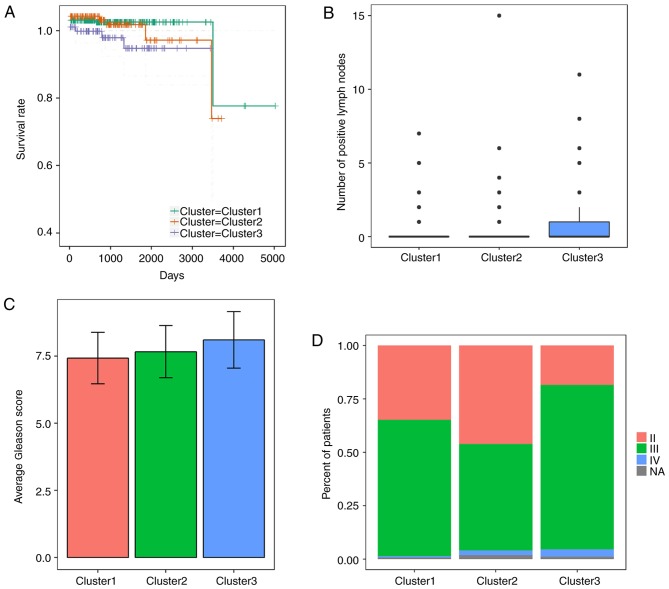
Large‑scale genomics studies have identified recurrently mutated genes in the ETS gene family, including fusions and copy number variations (CNVs), which are involved in the development of prostate adenocarcinoma (PRAD). However, the aetiology of PRAD remains to be fully elucidated. In the present study, 333 driver genes were identified using four computational tools: OncodriveFM, OncodriveCLUST, iCAGES and DrGaP. In addition, 32 driver pathways were identified using DrGaP. SPOP, TP53, SPTA1, AHNAK, HMCN1, ATM, FOXA1, CSMD3, LRP1B and FREM2 were the 10 most recurrently mutated genes in PRAD. ITGAL, TAGAP, SIGLEC10, RAC2 and ITGA4 were the five hub genes in the yellow module that were associated with the number of positive lymph nodes. Hierarchical clustering analysis of the 20 driver genes with the most frequent CNVs revealed three clusters of patients with PRAD. Cluster 3 tumours exhibited significantly higher numbers of positive lymph nodes, higher Gleason scores, more advanced cancer stages and poorer prognosis than cluster 1 and 2 tumours. A total of 48 genes were significantly associated with the number of positive lymph nodes, Gleason scores and pathologic stage in patients with PRAD. The identified set of cancer genes and pathways sheds light on the tumorigenesis of PRAD and creates avenues for the development of prognostic biomarkers and driver gene‑targeted therapies in PRAD.
大规模基因组学研究已经确定了 ETS 基因家族中经常发生突变的基因,包括融合和拷贝数变异(CNVs),这些基因参与了前列腺腺癌(PRAD)的发展。然而,PRAD 的病因仍有待充分阐明。在本研究中,使用四个计算工具:OncodriveFM、OncodriveCLUST、iCAGES 和 DrGaP,鉴定了 333 个驱动基因。此外,还使用 DrGaP 鉴定了 32 个驱动途径。SPOP、TP53、SPTA1、AHNAK、HMCN1、ATM、FOXA1、CSMD3、LRP1B 和 FREM2 是 PRAD 中最常突变的 10 个基因。ITGAL、TAGAP、SIGLEC10、RAC2 和 ITGA4 是与阳性淋巴结数量相关的黄色模块中的 5 个枢纽基因。对具有最频繁 CNVs 的 20 个驱动基因进行层次聚类分析,揭示了 3 组 PRAD 患者。与聚类 1 和聚类 2 相比,聚类 3 的肿瘤具有显著更多的阳性淋巴结、更高的 Gleason 评分、更晚期的癌症分期和更差的预后。共有 48 个基因与 PRAD 患者的阳性淋巴结数量、Gleason 评分和病理分期显著相关。所确定的癌症基因和途径集阐明了 PRAD 的肿瘤发生,并为 PRAD 中预后生物标志物和驱动基因靶向治疗的开发提供了途径。