Department of Surgery, San Antonio Military Medical Center, San Antonio, Texas.
National Capital Consortium Fellowship in Gynecologic Oncology, Walter Reed National Military Medical Center Bethesda, Bethesda, Maryland.
Cancer Med. 2019 Aug;8(10):4678-4687. doi: 10.1002/cam4.2378. Epub 2019 Jul 5.
E39, an HLA-A2-restricted, immunogenic peptide derived from the folate-binding protein (FBP), is overexpressed in multiple malignancies. We conducted a phase I/IIa trial of the E39 + GM-CSF vaccine with booster inoculations of either E39 or E39' (an attenuated version of E39) to prevent recurrences in disease-free endometrial and ovarian cancer patients(pts). Here, we present the final 24-month landmark analysis.
HLA-A2 + patients receiving E39 + GM-CSF were included in the vaccine group (VG), and HLA-A2- pts (or HLA-A2 + patients refusing vaccine) were followed as the control group (CG). VG group received 6 monthly inoculations as the primary vaccine series (PVS) and were randomized to receive either E39 or E39' booster inoculations. Demographic, safety, immunologic, and disease-free survival (DFS) data were collected and evaluated.
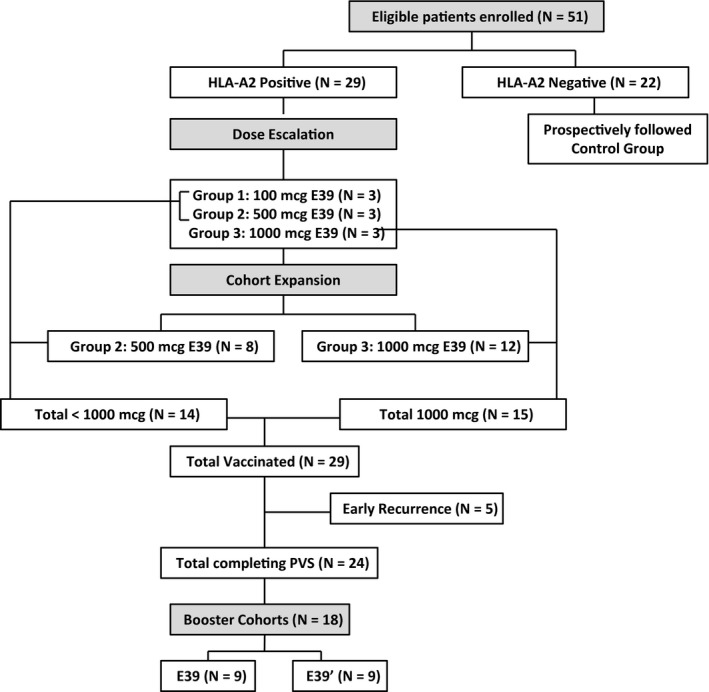
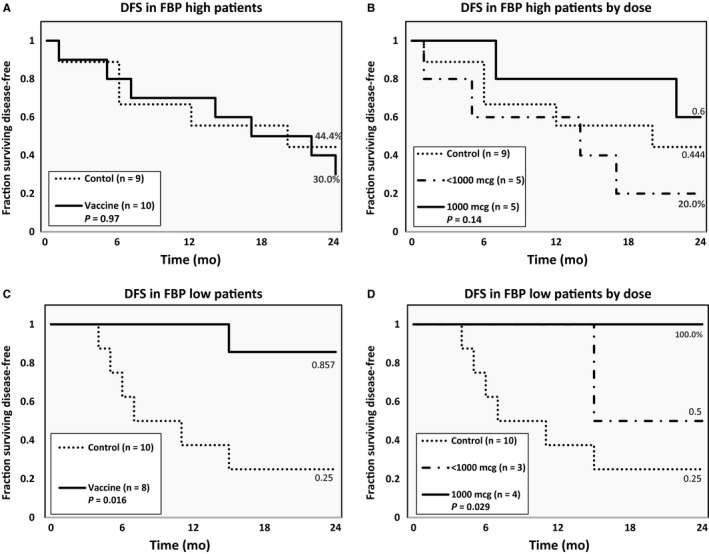
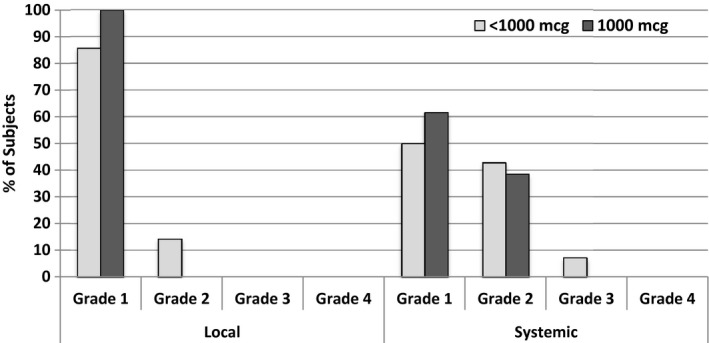
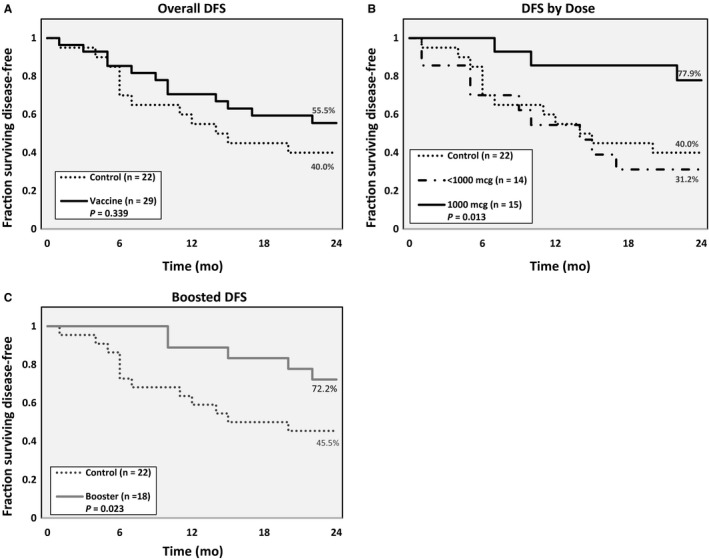
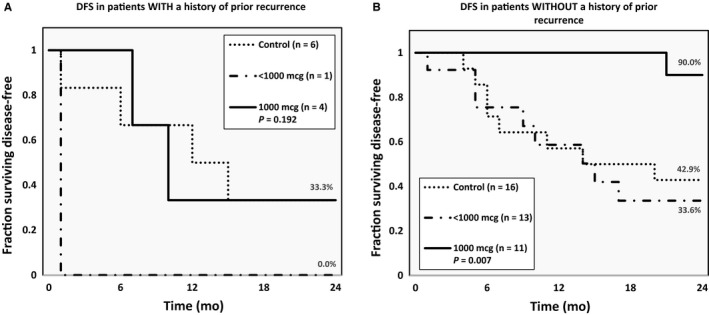
Fifty-one patients were enrolled; 29 in the VG and 22 in the CG. Fourteen patients received <1000 μg and 15 received 1000 μg of E39. There were no clinicopathologic differences between VG and CG or between dose groups. E39 was well tolerated. At the 24 months landmark, DFS was 55.5% (VG) vs 40.0% (CG), P = 0.339. Patients receiving 1000 μg and boosted patients also showed improved DFS (P < 0.03). DFS was improved in the 1000 μg group after treatment of primary disease (90.0% vs CG:42.9%, P = 0.007), but not in recurrent patients. In low-FBP expressing patients, DFS was 100.0% (1000 μg), 50.0% (<1000 μg), and 25.0% (CG), P = 0.029.
This phase I/IIa trial reveals that E39 + GM-CSF is safe and may be effective in preventing recurrence in high-risk ovarian and endometrial cancer when optimally dosed (1000 μg) to FBP low patients being treated for primary disease.
E39 是一种 HLA-A2 限制性免疫原性肽,来源于叶酸结合蛋白(FBP),在多种恶性肿瘤中过表达。我们进行了一项 E39+GM-CSF 疫苗的 I/IIa 期试验,对无疾病复发的子宫内膜和卵巢癌患者进行了加强接种 E39 或 E39'(E39 的减毒版本)的治疗。在此,我们报告了最终的 24 个月的里程碑分析。
接受 E39+GM-CSF 治疗的 HLA-A2+患者被纳入疫苗组(VG),而 HLA-A2-患者(或拒绝接种疫苗的 HLA-A2+患者)作为对照组(CG)进行随访。VG 组接受 6 个月的接种作为初级疫苗系列(PVS),并随机接受 E39 或 E39'的加强接种。收集和评估了人口统计学、安全性、免疫和无疾病生存(DFS)数据。
共纳入 51 例患者,其中 29 例在 VG 组,22 例在 CG 组。14 例患者接受了<1000μg 的 E39,15 例患者接受了 1000μg 的 E39。VG 组和 CG 组或剂量组之间没有临床病理差异。E39 具有良好的耐受性。在 24 个月的时间点,DFS 为 55.5%(VG 组)比 40.0%(CG 组),P=0.339。接受 1000μg 剂量并接受加强接种的患者也显示出更好的 DFS(P<0.03)。在治疗原发性疾病后,高剂量组的 DFS 有所改善(90.0%比 CG 组:42.9%,P=0.007),但在复发患者中没有改善。在低 FBP 表达的患者中,DFS 为 100.0%(1000μg 组)、50.0%(<1000μg 组)和 25.0%(CG 组),P=0.029。
这项 I/IIa 期试验表明,E39+GM-CSF 是安全的,当以最佳剂量(1000μg)用于治疗原发性疾病的低 FBP 患者时,可能有效预防高危卵巢和子宫内膜癌的复发。