Yang Bo, Fritsche Kevin L, Beversdorf David Q, Gu Zezong, Lee James C, Folk William R, Greenlief C Michael, Sun Grace Y
Department of Chemistry, University of Missouri, Columbia, MO, United States.
Department of Nutrition and Exercise Physiology, University of Missouri, Columbia, MO, United States.
Front Neurol. 2019 Jun 18;10:642. doi: 10.3389/fneur.2019.00642. eCollection 2019.
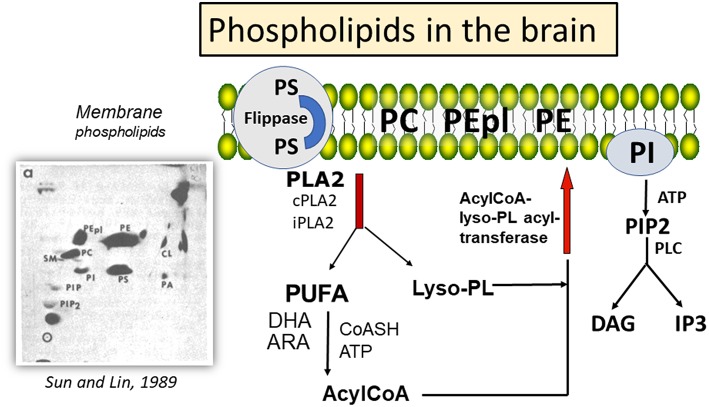
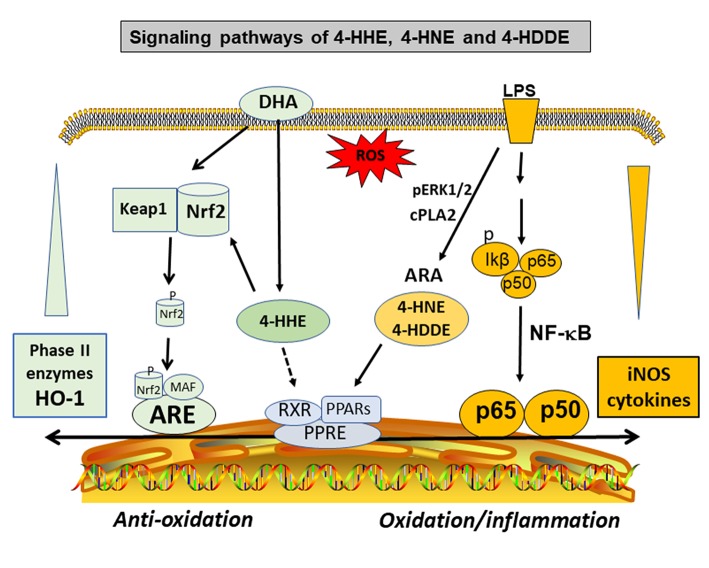
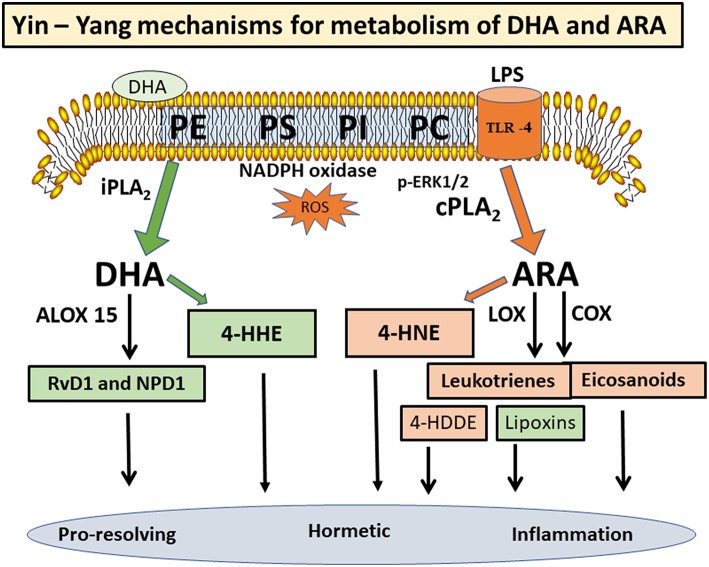
Phospholipids in the central nervous system (CNS) are rich in polyunsaturated fatty acids (PUFAs), particularly arachidonic acid (ARA) and docosahexaenoic acid (DHA). Besides providing physical properties to cell membranes, these PUFAs are metabolically active and undergo turnover through the "deacylation-reacylation (Land's) cycle". Recent studies suggest a Yin-Yang mechanism for metabolism of ARA and DHA, largely due to different phospholipases A (PLAs) mediating their release. ARA and DHA are substrates of cyclooxygenases and lipoxygenases resulting in an array of lipid mediators, which are pro-inflammatory and pro-resolving. The PUFAs are susceptible to peroxidation by oxygen free radicals, resulting in the production of 4-hydroxynonenal (4-HNE) from ARA and 4-hydroxyhexenal (4-HHE) from DHA. These alkenal electrophiles are reactive and capable of forming adducts with proteins, phospholipids and nucleic acids. The perceived cytotoxic and hormetic effects of these hydroxyl-alkenals have impacted cell signaling pathways, glucose metabolism and mitochondrial functions in chronic and inflammatory diseases. Due to the high levels of DHA and ARA in brain phospholipids, this review is aimed at providing information on the Yin-Yang mechanisms for regulating these PUFAs and their lipid peroxidation products in the CNS, and implications of their roles in neurological disorders.
中枢神经系统(CNS)中的磷脂富含多不饱和脂肪酸(PUFA),尤其是花生四烯酸(ARA)和二十二碳六烯酸(DHA)。除了赋予细胞膜物理特性外,这些多不饱和脂肪酸还具有代谢活性,并通过“脱酰基-再酰基化(兰德)循环”进行周转。最近的研究表明,ARA和DHA的代谢存在阴阳机制,这主要是由于不同的磷脂酶A(PLA)介导它们的释放。ARA和DHA是环氧化酶和脂氧合酶的底物,会产生一系列脂质介质,这些介质具有促炎和促分解作用。多不饱和脂肪酸易被氧自由基过氧化,导致从ARA产生4-羟基壬烯醛(4-HNE),从DHA产生4-羟基己烯醛(4-HHE)。这些烯醛亲电试剂具有反应性,能够与蛋白质、磷脂和核酸形成加合物。这些羟基烯醛的细胞毒性和兴奋效应已影响慢性和炎症性疾病中的细胞信号通路、葡萄糖代谢和线粒体功能。由于脑磷脂中DHA和ARA含量很高,本综述旨在提供有关调节中枢神经系统中这些多不饱和脂肪酸及其脂质过氧化产物的阴阳机制的信息,以及它们在神经疾病中的作用。