Department for Clinical Gerontology, Robert-Bosch-Hospital, Auerbachstr. 110, 70376, Stuttgart, Germany.
Network Aging Research (NAR), Heidelberg University, Heidelberg, Germany.
BMC Musculoskelet Disord. 2019 Jul 6;20(1):315. doi: 10.1186/s12891-019-2691-0.
The incidence of proximal humeral fractures (PHF) increased by more than 30% over the last decade, which is accompanied by an increased number of operations. However, the evidence on operative vs. non-operative treatment and post-operative treatments is limited and mostly based on expert opinion. It is mandatory to objectively assess functional capacity to compare different treatments. Clinical tools should be valid, reliable and sensitive to change assessing functional capacity after PHFs. This study aimed to analyse inter-rater reliability of the videotaped Wolf-Motor-Function-Test-Orthopaedic (WMFT-O) and the association between the clinical WMFT-O and the Disability of the Arm, Shoulder and Hand (DASH) and to determine the sensitivity to change of the WMFT-O and the DASH to measure functional capacity before and after rehabilitation in PHF patients.
Fifty-six patients (61.7 ± 14.7 years) after surgical treatment of PHF were assessed using the WMFT-O at two different time points. To determine inter-rater reliability, the videotaped WMFT-O was evaluated through three blinded raters. Inter-rater agreement was determined by Fleiss' Kappa statistics. Pearson correlation coefficients were calculated to assess the association between the clinical WMFT-O and the video rating as well as the DASH. Sensitivity to change and responsiveness were analysed for the WMFT-O and the DASH in a subsample of forty patients (53.8 ± 1.4 years) who were assessed before and after a three week robotic-assisted training intervention.
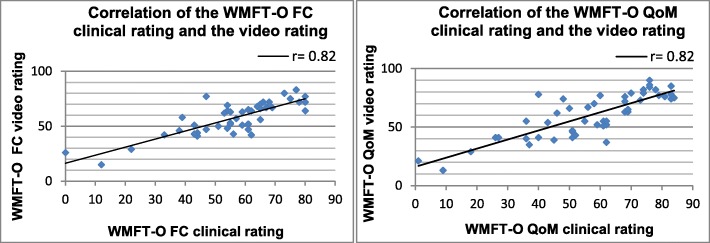
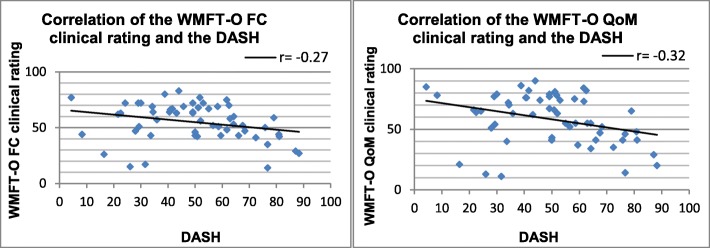
Inter-rater agreement was indicated by Fleiss' Kappa values ranging from 0.33-0.66 for functional capacity and from 0.27-0.54 for quality of movement. The correlation between the clinical WMFT-O and the video rating was higher than 0.77. The correlation between the clinical WMFT-O and the DASH was weak. Sensitivity to change was high for the WMFT-O and the DASH and responsiveness was given. In comparison to the DASH, the sensitivity to change of the WMFT-O was higher.
The overall results indicate that the WMFT-O is a reliable, sensitive and responsive instrument to measure more objectively functional change over time in rehabilitation after PHF. Furthermore, it has been shown that video assessment is eligible for studies to ensure a full blinding of raters.
Clinicaltrials.gov, NCT03100201 . Registered on 28 March 2017. The trial was retrospectively registered.
过去十年中,肱骨近端骨折(PHF)的发病率增加了 30%以上,随之而来的是手术数量的增加。然而,关于手术与非手术治疗以及术后治疗的证据有限,且主要基于专家意见。客观评估功能能力对于比较不同的治疗方法是必要的。临床工具应该是有效的、可靠的、能够敏感地反映 PHF 后功能能力的变化。本研究旨在分析录像 Wolf-Motor-Function-Test-Orthopaedic(WMFT-O)的评分者间信度,并探讨临床 WMFT-O 与残疾上肢、肩和手(DASH)之间的相关性,以及评估 PHF 患者康复前后 WMFT-O 和 DASH 测量功能能力的变化敏感性。
56 例 PHF 手术后患者(61.7±14.7 岁)分别在两个不同时间点使用 WMFT-O 进行评估。为了确定评分者间信度,通过 3 位盲法评分者对录像 WMFT-O 进行评估。采用 Fleiss' Kappa 统计量来确定评分者间的一致性。Pearson 相关系数用于评估临床 WMFT-O 与视频评分以及 DASH 之间的相关性。在 40 例(53.8±1.4 岁)接受三周机器人辅助训练干预前后评估的亚组中,分析 WMFT-O 和 DASH 的变化敏感性和反应性。
Fleiss' Kappa 值范围为 0.33-0.66 时,功能能力的评分者间一致性为中等;质量运动的评分者间一致性为低等。临床 WMFT-O 与视频评分的相关性高于 0.77。临床 WMFT-O 与 DASH 的相关性较弱。WMFT-O 和 DASH 的变化敏感性均较高,且具有反应性。与 DASH 相比,WMFT-O 的变化敏感性更高。
总体结果表明,WMFT-O 是一种可靠、敏感和反应性的工具,可在 PHF 康复后更客观地测量随时间变化的功能变化。此外,研究结果表明录像评估适合用于研究,以确保评分者完全盲法。
Clinicaltrials.gov,NCT03100201。于 2017 年 3 月 28 日注册。该试验为回顾性注册。