Center for Experimental Molecular Medicine, Amsterdam University Medical Centers, Academic Medical Center, University of Amsterdam, Amsterdam, The Netherlands.
Department of Clinical Epidemiology, Biostatistics and Bioinformatics, Amsterdam University Medical Centers, Academic Medical Center, Amsterdam, The Netherlands.
J Leukoc Biol. 2019 Nov;106(5):1153-1160. doi: 10.1002/JLB.4A0219-050R. Epub 2019 Jul 7.
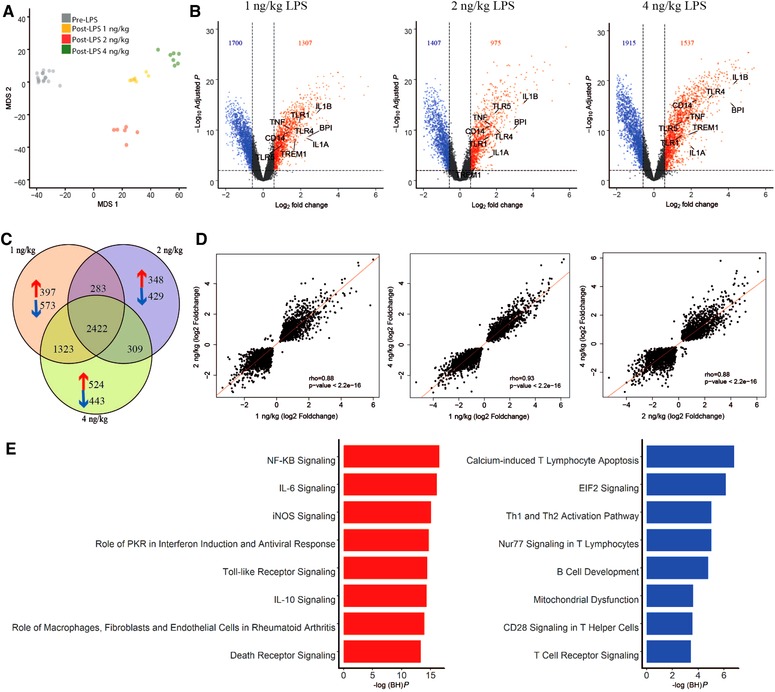
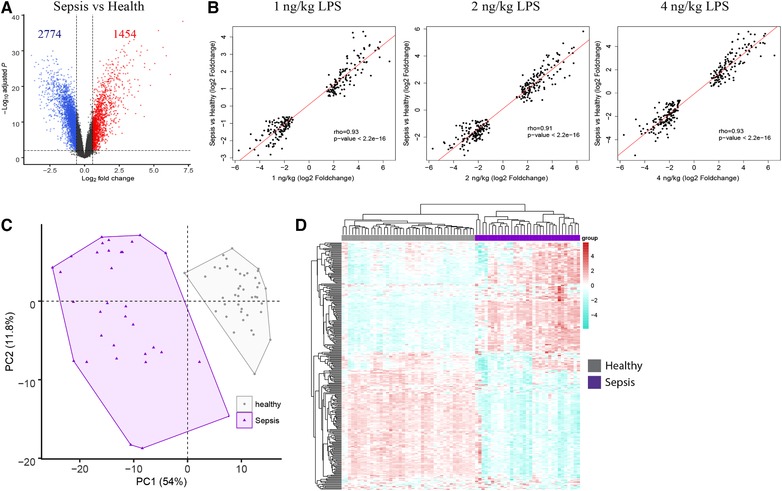
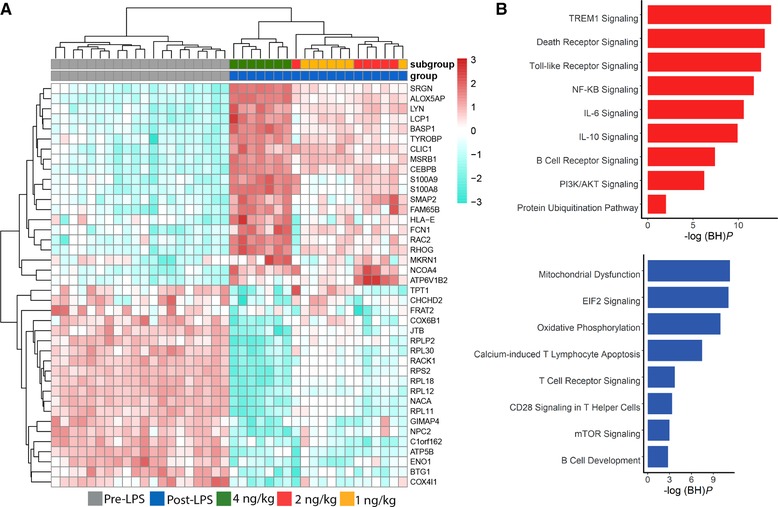
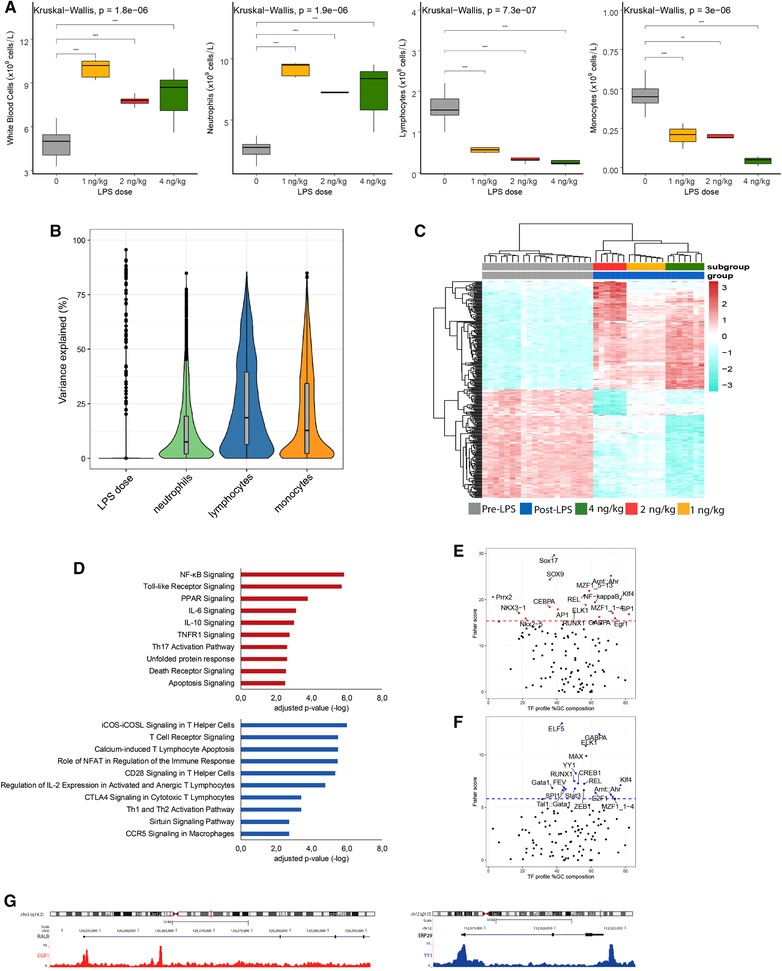
The host immune response is characterized by a complex interplay of signal-specific cellular transcriptional responses. The magnitude of the immune response is dependent on the strength of the external stimulus. Knowledge on leukocyte transcriptional responses altered in response to different stimulus dosages in man is lacking. Here, we sought to identify leukocyte transcriptional signatures dependent on LPS dose in humans. Healthy human volunteers were administered 1 ng/kg (n = 7), 2 ng/kg (n = 6), or 4 ng/kg (n = 7) LPS intravenously. Blood was collected before (pre-LPS) and 4 h after LPS administration. Total RNA was analyzed by microarrays and generalized linear models. Pathway analysis was performed by using Ingenuity pathway analysis. Leukocyte transcriptomes altered per LPS dosage were predominantly shared, with 47% common signatures relative to pre-LPS. A univariate linear model identified a set of 3736 genes that exhibited a dependency on differing LPS dosages. Neutrophil, monocyte, and lymphocyte counts explained 38.9% of the variance in the LPS dose-dependent gene set. A multivariate linear model including leukocyte composition delineated a set of 295 genes with a dependency on LPS dose. Evaluation of the 295 gene signature in patients with sepsis due to abdominal infections showed significant correlations. Promoter regions of the LPS dose gene set were enriched for YY1, EGR1, ELK1, GABPA, KLF4, and REL transcription factor binding sites. Intravenous injection of 1, 2, or 4 ng/kg LPS was accompanied by both shared and distinct leukocyte transcriptional alterations. These data may assist in assessing the severity of the insult in patients with abdominal sepsis.
宿主免疫反应的特征是信号特异性细胞转录反应的复杂相互作用。免疫反应的强度取决于外部刺激的强度。关于白细胞转录反应在人类中对不同刺激剂量的改变的知识是缺乏的。在这里,我们试图确定依赖于 LPS 剂量的人类白细胞转录特征。健康的人类志愿者静脉内给予 1ng/kg(n=7)、2ng/kg(n=6)或 4ng/kg(n=7)LPS。在 LPS 给药前(预 LPS)和给药后 4 小时采集血液。通过微阵列和广义线性模型分析总 RNA。通过使用 Ingenuity 途径分析进行途径分析。每个 LPS 剂量改变的白细胞转录组主要是共享的,与预 LPS 相比有 47%的共同特征。单变量线性模型确定了一组 3736 个基因,这些基因表现出对不同 LPS 剂量的依赖性。中性粒细胞、单核细胞和淋巴细胞计数解释了 LPS 剂量依赖性基因集的 38.9%的变异性。包括白细胞组成的多元线性模型描绘了一组 295 个依赖 LPS 剂量的基因。在腹部感染引起的败血症患者中评估 295 个基因特征显示出显著的相关性。LPS 剂量基因集的启动子区域富含 YY1、EGR1、ELK1、GABPA、KLF4 和 REL 转录因子结合位点。静脉内注射 1、2 或 4ng/kg LPS 伴随着白细胞转录改变的共享和独特。这些数据可能有助于评估腹部败血症患者损伤的严重程度。