Knight Daniel R, Riley Thomas V
Medical, Molecular, and Forensic Sciences, Murdoch University, Perth, WA, Australia.
School of Medical and Health Sciences, Edith Cowan University, Joondalup, WA, Australia.
Front Public Health. 2019 Jun 20;7:164. doi: 10.3389/fpubh.2019.00164. eCollection 2019.
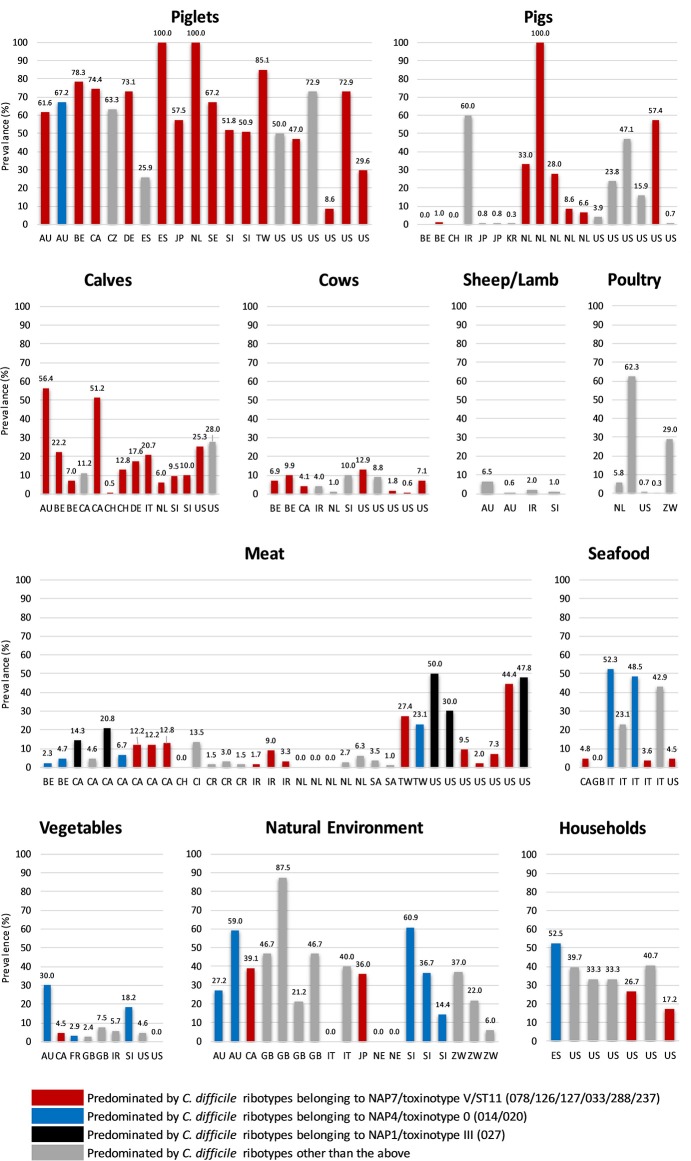
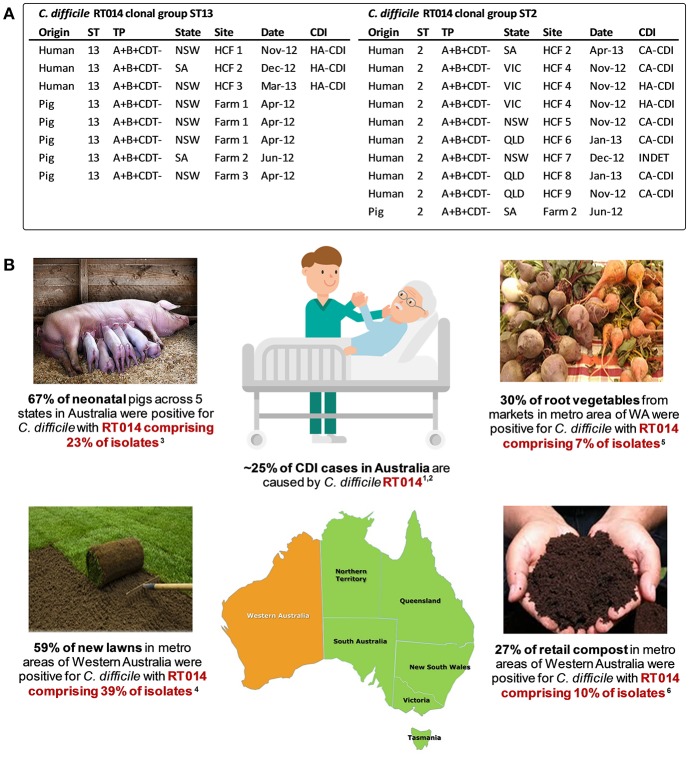
is toxin-producing antimicrobial resistant (AMR) enteropathogen historically associated with diarrhea and pseudomembranous colitis in hospitalized patients. In recent years, there have been dramatic increases in the incidence and severity of infection (CDI), and associated morbidity and mortality, in both healthcare and community settings. is an ancient and diverse species that displays a sympatric lifestyle, establishing itself in a range of ecological niches external to the healthcare system. These sources/reservoirs include food, water, soil, and over a dozen animal species, in particular, livestock such as pigs and cattle. In a manner analogous to human infection, excessive antimicrobial exposure, particularly to cephalosporins, is driving the expansion of in livestock populations worldwide. Subsequent spore contamination of meat, vegetables grown in soil containing animal feces, agricultural by-products such as compost and manure, and the environment in general (households, lawns, and public spaces) is contributing to a persistent community source/reservoir of and the insidious rise of CDI in the community. The whole-genome sequencing era continues to redefine our view of this complex pathogen. The application of high-resolution microbial genomics in a One Health framework (encompassing clinical, veterinary, and environment derived datasets) is the optimal paradigm for advancing our understanding of CDI in humans and animals. This approach has begun to yield critical insights into the genetic diversity, evolution, AMR, and zoonotic potential of . In Europe, North America, and Australia, microevolutionary analysis of the core genome shows strains common to humans and animals (livestock or companion animals) do not form distinct populations but share a recent evolutionary history. Moreover, for sequence type 11 and PCR ribotypes 078 and 014, major lineages of One Health importance, this approach has substantiated inter-species clonal transmission between animals and humans. These findings indicate either a zoonosis or anthroponosis. Moreover, they challenge the existing paradigm and the long-held misconception that CDI is primarily a healthcare-associated infection. In this article, evolutionary, and zoonotic aspects of CDI are discussed, including the anthropomorphic factors that contribute to the spread of from the farm to the community.
是一种产生毒素的耐抗菌药(AMR)肠道病原体,在历史上与住院患者的腹泻和伪膜性结肠炎有关。近年来,在医疗保健和社区环境中,艰难梭菌感染(CDI)的发病率和严重程度以及相关的发病率和死亡率都急剧上升。艰难梭菌是一个古老且多样的物种,呈现出同域生活方式,在医疗系统外部的一系列生态位中立足。这些来源/宿主包括食物、水、土壤以及十几种动物物种,特别是猪和牛等家畜。与人类感染类似,过度的抗菌药物暴露,尤其是头孢菌素的暴露,正在推动全球家畜种群中艰难梭菌的扩张。随后,肉类、在含有动物粪便的土壤中种植的蔬菜、堆肥和粪肥等农业副产品以及整个环境(家庭、草坪和公共场所)的孢子污染,导致了艰难梭菌在社区中的持续存在以及社区中CDI的悄然上升。全基因组测序时代不断重新定义我们对这种复杂病原体的看法。在“同一个健康”框架(包括临床、兽医和环境衍生数据集)中应用高分辨率微生物基因组学是推进我们对人类和动物CDI理解的最佳范式。这种方法已经开始对艰难梭菌的遗传多样性、进化、AMR和人畜共患病潜力产生关键见解。在欧洲、北美和澳大利亚,对艰难梭菌核心基因组的微观进化分析表明,人类和动物(家畜或伴侣动物)共有的菌株并未形成不同的群体,而是共享最近的进化历史。此外,对于具有“同一个健康”重要性的主要谱系,即序列类型11以及PCR核糖体分型078和014,这种方法证实了动物与人之间的种间克隆传播。这些发现表明存在人畜共患病或人传动物病。此外,它们挑战了现有范式以及长期以来认为CDI主要是一种与医疗保健相关感染的误解。在本文中,将讨论CDI的进化和人畜共患病方面,包括导致艰难梭菌从农场传播到社区的人为因素。