Sogorb-Gonzalez Marina, Landles Christian, Caron Nicholas S, Stam Anouk, Osborne Georgina, Hayden Michael R, Howland David, van Deventer Sander, Bates Gillian P, Vallès Astrid, Evers Melvin
Department of Research & Development, uniQure Biopharma BV, Amsterdam 1105 BP, The Netherlands.
Department of Gastroenterology and Hepatology, Leiden University Medical Center, Leiden, 2333 ZA, The Netherlands.
Brain. 2024 Dec 3;147(12):4043-4055. doi: 10.1093/brain/awae266.
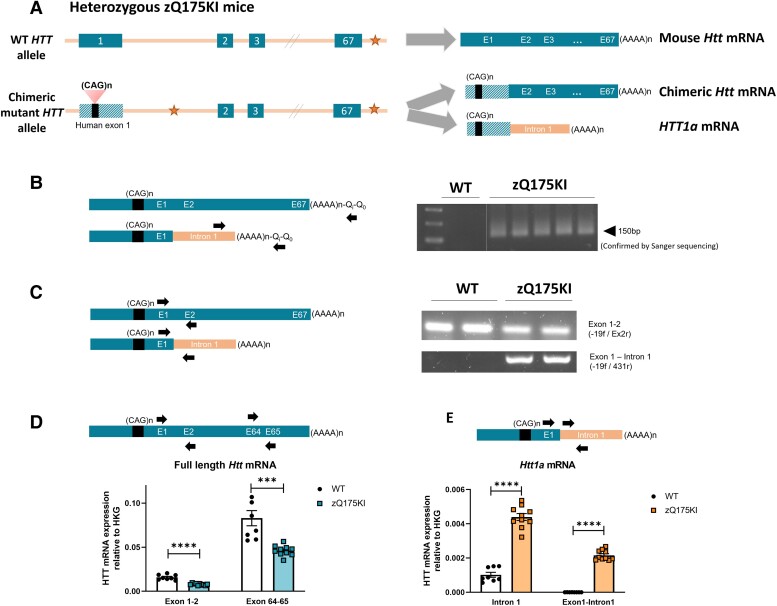
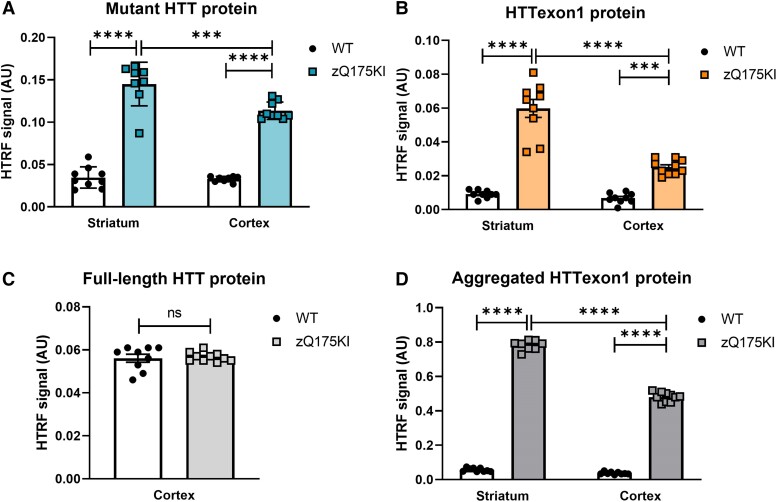
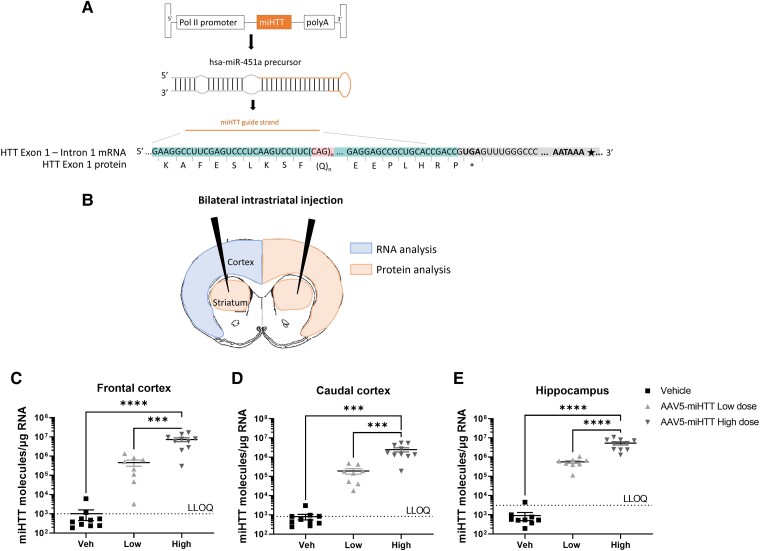
Huntington's disease (HD) is a fatal neurodegenerative disease caused by a trinucleotide repeat expansion in exon 1 of the huntingtin gene (HTT) that results in toxic gain of function and cell death. Despite its monogenic cause, the pathogenesis of HD is highly complex, and increasing evidence indicates that, in addition to the full-length (FL) mutant HTT protein, the expanded exon 1 HTT (HTTexon1) protein that is translated from the HTT1a transcript generated by aberrant splicing is prone to aggregate and might contribute to HD pathology. This finding suggests that reducing the expression of HTT1a might achieve a greater therapeutic benefit than targeting only FL mutant HTT. Conversely, strategies that exclusively target FL HTT might not completely prevent the pathogenesis of HD. We have developed an engineered microRNA targeting the HTT exon 1 sequence (miHTT), delivered via adeno-associated virus serotype 5 (AAV5). The target sequence of miHTT is present in both FL HTT and HTT1a transcripts. Preclinical studies with AAV5-miHTT have demonstrated efficacy in several rodent and large animal models by reducing FL HTT mRNA and protein and rescuing HD-like phenotypes and have been the rationale for phase I/II clinical studies now ongoing in the USA and Europe. In the present study, we evaluated the ability of AAV5-miHTT to reduce the levels of aberrantly spliced HTT1a mRNA and the HTTexon1 protein in the brain of two mouse models of HD (heterozygous zQ175 knock-in mice and humanized Hu128/21 mice). Polyadenylated HTT1a mRNA and HTTexon1 protein were detected in the striatum and cortex of heterozygous zQ175 knock-in mice, but not in wild-type littermate control mice. Intrastriatal administration of AAV5-miHTT resulted in dose-dependent expression of mature miHTT microRNA in cortical brain regions, accompanied by significant lowering of both FL HTT and HTT1a mRNA expression at 2 months postinjection. Mutant HTT and HTTexon1 protein levels were also significantly reduced in the striatum and cortex of heterozygous zQ175 knock-in mice at 2 months after AAV5-miHTT treatment and in humanized Hu128/21 mice 7 months post-treatment. The effects were confirmed in primary Hu128/21 neuronal cultures. These results demonstrate that AAV5-miHTT gene therapy is an effective approach to lower both FL HTT and the pathogenic HTTexon1 levels, which could potentially have an additive therapeutic benefit in comparison to other HTT-targeting modalities.
亨廷顿舞蹈症(HD)是一种致命的神经退行性疾病,由亨廷顿基因(HTT)外显子1中的三核苷酸重复扩增引起,导致功能获得性毒性和细胞死亡。尽管其病因是单基因的,但HD的发病机制高度复杂,越来越多的证据表明,除了全长(FL)突变型HTT蛋白外,由异常剪接产生的HTT1a转录本翻译出的外显子1 HTT(HTTexon1)蛋白易于聚集,可能对HD病理有影响。这一发现表明,降低HTT1a的表达可能比仅靶向FL突变型HTT带来更大的治疗益处。相反,仅靶向FL HTT的策略可能无法完全预防HD的发病机制。我们开发了一种通过腺相关病毒血清型5(AAV5)递送的靶向HTT外显子1序列的工程化微小RNA(miHTT)。miHTT的靶序列存在于FL HTT和HTT1a转录本中。对AAV5-miHTT的临床前研究已在几种啮齿动物和大型动物模型中证明了其有效性,可通过降低FL HTT mRNA和蛋白水平以及挽救HD样表型,这也是目前美国和欧洲正在进行的I/II期临床研究的理论依据。在本研究中,我们评估了AAV5-miHTT降低两种HD小鼠模型(杂合子zQ175基因敲入小鼠和人源化Hu128/21小鼠)大脑中异常剪接的HTT1a mRNA和HTTexon1蛋白水平的能力。在杂合子zQ175基因敲入小鼠的纹状体和皮质中检测到了多聚腺苷酸化的HTT1a mRNA和HTTexon1蛋白,但在野生型同窝对照小鼠中未检测到。纹状体内注射AAV5-miHTT导致成熟miHTT微小RNA在大脑皮质区域呈剂量依赖性表达,在注射后2个月时FL HTT和HTT1a mRNA表达均显著降低。在AAV5-miHTT治疗后2个月,杂合子zQ175基因敲入小鼠的纹状体和皮质以及治疗后7个月的人源化Hu128/21小鼠中,突变型HTT和HTTexon1蛋白水平也显著降低。在原代Hu128/21神经元培养物中证实了这些效果。这些结果表明,AAV5-miHTT基因治疗是一种有效降低FL HTT和致病性HTTexon1水平的方法,与其他靶向HTT的方式相比,可能具有额外的治疗益处。