Department of Biophysics, Centre of the Region Haná for Biotechnological and Agricultural Research, Faculty of Science, Palacký University, Šlechtitelů 27, 783 71 Olomouc, Czech Republic.
Biomolecules. 2019 Jul 5;9(7):258. doi: 10.3390/biom9070258.
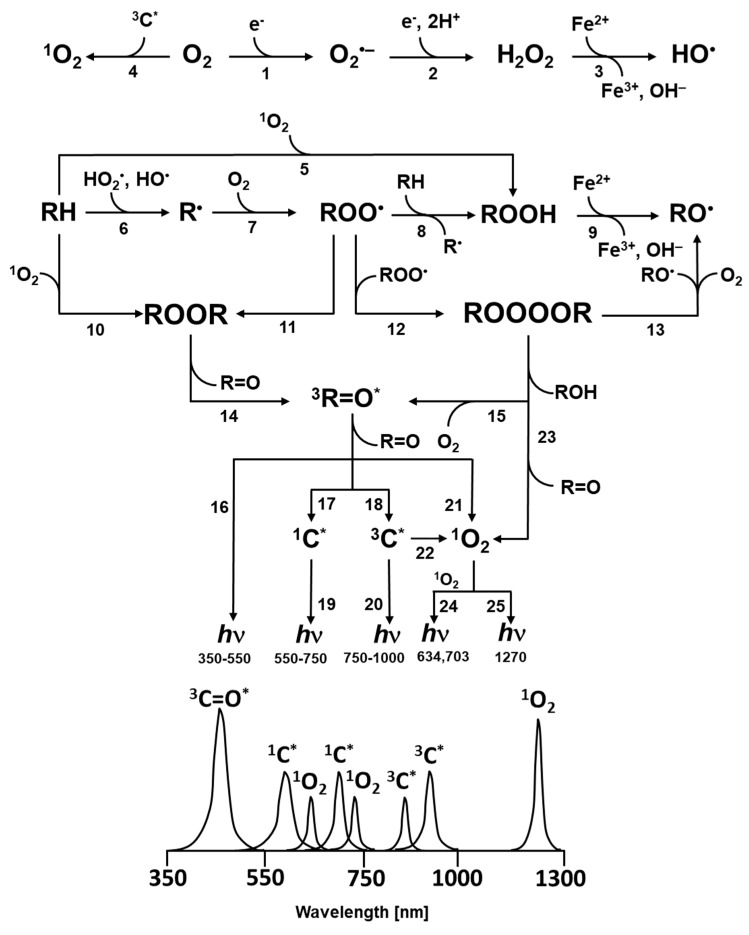
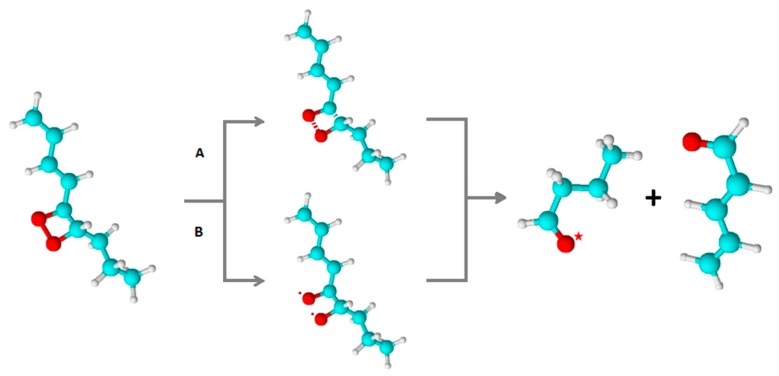
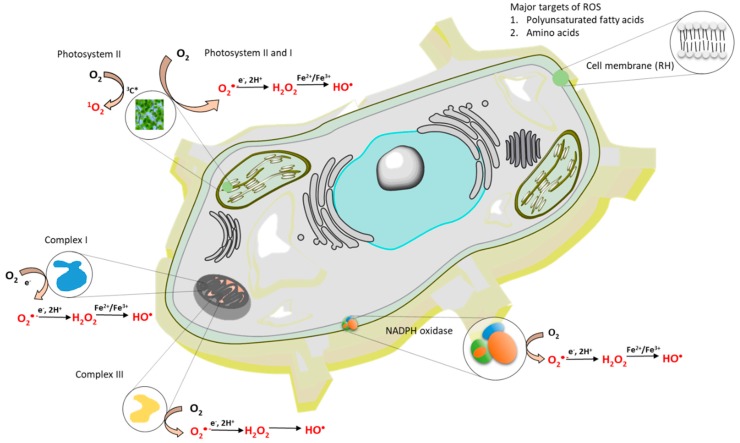
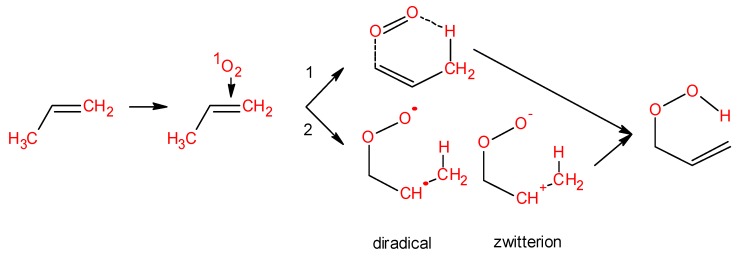
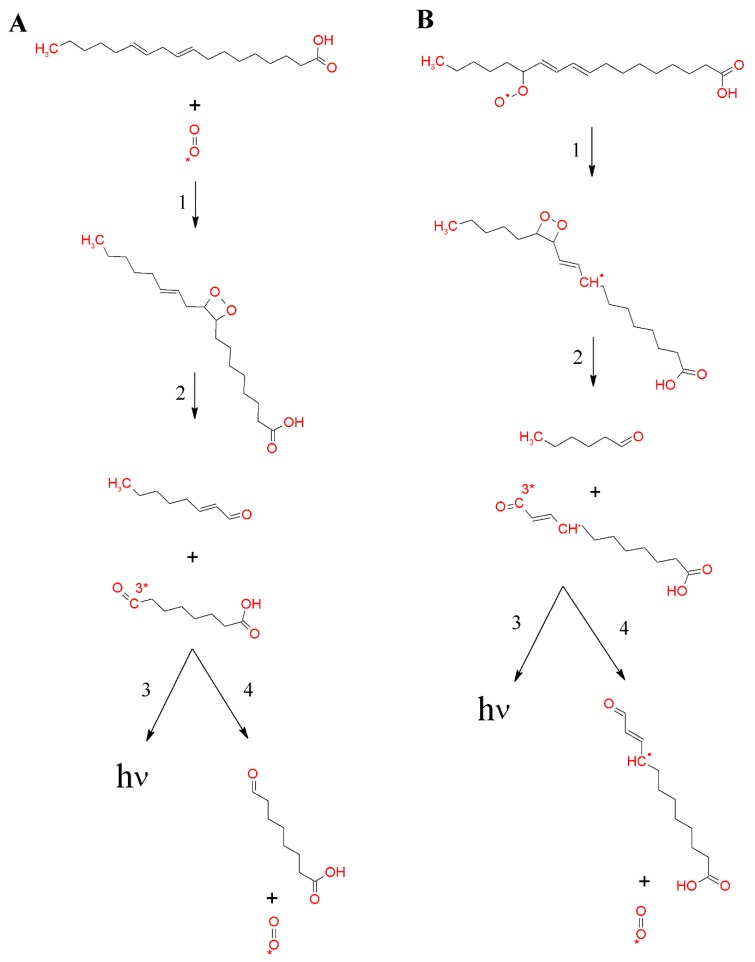
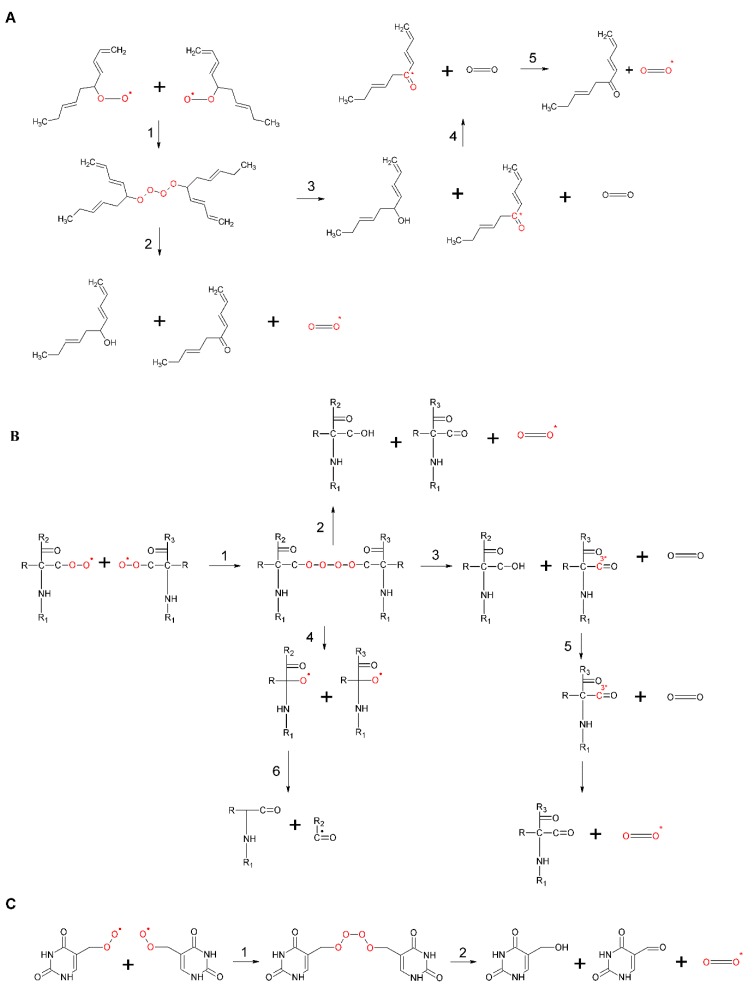
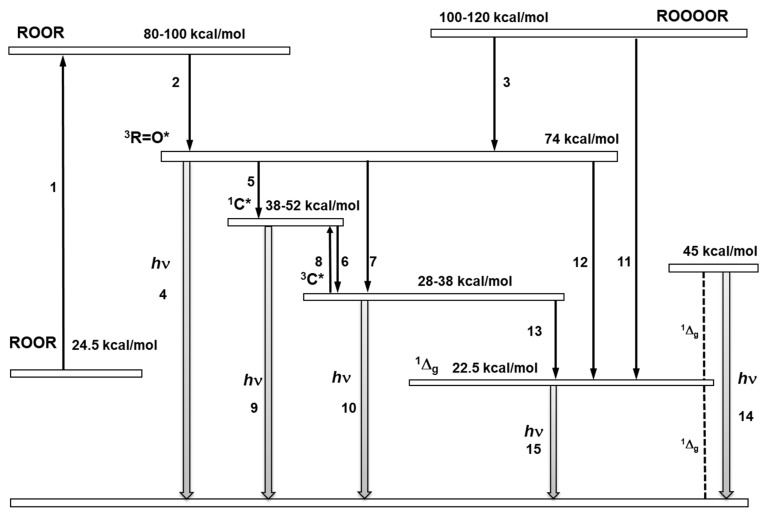
It is well known that biological systems, such as microorganisms, plants, and animals, including human beings, form spontaneous electronically excited species through oxidative metabolic processes. Though the mechanism responsible for the formation of electronically excited species is still not clearly understood, several lines of evidence suggest that reactive oxygen species (ROS) are involved in the formation of electronically excited species. This review attempts to describe the role of ROS in the formation of electronically excited species during oxidative metabolic processes. Briefly, the oxidation of biomolecules, such as lipids, proteins, and nucleic acids by ROS initiates a cascade of reactions that leads to the formation of triplet excited carbonyls formed by the decomposition of cyclic (1,2-dioxetane) and linear (tetroxide) high-energy intermediates. When chromophores are in proximity to triplet excited carbonyls, the triplet-singlet and triplet-triplet energy transfers from triplet excited carbonyls to chromophores result in the formation of singlet and triplet excited chromophores, respectively. Alternatively, when molecular oxygen is present, the triplet-singlet energy transfer from triplet excited carbonyls to molecular oxygen initiates the formation of singlet oxygen. Understanding the mechanism of the formation of electronically excited species allows us to use electronically excited species as a marker for oxidative metabolic processes in cells.
众所周知,生物系统,如微生物、植物和动物,包括人类,通过氧化代谢过程形成自发的电子激发态物种。尽管形成电子激发态物种的机制尚不清楚,但有几条证据表明活性氧(ROS)参与了电子激发态物种的形成。本文试图描述 ROS 在氧化代谢过程中形成电子激发态物种中的作用。简而言之,ROS 对生物分子(如脂质、蛋白质和核酸)的氧化引发了一系列反应,导致由环状(1,2-二氧杂环乙烷)和线性(四氧化物)高能中间体分解形成的三重激发羰基的形成。当生色团接近三重激发羰基时,三重激发态羰基到生色团的三重激发态-单重态和三重激发态-三重激发态能量转移导致分别形成单重激发态和三重激发态生色团。或者,当分子氧存在时,三重激发态羰基到分子氧的三重激发态-单重激发态能量转移引发单线态氧的形成。了解电子激发态物种形成的机制可以使我们能够将电子激发态物种用作细胞中氧化代谢过程的标志物。