
Septin 9 异构体通过在黏着斑处分泌金属蛋白酶增加迁移和细胞外基质降解来促进乳腺上皮细胞的肿瘤发生。
Septin 9 isoforms promote tumorigenesis in mammary epithelial cells by increasing migration and ECM degradation through metalloproteinase secretion at focal adhesions.
机构信息
Departments of Obstetrics & Gynecology and Women's Health, Albert Einstein College of Medicine, Yeshiva University, Bronx, NY, USA.
Genetics, Albert Einstein College of Medicine, Yeshiva University, Bronx, NY, USA.
出版信息
Oncogene. 2019 Jul;38(30):5839-5859. doi: 10.1038/s41388-019-0844-0. Epub 2019 Jul 8.
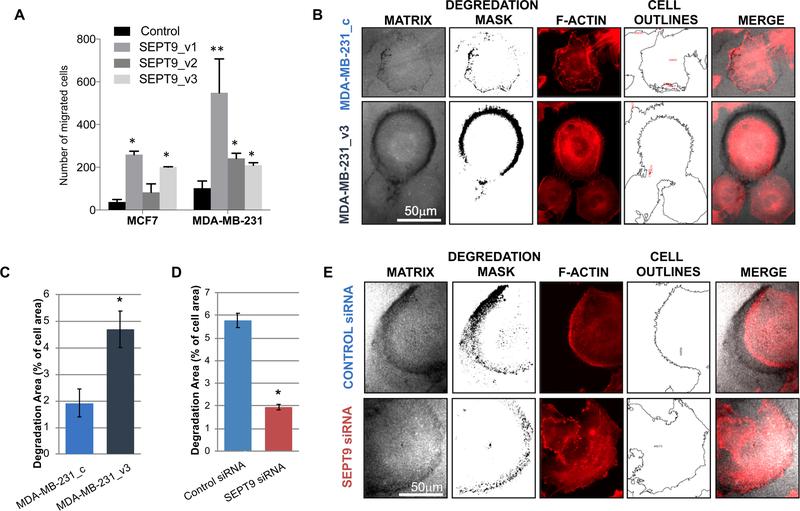
The cytoskeletal interacting protein Septin 9 (SEPT9), a member of the septin gene family, has been proposed to have oncogenic functions. It is a known hot spot of retroviral tagging insertion and a fusion partner of both de novo and therapy-induced mixed lineage leukemia (MLL). Of all septins, SEPT9 holds the strongest link to cancer, especially breast cancer. Murine models of breast cancer frequently exhibit SEPT9 amplification in the form of double minute chromosomes, and about 20% of human breast cancer display genomic amplification and protein over expression at the SEPT9 locus. Yet, a clear mechanism by which SEPT9 elicits tumor-promoting functions is lacking. To obtain unbiased insights on molecular signatures of SEPT9 upregulation in breast tumors, we overexpressed several of its isoforms in breast cancer cell lines. Global transcriptomic profiling supports a role of SEPT9 in invasion. Functional studies reveal that SEPT9 upregulation is sufficient to increase degradation of the extracellular matrix, while SEPT9 downregulation inhibits this process. The degradation pattern is peripheral and associated with focal adhesions (FAs), where it is coupled with increased expression of matrix metalloproteinases (MMPs). SEPT9 overexpression induces MMP upregulation in human tumors and in culture models and promotes MMP3 secretion to the media at FAs. Downregulation of SEPT9 or chemical inhibition of septin filament assembly impairs recruitment of MMP3 to FAs. Our results indicate that SEPT9 promotes upregulation and both trafficking and secretion of MMPs near FAs, thus enhancing migration and invasion of breast cancer cells.
细胞骨架相互作用蛋白 Septin 9(SEPT9)是 septin 基因家族的成员,被认为具有致癌功能。它是逆转录病毒标记插入的已知热点,也是从头和治疗诱导的混合谱系白血病(MLL)的融合伙伴。在所有 septin 中,SEPT9 与癌症的联系最为紧密,尤其是乳腺癌。乳腺癌的鼠模型经常表现出双微体染色体形式的 SEPT9 扩增,大约 20%的人类乳腺癌在 SEPT9 基因座显示基因组扩增和蛋白过表达。然而,SEPT9 引发肿瘤促进功能的确切机制尚不清楚。为了获得 SEPT9 在乳腺癌中上调的分子特征的无偏见解,我们在乳腺癌细胞系中过表达了其几种异构体。全转录组谱分析支持 SEPT9 在侵袭中的作用。功能研究表明,SEPT9 的上调足以增加细胞外基质的降解,而 SEPT9 的下调则抑制这一过程。降解模式是周边的,并与焦点粘连(FAs)相关,在那里它与基质金属蛋白酶(MMPs)的表达增加相关。SEPT9 的过表达在人肿瘤和培养模型中诱导 MMP 的上调,并促进 MMP3 在 FA 处分泌到培养基中。SEPT9 的下调或 septin 细丝组装的化学抑制会损害 MMP3 向 FA 的募集。我们的结果表明,SEPT9 促进 MMPs 在 FA 附近的上调以及运输和分泌,从而增强乳腺癌细胞的迁移和侵袭。




 Zotero 插件