Infection Biology Department, London School of Hygiene and Tropical Medicine, London, WC1E 7HT, UK.
Centre for Tropical Medicine, Faculty of Medicine, Public Health and Nursing, Universitas Gadjah Mada, Yogyakarta, 55281, Indonesia.
Malar J. 2019 Jul 8;18(1):227. doi: 10.1186/s12936-019-2866-z.
Analysis of anti-malarial antibody responses has the potential to improve characterization of the variation in exposure to infection in low transmission settings, where conventional measures, such as entomological estimates and parasitaemia point prevalence become less sensitive and expensive to measure. This study evaluates the use of sero-epidemiological analysis to investigate heterogeneity of transmission in area conducting elimination in Indonesia.
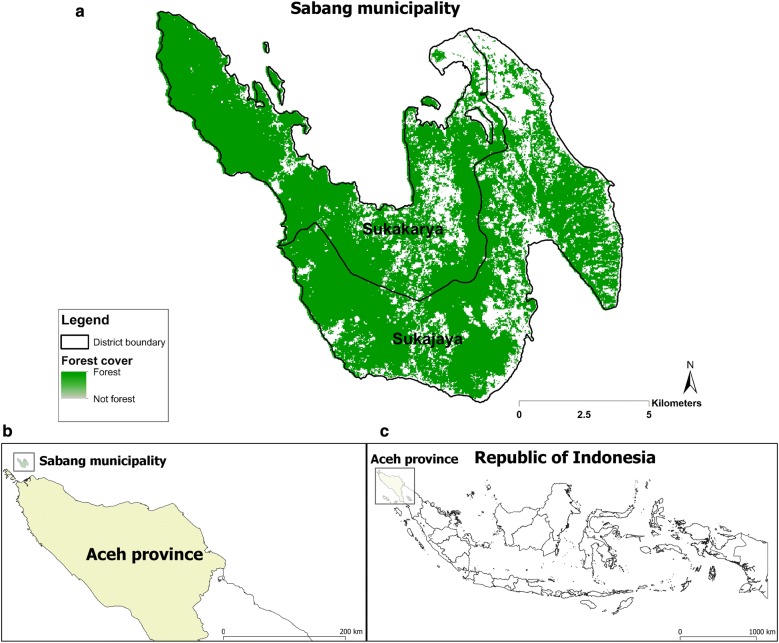
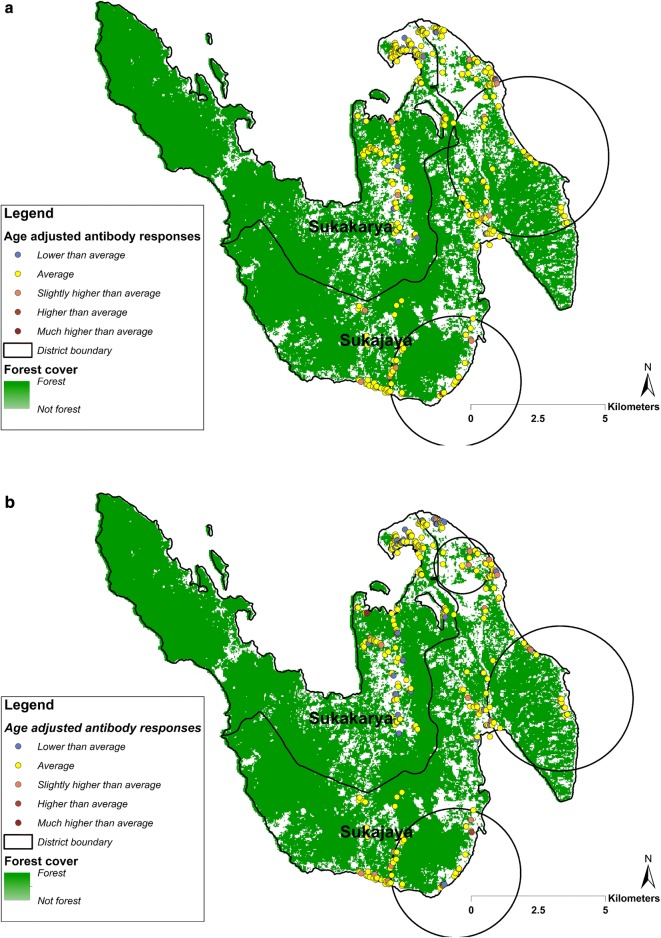
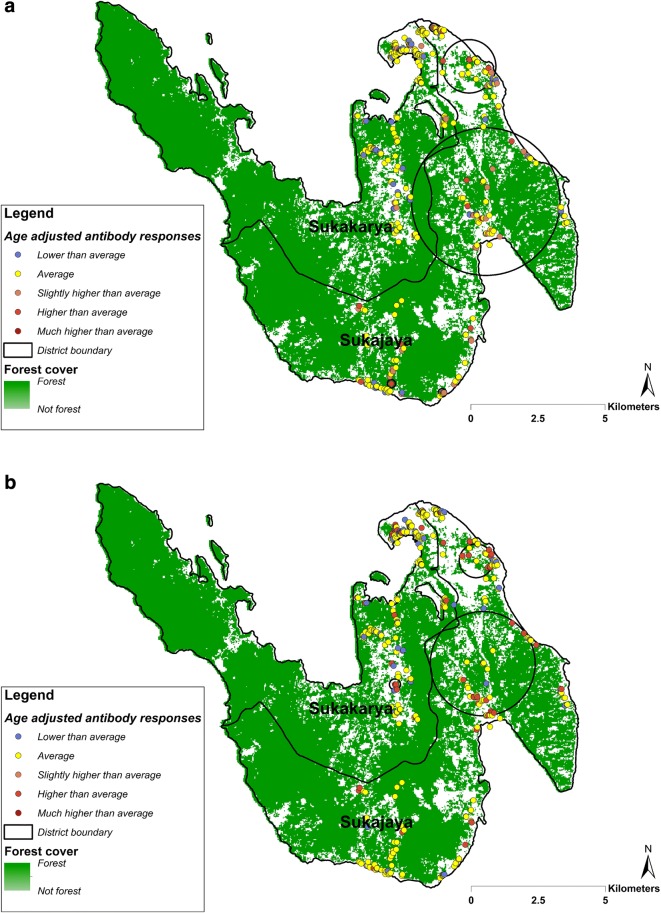
Filter paper bloodspots and epidemiological data were collected through a community-based cross-sectional study conducted in two sub-districts in Sabang municipality, Aceh province, Indonesia in 2013. Antibody responses to merozoite surface protein 1 (MSP-1) and apical membrane antigen 1 (AMA-1) for Plasmodium falciparum and Plasmodium vivax were measured using indirect enzyme-linked immunosorbent assay (ELISA). Seroconversion rates (SCR) were estimated by fitting a simple reversible catalytic model to seroprevalence data for each antibody. Spatial analysis was performed using a Normal model (SaTScan v.9.4.2) to identify the clustering of higher values of household antibody responses. Multiple logistic regression was used to investigate factors associated with exposure.
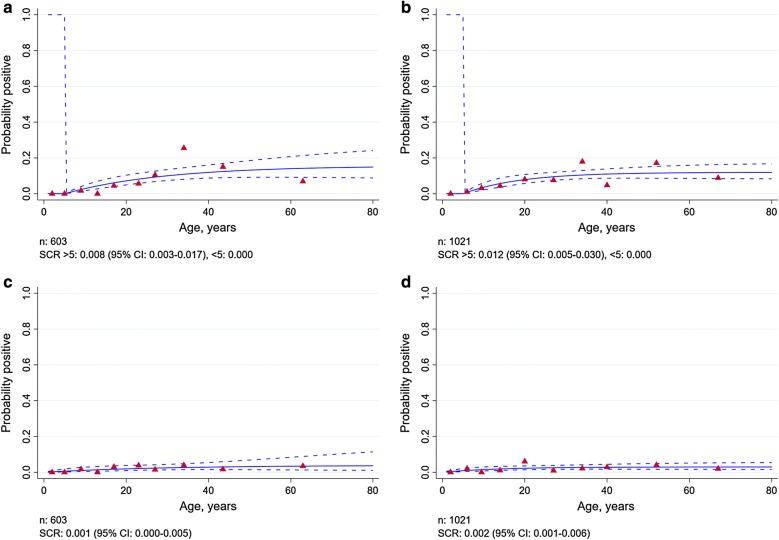
1624 samples were collected from 605 households. Seroprevalence to any P. falciparum antigen was higher than to any P. vivax antigen, 6.9% (95% CI 5.8-8.2) vs 2.0% (95% CI 1.4-2.8). SCR estimates suggest that there was a significant change in P. falciparum transmission with no exposure seen in children under 5 years old. Plasmodium falciparum SCR in over 5 years old was 0.008 (95% CI 0.003-0.017) and 0.012 (95% CI 0.005-0.030) in Sukakarya and Sukajaya sub-districts, respectively. Clusters of exposure were detected for both P. falciparum and P. vivax, most of them in Sukajaya sub-district. Higher age, P. vivax seropositivity and use of long-lasting insecticide-treated bed net (LLIN) were associated with higher P. falciparum exposure.
Analysis of community-based serological data helps describe the level of transmission, heterogeneity and factors associated with malaria transmission in Sabang. This approach could be an important additional tool for malaria monitoring and surveillance in low transmission settings in Indonesia.
分析抗疟抗体反应有可能改善对低传播环境中感染暴露变化的描述,在这种环境中,传统的测量方法(如昆虫学估计和寄生虫血症点流行率)变得不那么敏感和昂贵。本研究评估了血清流行病学分析在印度尼西亚进行消除的地区调查传播异质性的用途。
2013 年在印度尼西亚亚齐省萨邦市的两个分区进行了一项基于社区的横断面研究,收集了滤纸血斑和流行病学数据。使用间接酶联免疫吸附试验(ELISA)测量疟原虫表面蛋白 1(MSP-1)和顶膜抗原 1(AMA-1)对恶性疟原虫和间日疟原虫的抗体反应。通过拟合简单的可逆催化模型来估计血清转换率(SCR),该模型用于为每种抗体的血清流行率数据。使用正态模型(SaTScan v.9.4.2)进行空间分析,以识别家庭抗体反应较高值的聚类。使用多因素逻辑回归调查与暴露相关的因素。
从 605 户家庭中采集了 1624 个样本。任何恶性疟原虫抗原的血清流行率均高于任何间日疟原虫抗原,分别为 6.9%(95%CI 5.8-8.2)和 2.0%(95%CI 1.4-2.8)。SCR 估计表明,恶性疟原虫传播发生了显著变化,5 岁以下儿童无暴露。5 岁以上儿童的恶性疟原虫 SCR 在 Sukakarya 和 Sukajaya 分区分别为 0.008(95%CI 0.003-0.017)和 0.012(95%CI 0.005-0.030)。检测到恶性疟原虫和间日疟原虫的暴露集群,其中大部分在 Sukajaya 分区。较高的年龄、间日疟原虫血清阳性和使用长效驱虫蚊帐(LLIN)与较高的恶性疟原虫暴露有关。
基于社区的血清学数据分析有助于描述萨邦的传播水平、异质性以及与疟疾传播相关的因素。这种方法可能是印度尼西亚低传播环境中疟疾监测和监测的重要补充工具。