State University of New York at Buffalo, 3435 Main Street, Buffalo, 14214, US.
BMC Bioinformatics. 2019 Jul 10;20(1):386. doi: 10.1186/s12859-019-2872-8.
Mathematical models of biological networks can provide important predictions and insights into complex disease. Constraint-based models of cellular metabolism and probabilistic models of gene regulatory networks are two distinct areas that have progressed rapidly in parallel over the past decade. In principle, gene regulatory networks and metabolic networks underly the same complex phenotypes and diseases. However, systematic integration of these two model systems remains a fundamental challenge.
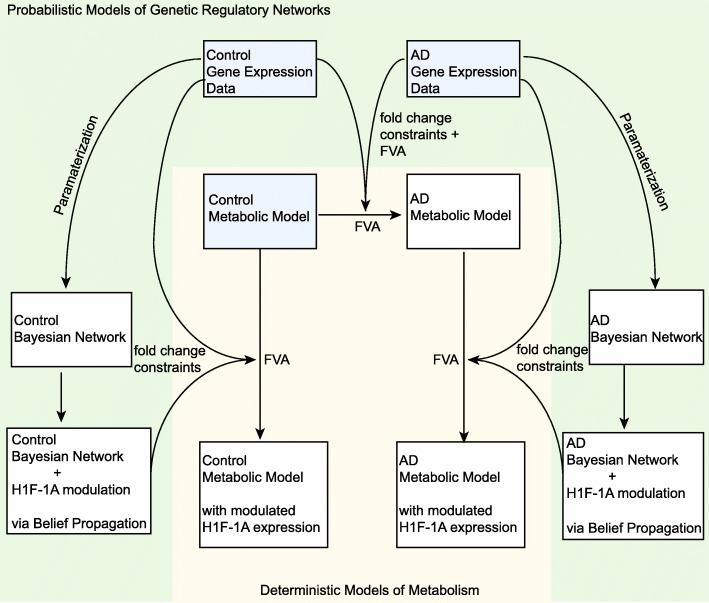
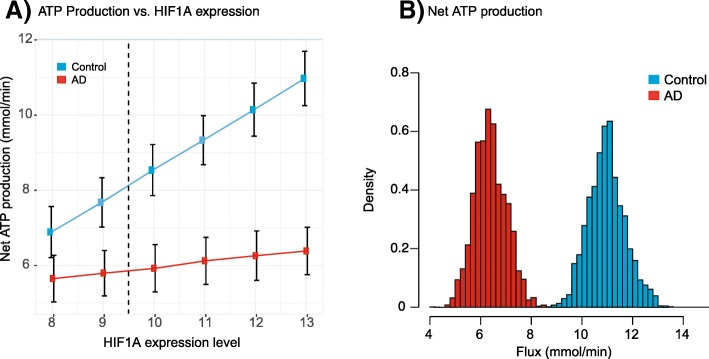
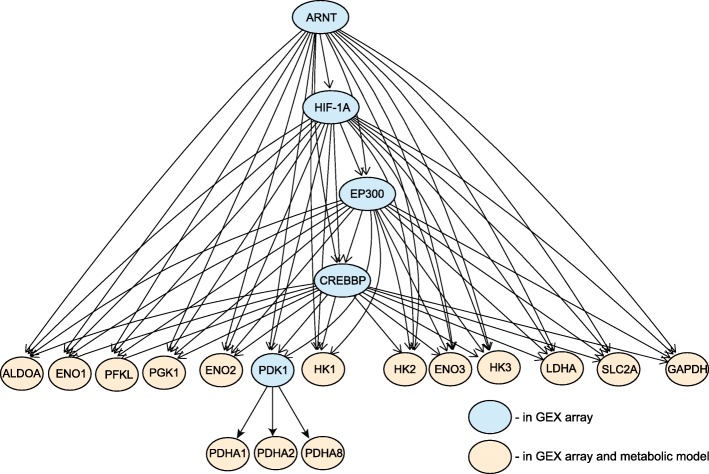
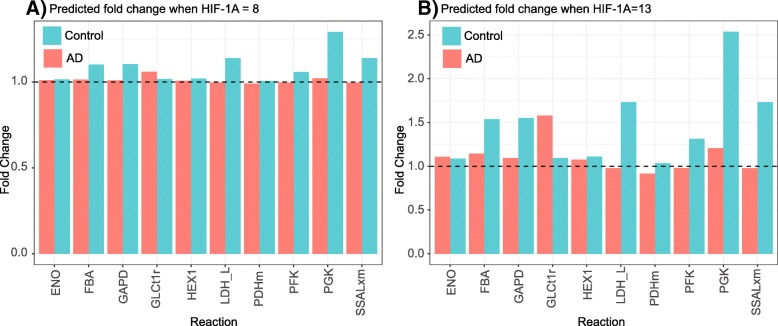
In this work, we address this challenge by fusing probabilistic models of gene regulatory networks into constraint-based models of metabolism. The novel approach utilizes probabilistic reasoning in BN models of regulatory networks serves as the "glue" that enables a natural interface between the two systems. Probabilistic reasoning is used to predict and quantify system-wide effects of perturbation to the regulatory network in the form of constraints for flux variability analysis. In this setting, both regulatory and metabolic networks inherently account for uncertainty. Applications leverage constraint-based metabolic models of brain metabolism and gene regulatory networks parameterized by gene expression data from the hippocampus to investigate the role of the HIF-1 pathway in Alzheimer's disease. Integrated models support HIF-1A as effective target to reduce the effects of hypoxia in Alzheimer's disease. However, HIF-1A activation is far less effective in shifting metabolism when compared to brain metabolism in healthy controls.
The direct integration of probabilistic regulatory networks into constraint-based models of metabolism provides novel insights into how perturbations in the regulatory network may influence metabolic states. Predictive modeling of enzymatic activity can be facilitated using probabilistic reasoning, thereby extending the predictive capacity of the network. This framework for model integration is generalizable to other systems.
生物网络的数学模型可以为复杂疾病提供重要的预测和见解。细胞代谢的约束模型和基因调控网络的概率模型是两个截然不同的领域,在过去十年中都取得了快速发展。原则上,基因调控网络和代谢网络是复杂表型和疾病的基础。然而,这两个模型系统的系统集成仍然是一个基本挑战。
在这项工作中,我们通过将基因调控网络的概率模型融合到代谢的约束模型中来解决这个挑战。该新方法利用了 BN 模型中基因调控网络的概率推理,作为两种系统之间自然接口的“胶水”。概率推理用于预测和量化对调控网络的扰动对通量可变性分析的系统范围的影响。在这种情况下,调控和代谢网络都固有地考虑了不确定性。应用程序利用基于约束的大脑代谢代谢模型和由海马体基因表达数据参数化的基因调控网络来研究 HIF-1 途径在阿尔茨海默病中的作用。整合模型支持 HIF-1A 作为减少阿尔茨海默病缺氧影响的有效靶点。然而,与健康对照组的大脑代谢相比,HIF-1A 的激活在改变代谢方面的效果要小得多。
将概率调控网络直接集成到代谢的约束模型中,为研究调控网络中的扰动如何影响代谢状态提供了新的见解。可以使用概率推理来促进酶活性的预测建模,从而扩展网络的预测能力。该模型集成框架适用于其他系统。