School of Public Health, University of Saskatchewan, 104 Clinic Place, Saskatoon, SK, S7N 2Z4, Canada.
The Heller School for Social Policy and Management, Brandeis University, 415 South St, Waltham, MA, 02453, USA.
Reprod Health. 2019 Jul 10;16(1):101. doi: 10.1186/s12978-019-0753-2.
Many women still deliver outside a health facility in Ghana, often under unhygienic conditions and without skilled birth attendants. This study aims to examine the social determinants influencing the use of health facility delivery among reproductive-aged women in Ghana.
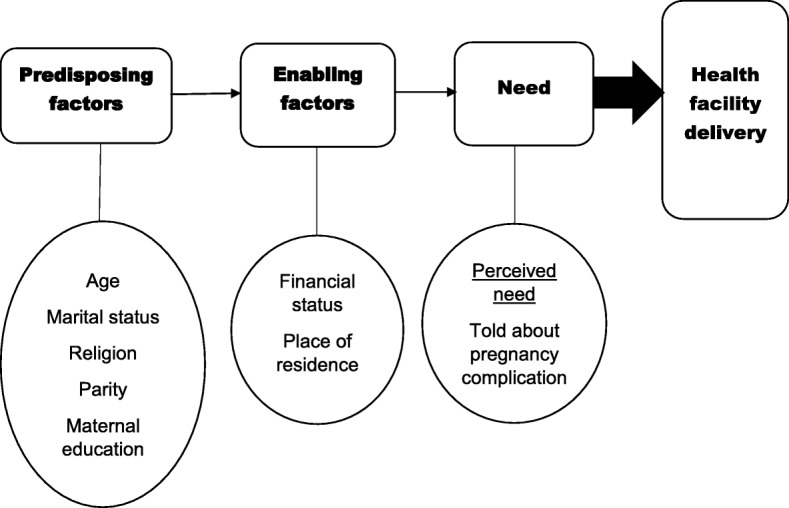
Nationally representative data from the 2014 Ghana Demographic and Health Survey was used to fit univariable and multivariable logistic regression models to estimate the influence of the social determinants on health facility delivery. Andresen's health care utilization model was used as the conceptual framework guiding this study..
Only 72% of deliveries take place at a health facility in Ghana. The results of the adjusted model indicate that place of residence, financial status, education, religion, parity and perceived need were significantly associated with health facility delivery. First, urban women had a higher likelihood of health facility delivery than rural women (Adjusted Odds ratio [AOR] =2.21; 95% Confidence interval [CI] = 1.53-3.19). Second, middle-class and rich women were 1.57 (95%CI = 1.18-2.08) times and 6.91 (95%CI = 4.12-11.59) times, respectively more likely to deliver at health facility compared to the poor. Third, women with either at least secondary education (AOR = 2.04; 95%CI = 1.57-2.64) or primary education (AOR = 1.39, 95%CI = 1.02-1.92) were more likely to deliver at health facility than women with no education. In terms of parity, first time mothers were 1.58 (95% CI = 1.18-2.12) times more likely to deliver at health facility than those who had given birth three or more times before. Finally, regarding perceived need, women who were aware of pregnancy complications were 1.32 (95%CI = 1.02-1.70) times more likely to use health facility delivery than those who were not informed about pregnancy complications.
First, in spite of Ghana's free maternal health services policy, poorer women were much less likely to have a health facility delivery, which points to the need to understand the indirect costs and other financial barriers preventing women from delivering at a health facility. Second, many of the identified variables influence the demand and not just the supply for health care services, and highlight the importance of the social determinants of health and investments in interventions that extend beyond improving physical access.
在加纳,许多妇女仍在医疗机构外分娩,分娩环境往往不卫生,也没有熟练的接生员。本研究旨在探讨影响加纳育龄妇女选择医疗机构分娩的社会决定因素。
本研究使用 2014 年加纳人口与健康调查的全国代表性数据,拟合单变量和多变量逻辑回归模型,以估计社会决定因素对医疗机构分娩的影响。安德雷森的医疗保健利用模型被用作指导本研究的概念框架。
在加纳,只有 72%的分娩是在医疗机构进行的。调整后的模型结果表明,居住地、经济状况、教育、宗教、生育次数和感知需求与医疗机构分娩显著相关。首先,城市妇女比农村妇女更有可能在医疗机构分娩(调整后的优势比[OR] =2.21;95%置信区间[CI] =1.53-3.19)。其次,中产阶级和富裕妇女分别有 1.57 倍(95%CI =1.18-2.08)和 6.91 倍(95%CI =4.12-11.59)更有可能在医疗机构分娩,而贫穷妇女则没有。第三,至少接受过中等教育(OR =2.04;95%CI =1.57-2.64)或小学教育(OR =1.39,95%CI =1.02-1.92)的妇女比没有受过教育的妇女更有可能在医疗机构分娩。就生育次数而言,第一次生育的母亲比之前生育过三次或更多次的母亲更有可能在医疗机构分娩,比例为 1.58(95%CI =1.18-2.12)。最后,关于感知需求,那些意识到妊娠并发症的妇女比那些没有被告知妊娠并发症的妇女更有可能使用医疗机构分娩,比例为 1.32(95%CI =1.02-1.70)。
首先,尽管加纳有免费的产妇保健政策,但较贫穷的妇女更不可能在医疗机构分娩,这表明需要了解阻止妇女在医疗机构分娩的间接费用和其他经济障碍。其次,许多确定的变量影响医疗保健服务的需求,而不仅仅是供应,这突显了健康的社会决定因素以及投资于超越改善物质获得的干预措施的重要性。