From the University Medical Center Utrecht (D.G.A.K.- N.T.), the Netherlands; Sapienza University (D.G.A.K.- N.T.), Rome, Italy; Epilepsy Study Consortium (B.D.D., J.A.F.), Reston, VA; University of Pennsylvania (J.R.P.), Philadelphia; Johns Hopkins University (G.L.K.), Baltimore, MD; MedVal Scientific Information Services (S.M.), Princeton, NJ; and NYU Langone Comprehensive Epilepsy Center (J.A.F.), New York, NY.
Neurology. 2019 Aug 6;93(6):e559-e567. doi: 10.1212/WNL.0000000000007894. Epub 2019 Jul 10.
To evaluate the effect of cenobamate in patients with photoparoxysmal-EEG response (PPR) to intermittent photic stimulation (IPS) as proof of principle of efficacy in patients with epilepsy.
In this multicenter, single-blind study, adults with photosensitive epilepsy, with/without concomitant antiepileptic drug therapy, underwent IPS under 3 eye conditions after a single dose of placebo (day -1, day 2) or cenobamate (day 1; 100, 250, or 400 mg). Complete suppression was a standardized photosensitivity range reduction to 0 over ≥1 time points for all eye conditions. Partial suppression was a ≥3-point reduction over ≥3 testing times vs the same time points on day -1 in ≥1 eye condition. Pharmacokinetics and safety were assessed.
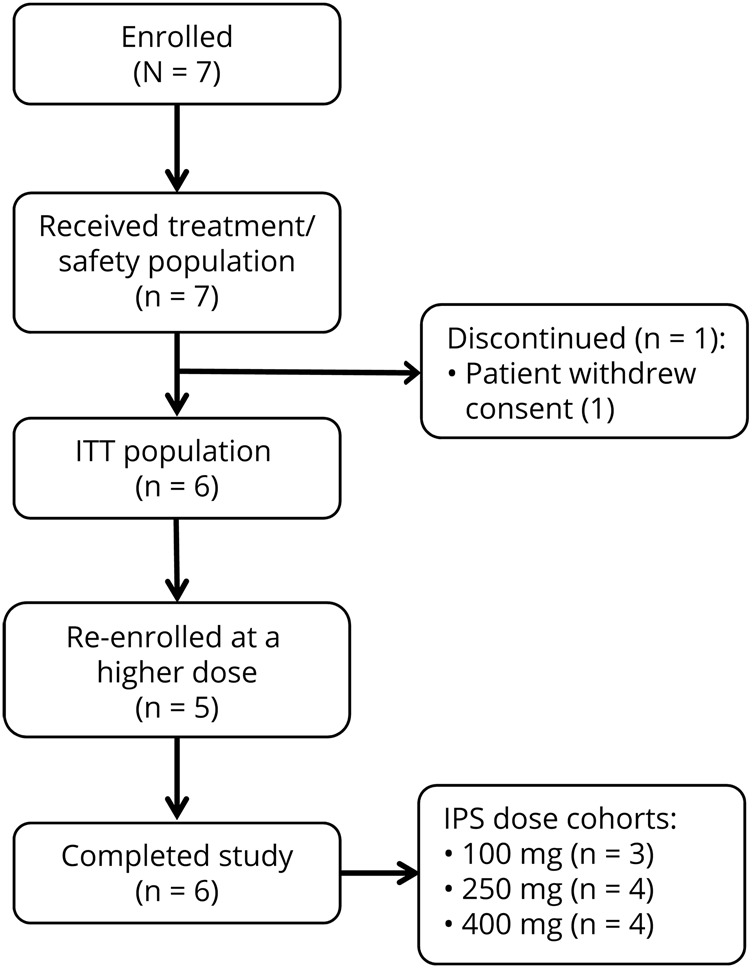
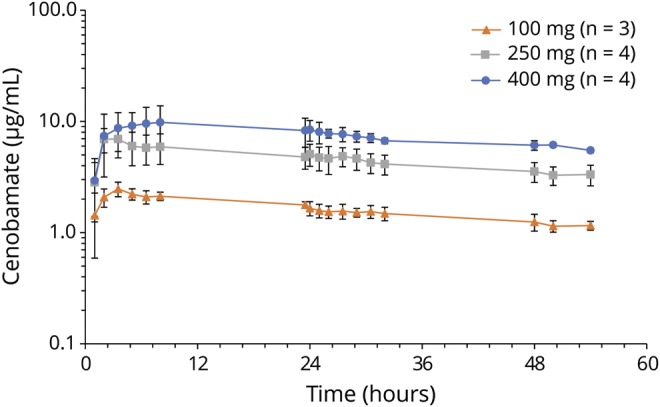
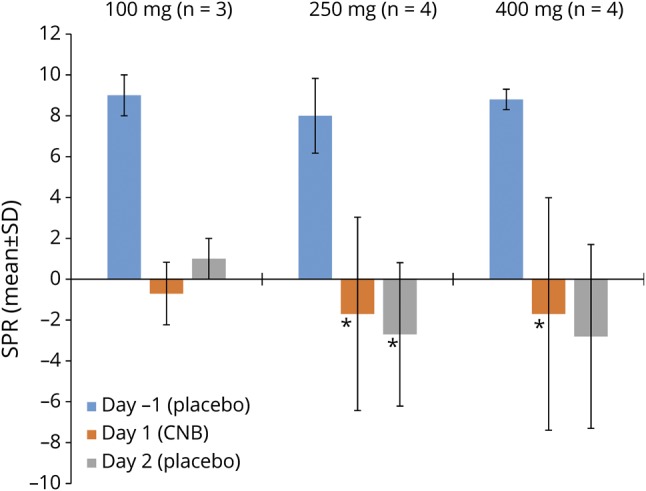
Of 6 evaluable patients, 5 reentered to receive higher doses. Cenobamate 100 mg produced partial suppression in 1 of 3 patients; 250 mg produced complete suppression in 1 of 4 and partial suppression in 4 of 4 patients; and 400 mg produced complete suppression in 1 of 4 and partial suppression in 2 of 4 patients. PPR was consistently reduced on days 1 and 2 (>24 hours after cenobamate) vs day -1 (placebo) with the 250- and 400-mg doses. Area under the plasma concentration-time curve (before dose to last measurable concentration) values between 201 and 400 μg/h/mL resulted in partial suppression in 4 of 6 (66%) patients. Most common adverse events were dizziness and somnolence.
This proof-of-principle study demonstrated that cenobamate is a potentially effective product for epilepsy.
NCT00616148.
This study provides Class III evidence that, for patients with photosensitive epilepsy, cenobamate suppresses IPS-induced PPR.
评估 cenobamate 对间歇性光刺激(IPS)引起的光激发脑电图反应(PPR)患者的疗效,以此作为治疗癫痫患者的疗效原理的证据。
在这项多中心、单盲研究中,有光敏感性癫痫且伴有/不伴有抗癫痫药物治疗的成年人,在单次给予安慰剂(第-1 天、第 2 天)或 cenobamate(第 1 天;100、250 或 400mg)后,在 3 种眼部条件下进行 IPS。完全抑制是指所有眼部条件下的标准化光敏范围减少到 0 超过≥1 个时间点。部分抑制是指与第-1 天相同时间点相比,≥1 种眼部条件下≥3 次测试时间点的减少≥3 点。评估药代动力学和安全性。
在 6 名可评估的患者中,有 5 名重新入组接受更高剂量的药物。Cenobamate 100mg 使 3 名患者中的 1 名出现部分抑制;250mg 使 4 名患者中的 1 名出现完全抑制,使 4 名患者中的 4 名出现部分抑制;400mg 使 4 名患者中的 1 名出现完全抑制,使 4 名患者中的 2 名出现部分抑制。与第-1 天(安慰剂)相比,cenobamate 100mg、250mg 和 400mg 在第 1 天和第 2 天(给药后 24 小时以上)均能持续降低 PPR(>24 小时)。在 6 名患者中有 4 名(66%)患者的血浆浓度-时间曲线下面积(从给药到最后可测量浓度)值在 201 至 400μg/h/mL 之间,出现部分抑制。最常见的不良事件是头晕和嗜睡。
这项原理验证研究表明,cenobamate 可能是一种治疗癫痫有效的药物。
临床试验.gov 标识符:NCT00616148。
这项研究提供了 III 级证据,表明对于光敏感性癫痫患者,cenobamate 可抑制 IPS 诱导的 PPR。