Iwasa Motoh, Ishihara Tomoaki, Kato Michio, Isoai Ayako, Kobayashi Ryosuke, Torii Naoko, Soneda Noriko, Takei Yoshiyuki
Department of Gastroenterology and Hepatology, Mie University Graduate School of Medicine, Japan.
Department of Gastroenterology and Hepatology, Yokkaichi Digestive Disease Center, Japan.
Intern Med. 2019 Nov 1;58(21):3069-3075. doi: 10.2169/internalmedicine.3091-19. Epub 2019 Jul 10.
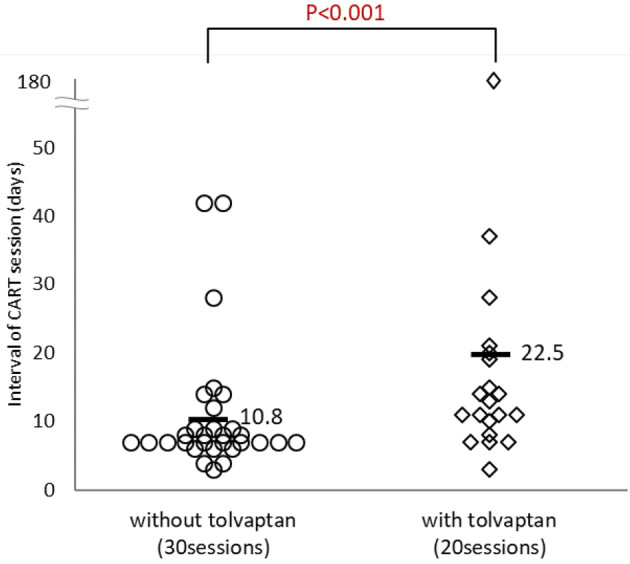
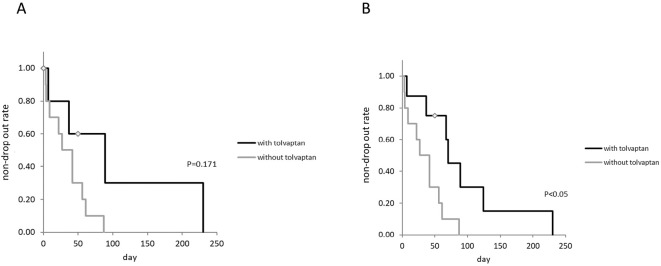
Objective Ascites becomes refractory to diuretics in cirrhotic patients, who then require repeated large-volume paracentesis or cell-free and concentrated ascites reinfusion therapy (CART). The objective of this study was to confirm the safety and efficacy of CART, evaluate the actual situations with respect to the prescription of diuretics and determine the role of diuretics after the introduction of CART. Patients and Methods We recruited 34 cirrhotic patients who received CART with concomitant diuretics using furosemide (76.2%), spironolactone (48.5%), thiazide (4.0%) and tolvaptan (53.5%) from a post-marketing surveillance of CART. Results CART improved the tested clinical indices, i.e., body weight, abdominal circumference, performance status, dietary intake, total protein and albumin. The intervals of CART sessions were significantly prolonged in patients who received tolvaptan (mean, 22.5 days) compared to those not receiving tolvaptan (mean, 10.8 days) (p<0.001). The drop-out rate was significantly decreased in patients receiving tolvaptan compared to those not receiving tolvaptan when drop-out was defined as paracentesis (p<0.05). Conclusion We confirmed that CART is an effective treatment for refractory ascites occurring in cirrhotic patients. The administration of tolvaptan in combination with CART leads to a significantly reduced rate of ascites accumulation.
肝硬化患者的腹水会对利尿剂产生耐药性,此时需要反复进行大量腹腔穿刺放液或无细胞浓缩腹水回输治疗(CART)。本研究的目的是确认CART的安全性和有效性,评估利尿剂处方的实际情况,并确定引入CART后利尿剂的作用。患者与方法:我们从CART的上市后监测中招募了34例接受CART并同时使用利尿剂的肝硬化患者,所使用的利尿剂包括呋塞米(76.2%)、螺内酯(48.5%)、噻嗪类(4.0%)和托伐普坦(53.5%)。结果:CART改善了所检测的临床指标,即体重、腹围、体能状态、饮食摄入量、总蛋白和白蛋白。与未接受托伐普坦的患者(平均10.8天)相比,接受托伐普坦的患者CART疗程间隔显著延长(平均22.5天)(p<0.001)。当将退出定义为腹腔穿刺时,接受托伐普坦的患者退出率与未接受托伐普坦的患者相比显著降低(p<0.05)。结论:我们证实CART是治疗肝硬化患者顽固性腹水的有效方法。托伐普坦与CART联合使用可显著降低腹水积聚率。