Mendonça Nuno, Kingston Andrew, Granic Antoneta, Hill Tom R, Mathers John C, Jagger Carol
Newcastle University Institute for Ageing, Newcastle University, Newcastle upon Tyne, NE2 4AX, UK.
Human Nutrition Research Centre, Newcastle University, Newcastle upon Tyne, NE2 4HH, UK.
Eur J Nutr. 2020 Aug;59(5):1909-1918. doi: 10.1007/s00394-019-02041-1. Epub 2019 Jul 10.
Growth in the number of very old (≥ 85 years) adults will likely lead to increased prevalence of disability. Our aim was to determine the contribution of protein intake, and the interaction between protein intake and physical activity (PA), to the transition between disability states and to death in the very old using the Newcastle 85+ Study.
The analytic sample comprised of 717 older adults aged 85 years at baseline and living in the community. Protein intake was estimated with 2 × 24-h multiple pass recalls (24 h-MPR) at baseline. Disability was measured as difficulty performing 17 activities of daily living (ADL) at baseline, at 18, 36, and 60 months, and defined as having difficulties in one or more ADL. The contribution of protein intake [g/kg adjusted body weight/day (g/kg aBW/d)] to transition probabilities to and from disability, and to death over 5 years was examined by multi-state models adjusted for key health covariates.
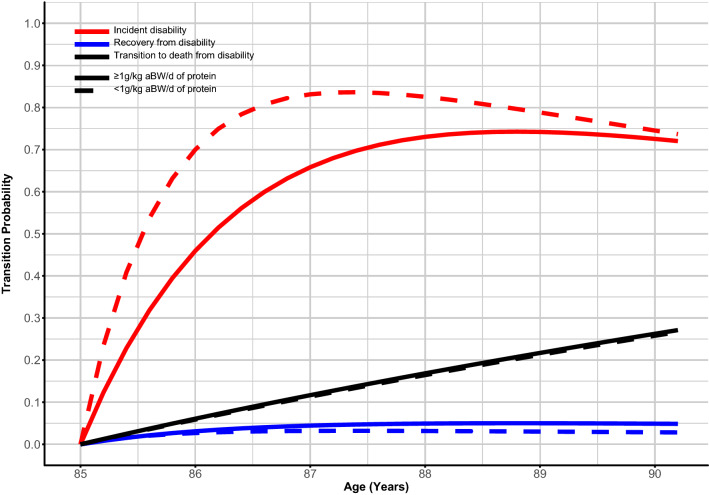
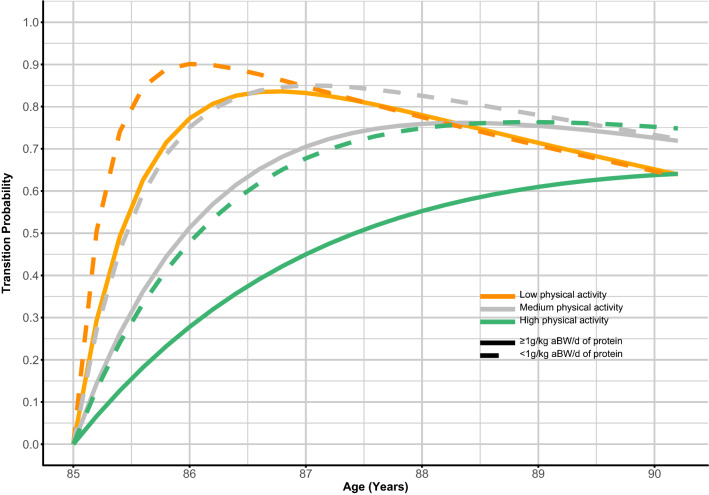
Participants were expected to spend 0.8 years (95% CI 0.6-1.0) disability-free and 2.8 years (95% CI 2.6-2.9) with disability between the ages 85 and 90 years. One unit increase in protein intake (g/kg aBW/d) halved the likelihood of incident disability (HR 0.44, 95% CI 0.24-0.83) but not for other transitions. Similar reductions in disability incidence were also found in individuals with protein intake ≥ 0.8 (HR 0.50, 95% CI 0.31-0.80) and ≥ 1 g/kg aBW/d (HR 0.49, 95% CI 0.33-0.73). Participants with high PA and protein intake ≥ 1 g/kg aBW/d were less likely to transition from disability-free to disability than those within the same PA level but with protein intake < 1 g/kg aBW/d (HR 0.45, 95% CI 0.28-0.72).
Higher protein intake, especially in combination with higher physical activity, may delay the incidence of disability in very old adults.
高龄(≥85岁)成年人数量的增长可能会导致残疾患病率上升。我们的目的是利用纽卡斯尔85岁以上老人研究,确定蛋白质摄入量以及蛋白质摄入量与身体活动(PA)之间的相互作用对高龄人群残疾状态转变和死亡的影响。
分析样本包括717名基线年龄为85岁且居住在社区的老年人。通过基线时的2次24小时多次回顾法(24h-MPR)估算蛋白质摄入量。在基线、18个月、36个月和60个月时,将残疾定义为在17项日常生活活动(ADL)中存在困难,即一项或多项ADL有困难。通过对关键健康协变量进行调整的多状态模型,研究蛋白质摄入量[克/千克调整体重/天(g/kg aBW/d)]对残疾状态转变概率以及5年死亡概率的影响。
参与者预计在85至90岁之间无残疾状态的时间为0.8年(95%置信区间0.6 - 1.0),有残疾状态的时间为2.8年(95%置信区间2.6 - 2.9)。蛋白质摄入量每增加一个单位(g/kg aBW/d),新发残疾的可能性减半(风险比0.44,95%置信区间0.24 - 0.83),但对其他转变情况无此影响。蛋白质摄入量≥0.8(风险比0.50,95%置信区间0.31 - 0.80)和≥1 g/kg aBW/d(风险比0.49,95%置信区间0.33 - 0.73)的个体中,残疾发生率也有类似降低。与相同身体活动水平但蛋白质摄入量<1 g/kg aBW/d的参与者相比,如果身体活动水平高且蛋白质摄入量≥1 g/kg aBW/d,那么从无残疾转变为残疾的可能性较小(风险比0.45,95%置信区间0.28 - 0.72)。
较高的蛋白质摄入量,尤其是与较高的身体活动相结合,可能会延缓高龄成年人残疾的发生。