Division of Endocrinology, Metabolism and Nephrology Department of Internal Medicine, Keio University, School of Medicine, Shinjuku-ku, Tokyo, 160-0016, Japan.
Centre for Supercentenarian Medical Research, Keio University School of Medicine, Shinjuku- ku, Tokyo, 160-0016, Japan.
BMC Geriatr. 2023 Aug 9;23(1):479. doi: 10.1186/s12877-023-04173-w.
Increased protein intake has been recommended to prevent sarcopenia/frailty, reports on the quantity and quality of protein intake needed and the associated prognosis, particularly in the aging population of Asia, are limited. In this study, we aimed to investigate the relationship between protein intake and mortality in Japanese individuals, aged 85 years and older.
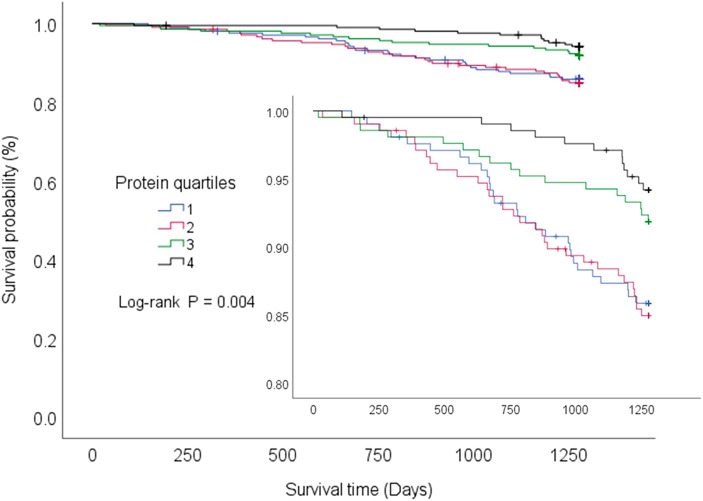
The data were obtained from The Kawasaki Aging and Wellbeing Project, which is a prospective cohort study of older adults aged between 85 and 89 years with no physical disability at baseline. Of the 1,026 adults in the cohort, 833 were included in the analysis, after excluding those who had not completed a brief, self-administered diet history questionnaire or those who scored less than 24 on the Mini-Mental State Examination. The participants were grouped into quartiles based on protein intake: Q1 (protein < 14.7, %Energy), Q2 (14.7 ≤ protein < 16.7, %Energy), Q3 (16.7 ≤ protein < 19.1, %Energy), and Q4 (≥ 19.1, %Energy). Multivariate Cox proportional hazards models were utilized to evaluate the association between protein intake and all-cause mortality. Kaplan-Meier survival curves were employed to investigate the relationship between protein intake and all-cause mortality.
The mean protein intake of our study population was 17.0% of total energy. Animal protein intake, particularly fish intake, increased significantly along with total protein intake. The study had an average observation period of 1,218 days and recorded 89 deaths. After adjusting for age, sex, skeletal muscle mass index, cardiovascular disease, cancer, education, and serum albumin levels, a lower risk of all-cause mortality was observed in the highest protein intake (Q4) group than in the lowest protein intake (Q1) group (hazard ratio: 0.44, 95% confidence interval: 0.22-0.90, p-value: 0.020).
Protein intake is associated with a reduced risk of all-cause mortality in older adults (aged ≥ 85 years) who engage in independent activities of daily living. This association may impact all-cause mortality independent of muscle mass.
增加蛋白质的摄入量已被推荐用于预防肌肉减少症/衰弱,然而关于所需蛋白质的摄入量和质量的报告,以及相关预后,特别是在亚洲的老年人群中,仍然有限。本研究旨在调查日本 85 岁及以上人群中蛋白质摄入量与死亡率之间的关系。
该数据来源于川崎老龄化与健康项目,这是一项针对 85-89 岁无身体残疾的老年人的前瞻性队列研究。在队列中的 1026 名成年人中,有 833 人被纳入分析,排除了那些没有完成简短的自我管理饮食史问卷或那些在简易精神状态检查中得分低于 24 分的人。参与者根据蛋白质摄入量分为四组:Q1(蛋白质<14.7%,能量%)、Q2(14.7%≤蛋白质<16.7%,能量%)、Q3(16.7%≤蛋白质<19.1%,能量%)和 Q4(蛋白质≥19.1%,能量%)。利用多变量 Cox 比例风险模型评估蛋白质摄入量与全因死亡率之间的关系。采用 Kaplan-Meier 生存曲线研究蛋白质摄入量与全因死亡率之间的关系。
研究人群的平均蛋白质摄入量为总能量的 17.0%。动物蛋白质摄入,特别是鱼类摄入,随着总蛋白质摄入的增加而显著增加。该研究的平均观察期为 1218 天,记录了 89 例死亡。在校正年龄、性别、骨骼肌指数、心血管疾病、癌症、教育程度和血清白蛋白水平后,最高蛋白质摄入量(Q4)组的全因死亡率风险低于最低蛋白质摄入量(Q1)组(风险比:0.44,95%置信区间:0.22-0.90,p 值:0.020)。
在从事独立日常生活活动的老年人(年龄≥85 岁)中,蛋白质摄入量与全因死亡率降低相关。这种相关性可能独立于肌肉质量影响全因死亡率。