Department of Internal Medicine, Amsterdam University Medical Centers, Amsterdam, Netherlands.
Amsterdam Public Health Research Institute, Amsterdam, Netherlands.
J Nutr. 2021 Mar 11;151(3):605-614. doi: 10.1093/jn/nxaa400.
Age-related declines in taste and smell function are widely assumed to contribute to the decrease in appetite and the development of undernutrition in older adults.
Here we aim to assess the associations of both taste and smell function with several nutrition-related outcomes in a single study, with poor appetite and undernutrition as primary outcomes.
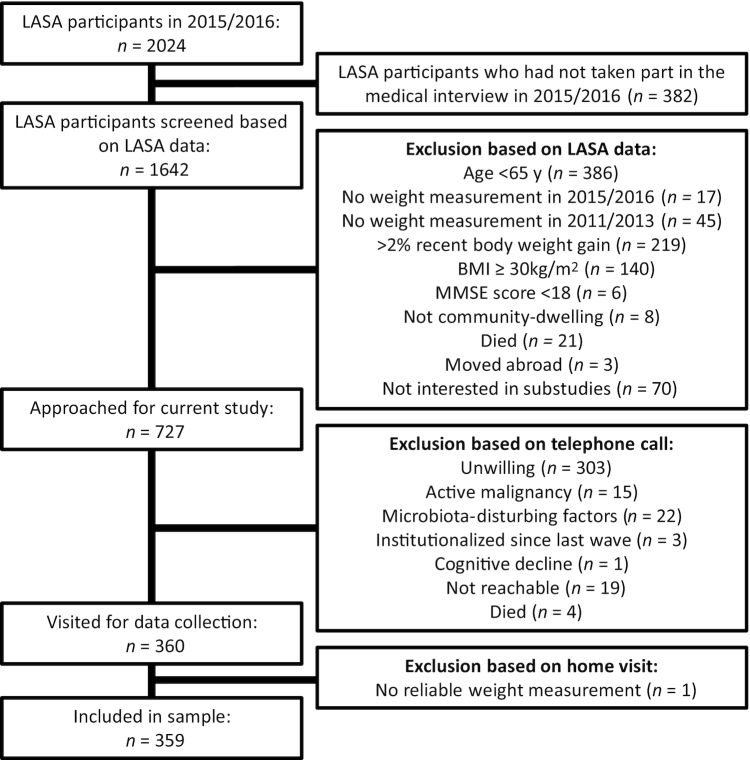
This is a cross-sectional cohort study of 359 community-dwelling Dutch older adults, aged 65-93 y. Taste function was measured for all 5 basic tastes. Smell function was assessed with 3 tests: for odor identification, discrimination, and threshold. Self-reported taste and smell, appetite, energy (kcal/d) and macronutrient (% energy) intake, and covariates were assessed with extensive questionnaires. Dietary quality was calculated using the Dutch Healthy Diet index 2015, Alternative Healthy Eating Index 2010, and Mediterranean Diet Score. Body measurements included body weight (current and 2 y prior), height, and body impedance analysis. Data were analyzed via multiple logistic and linear regression.
Of our sample, 9.2% had poor taste and 17.0% poor smell, 6.1% had poor appetite, and 21.4% were undernourished. Self-reported poor taste (OR: 8.44; 95% CI: 1.56, 45.56; P = 0.013) was associated with poor appetite, but no other taste or smell score was associated with either poor appetite or undernutrition. Some associations were found of individual taste and smell scores with macronutrient intake and dietary quality. Self-reported poor taste and smell were both consistently associated with poorer dietary quality.
In community-dwelling older adults, specific taste and smell impairments may have diverse consequences for appetite, food intake, or dietary quality. However, this does not necessarily result in undernutrition. The consistent associations of self-reported poor taste and smell with poor dietary quality do underline the usefulness of this information when screening for nutritional risk.
人们普遍认为,与年龄相关的味觉和嗅觉功能下降是导致老年人食欲下降和营养不良的原因之一。
本研究旨在评估单一研究中味觉和嗅觉功能与多种营养相关结局的相关性,以食欲差和营养不良为主要结局。
这是一项横断面队列研究,纳入了 359 名居住在社区的荷兰老年人,年龄在 65-93 岁之间。所有 5 种基本味觉均进行了味觉功能测量。嗅觉功能通过 3 项测试进行评估:嗅觉识别、嗅觉辨别和嗅觉阈值。通过广泛的问卷评估自我报告的味觉和嗅觉、食欲、能量(千卡/天)和宏量营养素(能量%)摄入量以及其他协变量。使用荷兰健康饮食指数 2015、替代健康饮食指数 2010 和地中海饮食评分计算膳食质量。身体测量包括体重(当前和 2 年前)、身高和身体阻抗分析。数据分析采用多因素逻辑回归和线性回归。
在我们的样本中,9.2%的人味觉差,17.0%的人嗅觉差,6.1%的人食欲差,21.4%的人营养不良。自我报告的味觉差(比值比:8.44;95%置信区间:1.56,45.56;P=0.013)与食欲差相关,但其他味觉或嗅觉评分与食欲差或营养不良均无相关性。一些个体味觉和嗅觉评分与宏量营养素摄入和膳食质量相关。自我报告的味觉和嗅觉差与较差的膳食质量始终相关。
在社区居住的老年人中,特定的味觉和嗅觉损伤可能对食欲、食物摄入或膳食质量产生不同的影响。然而,这并不一定会导致营养不良。自我报告的味觉和嗅觉差与较差的膳食质量始终存在关联,这突显了在筛查营养风险时使用这些信息的有用性。