Simão Adriano Prado, Mendonça Vanessa Amaral, Avelar Núbia Carelli Pereira, da Fonseca Sueli Ferreira, Santos Jousielle Márcia, de Oliveira Ana Carolina Coelho, Tossige-Gomes Rosalina, Ribeiro Vanessa Gonçalves César, Neves Camila Danielle Cunha, Balthazar Cláudio Heitor, Leite Hércules Ribeiro, Figueiredo Pedro Henrique Scheidt, Bernardo-Filho Mário, Lacerda Ana Cristina Rodrigues
Departamento de Fisioterapia, Universidade Federal de Alfenas (UNIFAL), Alfenas, Brazil.
Centro Integrado de Pós-Graduação e Pesquisa em Saúde (CIPq-Saúde), Universidade Federal dos Vales do Jequitinhonha e Mucuri (UFVJM), Diamantina, Brazil.
Front Physiol. 2019 Jun 25;10:756. doi: 10.3389/fphys.2019.00756. eCollection 2019.
: Osteoarthritis of the knee (kOA) is a chronic, progressive, degenerative health condition that contributes to the imbalance between the synthesis and destruction of articular cartilage. Recently, whole body vibration (WBV) training has been recommended as an effective alternative for strength training in elderly people, and various physiological effects are obtained in response to exercise performed on a vibratory platform, such as an increase in muscle activation and improved muscle performance. However, the effects of WBV particularly on the strength of the quadriceps muscle and neuronal plasticity are unknown. : The aim of this study was to evaluate the effects of adding WBV to squat training on the isometric quadriceps muscle strength (IQMS) and the plasma levels of brain-derived neurotrophic factor (BDNF) in elderly woman with kOA. : Fifteen elderly women ≥65 years of age with kOA were randomized into two interventions: (1) the vibration group (VG), in which participants performed squat exercise training in association with WBV or (2) the exercise group (EG), in which participants performed squat exercise training without vibration, for 12 weeks 3×/week. : Compared to the EG group, the VG group demonstrated a significantly greater delta (Δ) in IQMS values (IC95% 0.43-7.06; ≤ 0.05) and in Δ BDNF plasma levels (IC95% -32.51 to 4.217; ≤ 0.05) after the intervention period. There was an association between increase of Δ BDNF plasma levels and increase of Δ IQMS ( = 0.57; = 0.32; = 0.03). : The addition of WBV to squat exercise training improves lower limb muscle performance in elderly women with kOA. These findings suggest that the improvement in muscle performance is related to neuromuscular adaptations induced by WBV. : www.ClinicalTrials.gov, identifier NCT03918291.
膝关节骨关节炎(kOA)是一种慢性、进行性、退行性健康状况,会导致关节软骨合成与破坏之间的失衡。最近,全身振动(WBV)训练被推荐为老年人力量训练的有效替代方法,在振动平台上进行运动可获得各种生理效应,如肌肉激活增加和肌肉性能改善。然而,WBV对股四头肌力量和神经可塑性的影响尚不清楚。
本研究的目的是评估在深蹲训练中加入WBV对患有kOA的老年女性等长股四头肌力量(IQMS)和血浆脑源性神经营养因子(BDNF)水平的影响。
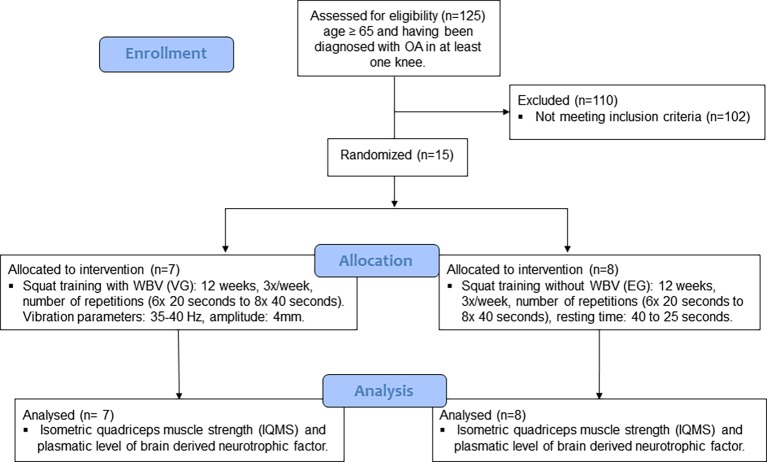
15名年龄≥65岁的患有kOA的老年女性被随机分为两种干预组:(1)振动组(VG),参与者在进行深蹲运动训练的同时结合WBV;(2)运动组(EG),参与者进行无振动的深蹲运动训练,为期12周,每周3次。
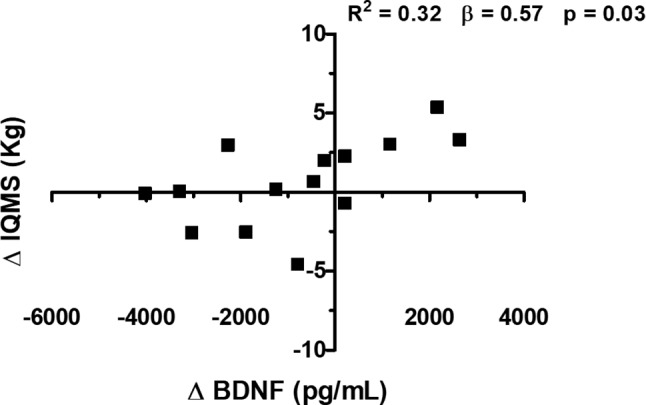
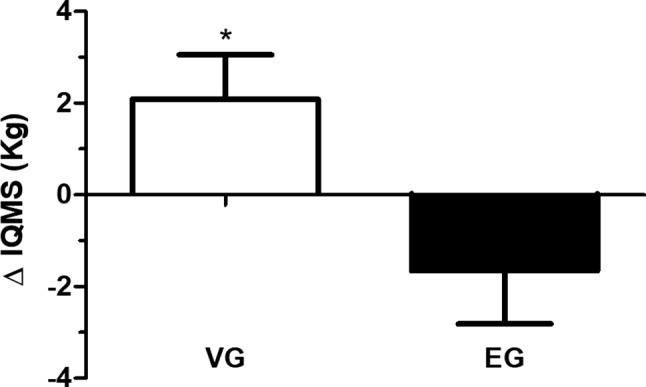
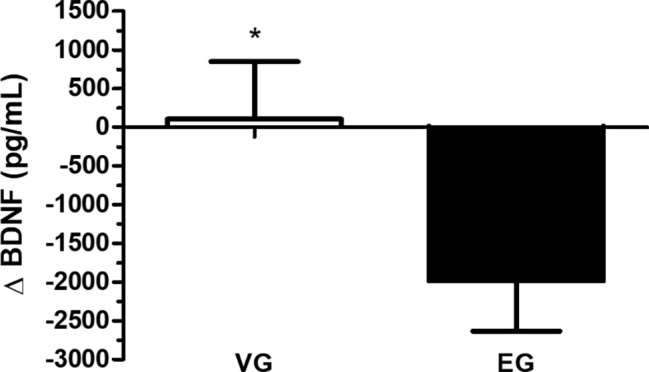
与EG组相比,干预期后,VG组的IQMS值变化(Δ)(IC95% 0.43 - 7.06;P≤0.05)和BDNF血浆水平变化(Δ)(IC95% -32.51至4.217;P≤0.05)明显更大。BDNF血浆水平变化的增加与IQMS变化的增加之间存在关联(r = 0.57;P = 0.32;P = 0.03)。
在深蹲运动训练中加入WBV可改善患有kOA的老年女性的下肢肌肉性能。这些发现表明,肌肉性能的改善与WBV诱导的神经肌肉适应性有关。
ClinicalTrials.gov网站,标识符NCT03918291。